
Djibouti
Djibouti is a developing country located at the juncture of the Red Sea and the Gulf of Aden that gained independence from France in 1977. It is a republic with a multi-party political system dominated by the ruling Union for Presidential Majority (UMP) party and a legal system based on French civil law, though modified by traditional practices and Islamic (Sharia) law. Although exact numbers are unavailable, unemployment is estimated to be in excess of 60 percent of the working-age population. Over two-thirds of the country’s estimated 850,000 residents live in the capital, also called Djibouti. Modern tourist facilities and communications infrastructure exist in the city of Djibouti but are limited outside the capital.
Transportation
TRAFFIC SAFETY AND ROAD CONDITIONS: While in a foreign country, U.S. citizens may encounter road conditions that differ significantly from those in the United States. The information below concerning Djibouti is provided for general reference only, and may not be totally accurate in a particular location or circumstance.
The only means of public inter-city travel is by bus. Buses are poorly maintained and their operators often drive erratically with little regard for passenger safety. Taxis should be avoided at all costs.
Driving on Djiboutian roads can be hazardous. Since most roads do not have shoulders or sidewalks, pedestrians and livestock use the roadways both day and night. Driving at night is extremely dangerous and strongly discouraged on all roads outside Djibouti City. While some main roads in Djibouti are well maintained, roads are often narrow, poorly lit, or rutted. Many secondary roads are in poor repair. Drivers and pedestrians should exercise extreme caution. Minibuses and cars often break down; when breakdowns occur, local drivers usually place branches or rocks behind the vehicle to indicate trouble, but these warning signals are barely visible and hazardous in and of themselves. Excessive speed, unpredictable local driving habits, pedestrians and livestock in the roadway, and the lack of basic safety equipment on many vehicles are daily hazards. Speed limits are posted occasionally but are not enforced. The leafy narcotic – khat – is widely used, particularly in the afternoons, creating other traffic hazards.
The Djiboutian Gendarmerie and the National Police Force share responsibility for road safety in Djibouti. In March 2012 a “Road Police” was created, though its role has yet to be clearly defined. Djiboutian authorities recently erected traffic lights to help regulate the flow of traffic. Be very cautious approaching these lights, as many other drivers continue to disregard them. It is illegal to turn right on a red-light. Travelers should be aware that police use large obstacles as roadblocks on some of the major roads, and these may be difficult to see at night.
There are two main international highways to the capital city, via Dire Dawa, Ethiopia, and Obock, Djibouti, and both demand that drivers remain vigilant. The route toward Dire Dawa is in very poor condition. Both have a high volume of Ethiopian trucks transporting large cargo. Railroad crossings are not clearly marked. Drivers who do not have a four-wheel drive vehicle will encounter problems driving on rural roads. While the quality of roads is improving, drivers should make sure their vehicle is in good mechanical condition before leaving major population centers. Once a driver has left Djibouti city there are limited services to aid broken-down vehicles. The Embassy recommends that U.S. citizens travel in two-vehicle caravans outside the city. In addition gasoline is not readily available outside of Djibouti City so drivers utilizing a gasoline powered vehicle should plan accordingly. Diesel fuel is available in other areas of Djibouti.
There are no emergency services in Djibouti. It will be difficult to coordinate medical assistance in the event of an accident. It is always advisable to carry a cell phone or satellite phone when undertaking a trip outside of the capital; however, many parts of the country do not have cell phone coverage.
While Djibouti has been declared a “mine-safe” country, this indicates that landmines have been identified and marked, not that they have been removed. Landmines are known to be present in northern Tadjourah and Obock districts. In addition, there may be mines in the Ali Sabieh area of the south. In March 2012, a 12-year-old boy was seriously injured by a land mine in the vicinity of Lac Assal and Ghoubet, two popular tourist destinations. The incident occurred in the area known as Dabaleh Gahar, east of where National Route 10 splits off from National Route 9. This location is approximately 20 km southeast of where most people visit Lac Assal; about one kilometer from the paved road. This area was home to a Djiboutian military encampment during the civil war (1991-1994) and the mine likely remained in place after that conflict. Travelers should stay on paved roads and should check with local authorities before using unpaved roads.
Please refer to our Road Safety page for more information.
AVIATION SAFETY OVERSIGHT: As there is no direct commercial air service to the United States by carriers registered in Djibouti, the U.S. Federal Aviation Administration (FAA) has not assessed the government of Djibouti’s Civil Aviation Authority for compliance with International Civil Aviation Organization (ICAO) aviation safety standards. Further information may be found on the FAA’s safety assessment page.
Safety and Security
A travel warning is currently in effect for Djibouti due to the threats posed by regional terrorists. Djibouti’s international borders are porous and regional terrorist groups pose serious dangers in east Africa. Regional al-Qaeda affiliate al-Shabaab, designated by the U.S. government to be a foreign terrorist organization in 2008, poses a particular threat to U.S. citizens in Djibouti. On May 24, 2014, two al-Shabaab suicide bombers detonated explosives in a Menelik Square restaurant popular with Westerners. The attack killed one Turkish civilian and wounded twelve other individuals, primarily a mix of Dutch, Spanish and French citizens. Al-Shabaab threats against Djibouti began in 2011 after Djibouti announced it would join the African Union Mission in Somalia (AMISOM) peacekeeping mission. Al-Shabaab announced its intention to retaliate by launching attacks inside Djibouti. These threats have been repeated regularly, most recently following the deployment of Djiboutian forces to Somalia to conduct offensive counterterrorism operations. U.S. citizens traveling in East Africa should be aware of the potential for indiscriminate attacks on civilian targets in public places, including hotels and tourist sites where Westerners are known to congregate. Kidnapping of Westerners for ransom is a growing concern in the region. Read our Worldwide Caution for more information on terrorism in Africa.
Protests in Djibouti, such as those related to the 2011 presidential election and the February 2013 legislative elections, disrupt travel around the city. Security forces have used excessive force to break-up protests, arresting large numbers of protestors. If you see a demonstration, do not try to walk or drive through it. Remember the importance of maintaining a low profile. Even demonstrations intended to be peaceful can turn confrontational and escalate into violence. You should avoid areas of demonstrations, and exercise caution in the vicinity of any large gatherings or protests.
Tensions exist between neighboring Ethiopia and Eritrea due to their long-running border dispute. Relations were further aggravated in January 2012 when ethnic Afar gunmen attacked a Western tourist convoy travelling in Ethiopia's northeastern region that borders Djibouti. In March and May 2012, Ethiopia staged raids across the Eritrean border, bringing tensions to their highest point since the 1998-2000 war between the two countries.
Since April 2008 there has been tension on Djibouti’s border with Eritrea after an incursion by Eritreans in that area. U.S. citizens in Djibouti should not attempt to cross the land border with Eritrea nor travel north of the town of Obock. Civil unrest or armed conflict in neighboring countries could disrupt air travel to and from Djibouti or otherwise negatively affect its security. Travelers should exercise caution when traveling to any remote area of Djibouti, especially near the borders with Eritrea, Ethiopia, and Somalia.
Pirates and other criminals have specifically targeted and kidnapped foreigners working in Somalia. In October 2011, a U.S. citizen aid worker living in Somalia was kidnapped, and in January 2012, another U.S. citizen was kidnapped while on work-related travel in Somalia. In both cases, as well as in recent kidnappings of other Westerners, the victims took precautionary measures by hiring local security personnel, but those hired to protect them appear to have played a key role in the abductions. A strong familiarity with Somalia and/or extensive prior travel to the region does not reduce risk of travel into that region. Any U.S. citizens travelling to Somalia, including Somaliland and Puntland, are advised to obtain Kidnap and Recovery Insurance, as well as Medical Evacuation Insurance, prior to travel and register with the U.S. Embassy in Nairobi, which covers Somalia.
Seaborne travel near Djibouti is extremely dangerous. There have been hundreds of incidents of armed attacks and robberies at sea by pirate groups on ships transiting around the Horn of Africa. In 2011, pirates hijacked a yacht in the Gulf of Aden carrying four U.S. citizens, who were subsequently killed. Additionally, after the April 2009 hijacking of a U.S. cargo vessel and subsequent rescue of the vessel’s captain by U.S. forces, Somali pirates threatened to retaliate against U.S. citizens transiting the region. See our International Maritime Piracy and Armed Robbery Fact Sheet. Also, please see the Somalia Travel Warning and the Country Specific Information Sheet for Yemen for recent information on maritime conditions in Yemen’s waters.
In the event that seaborne travel is unavoidable, vessels should convoy in groups and maintain good communications contact at all times. Marine channels 12, 13 and 16 VHF-FM are international call-up and emergency channels and are commonly monitored by ships at sea. 2182 MHz is the HF international call-up and emergency channel. In the Gulf of Aden, use of transit routes farther offshore appears to reduce, but does not eliminate, the risk of contact with assailants. Wherever possible, travel in trafficked sea-lanes. Avoid loitering in or transiting isolated or remote areas. In the event of an attack, activate the Emergency Position Indicating Radio Beacon. Due to distances involved, there may be a considerable delay before assistance arrives. Vessels may also contact the Yemeni Coast Guard 24-hour Operations Center at 967-1-562-402. Operations Center staff members speak English.
The United States Maritime Administration (MARAD) has advised that elevated regional tensions have increased the risk of maritime attacks being conducted by extremist to vessels operating in the Gulf of Oman, North Arabian Sea, Gulf of Aden, and the Bab el Mandeb regions.
MARAD recommends vessels at anchor, operating in restricted maneuvering environments, or at slow speeds should be especially vigilant, and report suspicious activity. U.S. flag vessels that observe suspicious activity in the area are advised to report such suspicious activity or any hostile or potentially hostile action to Commander, U.S. Naval Forces Central Command (COMUSNAVCENT) battlewatch captain at phone number 011-973-1785-3879. All suspicious activities and events are also to be reported to the U.S. Coast Guard National Response Center at the following toll free telephone: 1-800-424-8802, direct telephone 202-267-2675, or TDD 202-267-4477. The complete advisory is available on the MARAD website at www.MARAD.DOT.gov.
To stay connected:
- Enroll in the Smart Traveler Enrollment Program so we can keep you up to date with important safety and security announcements.
- Follow the Bureau of Consular Affairs on Twitter and Facebook.
- Bookmark the Bureau of Consular Affairs website, which contains the current Travel Warnings and Travel Alerts as well as the Worldwide Caution.
- Follow the U.S. Embassy in Djibouti on Twitter and visit the Embassy’s website.
- In the event of an emergency, contact us at 1-888-407-4747 toll-free within the United States and Canada, or via a regular toll line, 1-202-501-4444, from other countries.
- Take some time before traveling to consider your personal security and checking for useful tips for traveling safely abroad.
CRIME: Accurate Djiboutian crime statistics are not available, but the majority of crimes are petty theft and crimes of opportunity. Anecdotal evidence suggests an increasing frequency of violent crimes against Djiboutian citizens and burglaries of residences in established neighborhoods. Violent crimes against foreigners are rare in Djibouti. However, foreigners are frequent victims of snatch-and-grab robberies and price gouging by unscrupulous taxi drivers.
Do not buy counterfeit and pirated goods, even if they are widely available. Not only are the bootlegs illegal in the United States, if you purchase them you may also be breaking local law.
VICTIMS OF CRIME: If you or someone you know becomes the victim of a crime abroad, you should contact the local police and the nearest U.S. embassy or consulate.
We can:
- Replace a stolen passport.
- Help you find appropriate medical care if you are the victim of violent crimes such as assault or rape.
- Put you in contact with the appropriate police authorities, and if you want us to, we can contact family members or friends.
- Help you understand the local criminal justice process and direct you to local attorneys, although it is important to remember that local authorities are responsible for investigating and prosecuting the crime.
The local equivalent to the “911” emergency line in Djibouti is 18.
Please see our information on victims of crime, including possible victim compensation programs in the United States.
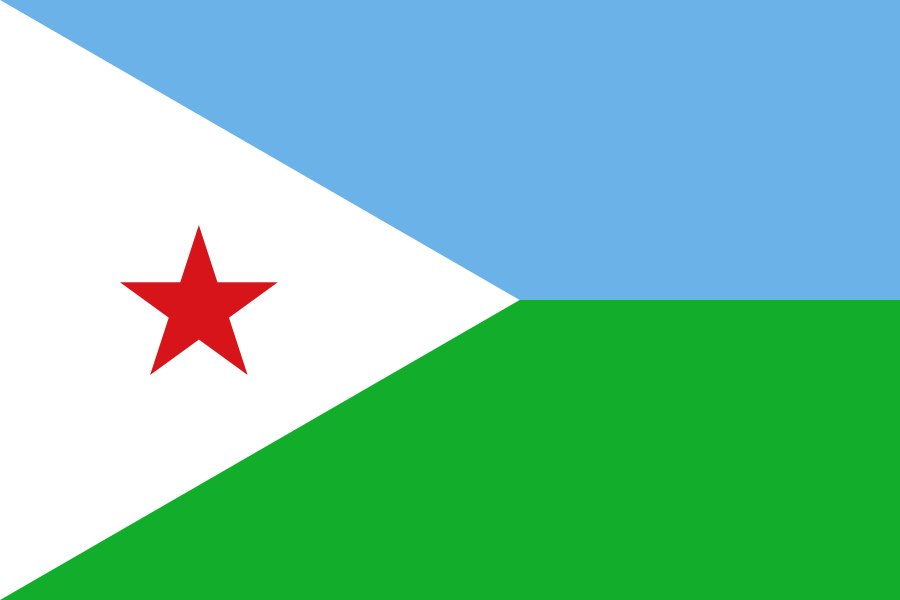
Population: 988,000
Total Land Area: 23,180 km2
Population/km2: 42.62
Official Visa Info: Government e-Visa system / immigration