
Democratic Republic of the Congo
The Democratic Republic of the Congo (a.k.a. DRC or Congo-Kinshasa,), located in central Africa, is the second largest country on the continent. The capital is Kinshasa. French is the official language. The country endured more than a decade of civil war that ended in 2003, but still faces continuing violence from armed groups, political instability, and extreme poverty. Read the Department of State’s Fact Sheet on the Democratic Republic of the Congo (DRC) for additional information on U.S. - Democratic Republic of the Congo relations.
Transportation
TRAFFIC SAFETY AND ROAD CONDITIONS: Road conditions in DRC are generally poor and deteriorate significantly during the rainy season from October to May. Traffic safety is hazardous due to lack of infrastructure, poorly trained/disciplined drivers, poorly maintained vehicles, and indifference among many drivers toward the safety of pedestrians and cyclists. Use of cell phones while driving is prohibited in the DRC. As with other traffic regulations, enforcement of this law is inconsistent. Distracted drivers pose a threat.
Lock vehicle doors and keep windows closed when driving. At roadblocks or checkpoints, open the driver’s side window slightly in order to communicate and show documents through closed windows. In the event of an automobile accident, remain inside the vehicle and wait for police. If a hostile mob forms or you feel your safety is in danger, leave the scene and proceed directly to the nearest police station or gendarmerie to report the incident. Do not stop at the scene of an accident or at intersections where people have gathered, as mobs can develop quickly. In heavy traffic, be wary of gangs of street children who may open doors and steal belongings.
Avoid all travel by public transportation, and hire private transport from a reliable source. Any form of public transportation is unregulated, unreliable, and generally unsafe. Taxis, mini-buses, buses, and trains are in poor mechanical condition and are often filled well beyond their intended capacity. Be particularly vigilant at airports where criminals have been known to use luggage tag information to present themselves as pre-arranged drivers. Overcrowded vans and taxis, which often do not meet Western safety standards, serve as public transportation in Kinshasa. Few independent taxis are available, and most do not meet U.S. safety standards. Reputable car rental firms include drivers in all rentals. The DRC has few viable highways or railways. Although boat transport is widely used, vessels are often overloaded and/or poorly maintained; accidents are commonplace and often fatal.
Official motorcades pose serious risks to drivers and pedestrians in Kinshasa. Drivers should pull to the side of the road as far as possible and extinguish the vehicle’s headlights when sirens or security forces announce their presence. Do not take photographs of motorcades. Do not attempt to move until the entire motorcade has passed and proceed only when security forces permit it. Failure to comply may result in arrest or vehicle damage with possible personal injury.
Drivers should stop their cars and pedestrians should stand still when passing a government installation during the raising and lowering of the Congolese flag. This ceremony occurs at roughly 7:30 a.m. and 6:00 p.m.
Ferry service between Brazzaville and Kinshasa may close completely with minimal notice. A visa for the destination country (DRC or Republic of Congo) is required to cross the Congo River between Brazzaville and Kinshasa.
Please refer to our Road Safety page for more information.
AVIATION SAFETY OVERSIGHT: As there is no direct commercial air service to the United States by carriers registered in the Democratic Republic of the Congo, the U.S. Federal Aviation Administration (FAA) has not assessed the government of the Democratic Republic of Congo’s Civil Aviation Authority for compliance with International Civil Aviation Organization (ICAO) aviation safety standards. Further information may be found on the FAA’s safety assessment page.
The U.S. Embassy prohibits official travel by U.S. government employees and certain contractors on some airlines flying domestic routes in the DRC due to safety and maintenance concerns. This prohibition does not apply to international flights on foreign-owned-and-operated carriers. A list of airlines approved for use by U.S. Embassy personnel may be found on the U.S. Embassy Kinshasa’s Regional Specific Information page.
Safety and Security
The security situation in the DRC remains unstable, difficult to predict, and sometimes volatile. Violent crime, political instability, and high unemployment persist throughout the country, while various armed groups remain active in eastern and southern Congo. Travelers should remain vigilant at all times. See the current Department of State Travel Warning for the DRC and the current Worldwide Caution for additional details.
Several ongoing conflicts in the DRC pose serious and significant risk to travelers in the country. The DRC military has conducted a series of operations against the Democratic Forces for the Liberation of Rwanda, the Allied Democratic Forces (ADF), and other rebel groups in the eastern DRC in an effort to restore state authority to the region. On December 30, 2013, clashes occurred when armed supporters of religious leader Paul Joseph Mukungubila attacked strategic government locations in Kinshasa, including the airport, as well as key locations in three other Congolese cities. More than 100 people were killed across the country when Congolese police and military units responded with live gunfire, effectively shutting down the capital until the situation stabilized. As a result of conflict and resulting humanitarian crises, there are approximately 2.7 million internally displaced persons in the DRC.
The security situation in eastern DRC remains unstable due to the activities of rebel and other armed groups and ongoing military operations. Limit travel to the provinces of North Kivu and South Kivu and the Ituri region in the province of Oriental. The United Nations’ largest peacekeeping operation, known by its French acronym of MONUSCO, has approximately 20,000 peacekeepers deployed in the DRC, primarily in the east. On February 5, 2014, a MONUSCO staff member was shot and killed by unknown assailants in the northeastern city of Beni. MONUSCO employees are not the only ones attacked. In eastern Congo, there is increased anti-MONUSCO resentment due to MONUSCO’s perceived lack of intervention and prevention of ongoing rebel attacks on civilian populations. Most recently in Oicha near Beni more than 25 villagers died and nearly 5,000 people were displaced in early October 2014. After events like this one, people often protest in Goma against MONUSCO’s perceived indifference.
Military actions against the Lord’s Resistance Army (LRA) in Haut Uele District have reduced the group’s presence but elements of the LRA are still active in this area and especially near the borders with the Central African Republic and South Sudan. Although DRC military forces supported by a MONUSCO intervention brigade defeated the rebel group M23 in North Kivu province in November 2013, sporadic but severe outbreaks of violence targeting civilians have occurred throughout North Kivu, South Kivu, and Katanga provinces, as well as in the Ituri, Bas-Uele, and Haut-Uele Districts of Orientale province, and less frequently in Bas-Congo and Equateur provinces.
Both inside and outside Kinshasa, security forces have been known to set up spontaneous roadblocks, especially after dark, at which they conduct vehicle searches and check passengers for identity papers. They may also solicit bribes. If confronted with such a situation, remain courteous and calm and remain inside your vehicle with doors locked and open the driver’s side window slightly in order to communicate. If detained, report the incident to the U.S. Embassy in Kinshasa as soon as possible.
To stay connected:
- Enroll in the Smart Traveler Enrollment Program to keep up to date with important safety and security announcements.
- Follow the Bureau of Consular Affairs on Twitter and Facebook.
- Bookmark the Bureau of Consular Affairs website, which contains the current Travel Warnings and Travel Alerts as well as the Worldwide Caution.
- Follow the U.S. Embassy in DRC on Twitter and visiting the Embassy’s website.
- In the event of an emergency, contact us at 1-888-407-4747 toll-free within the United States and Canada, or via a regular toll line, 1-202-501-4444, from other countries.
- Take some time before traveling to consider your personal security and checking useful tips for traveling safely abroad.
CRIME: Armed robberies, burglaries, and vehicle thefts, occur throughout the country with reports of some carjackings in the North Kivu area resulting in deaths. Drive with doors locked and windows closed at all times. Some criminal groups pose as law enforcement officials in both urban and rural areas, especially after nightfall. Do not permit soldiers or police officers to enter the vehicle, and do not get into the vehicle of anyone purporting to be a security official. Carry color photocopies of your passport and other identity documents to give to security or police officials instead of the originals. If confronted, remain courteous and calm and, if threatened, do not resist. Please report any incident to the U.S. Embassy in Kinshasa.
Major cities such as Kinshasa, Kisangani, and Lubumbashi are relatively safe during daylight hours. Avoid walking alone and displaying cash and other personal property of value, especially after dark. Kinshasa has a critically high level of crime, and U.S. citizens continue to be the victims of serious crimes, including armed robbery. Legal recourse is limited in cases involving theft and robbery. Keep a lower profile by leaving valuable items at home, carrying only minimal amounts of cash, not carrying credit cards, not wearing conspicuously expensive jewelry or clothing, and keeping cameras and cell phones out of sight.
Most reported criminal incidents in Kinshasa involve crimes of opportunity, which include pick-pocketing and petty theft, often committed by homeless street children called “shegues” who can be aggressive and persistent, particularly in Kinshasa. In heavy traffic, be wary of these gangs of street children who may open doors and steal belongings. Be vigilant particularly on public transportation, in traffic jams, and areas surrounding hotels, supermarkets, restaurants, and nightclubs. Do not stop at the scene of an accident or at intersections where people have gathered, as mobs can develop quickly. Avoid traveling in Goma and other smaller cities after dark when robbery and banditry are common.
VICTIMS OF CRIME: If you or someone you know becomes the victim of a crime abroad, you should contact the local police and the nearest U.S. embassy or consulate. The local emergency contact number for the Congolese Police is +243 81-555-5944. In October 2014, the Congolese Police launched an emergency contact number. Dial 112 to contact the police in an emergency in Kinshasa. This number eventually will be deployed throughout the DRC, but is only operative currently in Kinshasa.
We can:
- Assist you in seeking medical assistance and provide a list of doctors.
- Assist you in reporting the crime to the police, explain legal processes in general terms, and provide a list of lawyers. It is important to remember that Congolese authorities are responsible for investigating and prosecuting criminal and civil cases in the DRC.
- Contact relatives or friends at your request and with your written consent.
- Replace a stolen passport.
Please see our information on victims of crime, including possible victim assistance and compensation programs in the United States.
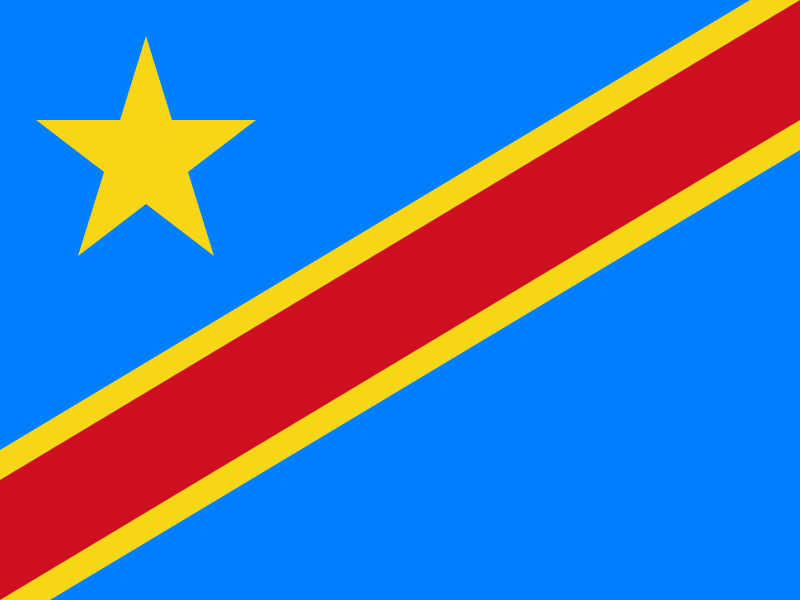
Population: 89,561,403
Total Land Area: 2,267,050 km2
Population/km2: 39.51
Official Visa Info: Direction Générale de Migration (DGM)