
Togo
Togo is a small West African country with a developing economy based primarily on agricultural production and port activity. Following a sustained period of political instability that began in the early 1990s, Togo has made considerable progress in recent years, highlighted by a succession of relatively free and fair elections in 2007, 2010, 2013, and 2015. Although significant challenges remain, Togo’s economy is developing by instituting business reforms, improving its health care and educational systems, and making significant new investments in infrastructure. French is the official language, while the most commonly spoken local languages are Ewe, Mina, and Kabiye. Some tourism infrastructure exists within the capital city, Lomé, and the cities of Kpalimé and Kara. Outside these areas the infrastructure for tourism is underdeveloped or non-existent. Read the Department of State’s Fact Sheet on Togo for additional information on U.S.- Togo relations.
Transportation
TRAFFIC SAFETY AND ROAD CONDITIONS: While in Togo, you may encounter road conditions that differ significantly from those in the United States.
While some major thoroughfares in urban parts of Togo are paved, many secondary streets are not, and they can become severely flooded when it rains. Driving conditions are hazardous throughout Togo due to the presence of pedestrians, large swarms of small motorcycles, disorderly drivers (moped, car and truck drivers), livestock on the roadways, and the poor condition of the roads, which often contain deep potholes. Overland travel off the main network of roads generally requires a four-wheel-drive vehicle. Many drivers in Togo do not obey traffic laws and most traffic signals do not function properly. Drivers should be prepared for the possibility that other drivers may run red lights or stop signs or drive in the wrong direction on one-way streets.
Nighttime travel is dangerous, and it is inadvisable to drive outside urban centers after dark. Even when driving in the city, keep car doors locked and the windows up. Poorly marked checkpoints, often manned by armed, undisciplined soldiers, exist throughout the country, including in the capital. Banditry, including demands for bribes at checkpoints, has been reported on major inter-city highways, including the Lomé-Cotonou coastal highway. You should be aware of your surroundings and drive defensively. At official checkpoints, Togolese security officials prefer that you approach with your interior light on, headlights dimmed, and have your driver’s license, registration, and proof of insurance ready.
If driving in Lomé, you should be aware of the staged-accident ploy. In this scam, a motorbike will cut in front of you, cause a collision, and draw a crowd, which can turn hostile if you attempt to leave the scene of the so-called accident. Such encounters appear designed to extort money from the vehicle driver. Pedestrians have also staged accidents. Genuine accidents can also draw hostile crowds. You should always keep car doors locked and windows closed, and have a cell phone in the vehicle. If you are involved in an accident and feel you are in danger (e.g. if your vehicle is attacked or you are threatened) you should leave the scene, drive to a safe location such as your hotel or a police station, and alert both the police and the U.S. embassy. Carjackings are reported in Togo and tend to increase during the summer months and holiday seasons.
You are advised to exercise caution when using any form of local public transportation. Never get into a taxi with unknown passengers and always agree on the fare before getting in.
Please refer to our Road Safety page for more information. Also, we suggest that you visit the website of the country’s national tourist office and national authority responsible for road safety.
AVIATION SAFETY OVERSIGHT: As there is no direct commercial air service to the United States by carriers registered in Togo, the U.S. Federal Aviation Administration (FAA) has not assessed the government of Togo’s Civil Aviation Authority for compliance with International Civil Aviation Organization (ICAO) aviation safety standards. Further information may be found on the FAA’s safety assessment page.
Safety and Security
U.S. citizens are urged to avoid political rallies and street demonstrations and maintain security awareness at all times. Togo experiences periodic strikes, demonstrations, political tensions, and political violence, especially during the lead-up to elections. Land borders with Ghana and Benin are typically shut down during elections within any of these three countries. Demonstrations can often arise with little advance warning. and quickly disintegrate into conflict or violence, including tire burning, stone throwing, and the use of tear gas, water cannons, and other crowd-control methods. Demonstrations and strikes also frequently lead to the closing of roads and public services such as hospitals and schools.
To stay connected:
- Enroll in the Smart Traveler Enrollment Program so we can keep you up to date with important safety and security announcements.
- Follow the Bureau of Consular Affairs on Twitter and Facebook.
- Bookmark the Bureau of Consular Affairs website, which contains the current Travel Warnings and Travel Alerts as well as the Worldwide Caution.
- Follow the U.S. Embassy in Togo on Twitter and by visiting the U.S. Embassy’s website.
- In the event of an emergency, contact us at 1-888-407-4747 toll-free within the United States and Canada, or via a regular toll line, 1-202-501-4444, from other countries.
- Take some time before traveling to consider your personal security and checking for useful tips for traveling safely abroad.
Environmental Hazards: Nearly all of Togo’s beaches have large surf and powerful undertows, so swimming is dangerous. There are some hotels and restaurants just to the east of the Port of Lome where a long stone reef creates a calmer area where many locals and visitors swim at their own risk. There are no lifeguards or emergency services.
Togo is vulnerable to floods, particularly during the rainy seasons. Floods and normal road degradation can lead to hazardous road conditions such as washed out roads, mud pits, and other unpredictable driving conditions. A number of people are found perished in gutters and wells near roads, with no known cause.
CRIME: In recent years, Togo has seen high levels of violent crime throughout the country. Incidents have included machete attacks as well as firearms-related crimes. U.S. citizens are strongly advised against going to public beaches or beaches where no security is provided at any time of day or night due to the frequency of muggings, especially against foreigners. At night time, U.S. citizens are strongly advised against going to the Boulevard du Mono, known as the “beach road”, the Ghana-Togo border areas, and markets. In the cities, parking should only take place in secured areas or where security personnel are present. Travelers are advised against visiting the Grand Marché area alone during the day, and at all after dark. Pick-pocketing incidents and theft are common in Togo, especially along the beach in Lome, in the market areas, and anywhere with large crowds.
Burglaries are frequent in the major cities. Most expatriates have 24-hour security guards at their residences and businesses. There are incidents of carjackings and other violent crime on the roads. Theft while riding in taxis is common, as thieves steal bags, wallets, and passports. Don’t share taxicabs with strangers. When using taxis, negotiate before you get in and insist that the driver not stop or wait for additional passengers.
Foreigners are targeted for robbery. U.S. citizens should be aware of their surroundings and the people present when coming and going from hotels, offices, banks, and residences. To lower the risk of ATM scams and robberies at ATMs, travelers should carefully choose only ATMs that have 24-hour security in established areas.
There have been reports of break-ins on parked cars to steal the items within the car. The criminals force their way into the car through the door or by forcing down a cracked window, and move quickly to take any accessible or visible items. Additionally, criminals steal motorcycles, both parked and in moving traffic.
Maintain a low profile. Do not do anything that draws unwanted attention. Do not flash money or wear conspicuous jewelry. When going out, carry only what you need. Foreigners are targeted for robbery. You should be aware of your surroundings and the people present when coming and going from hotels, offices, banks, and residences. Control your belongings by carrying bags and purses on the front of your body where you can see and touch them, especially in crowded places. Be aware of your surroundings and pay attention to people and activities in close proximity to you. In particular, you should closely monitor your surroundings when using ATMs because of petty theft during and after ATM usage. You should only use ATMs during the day and choose ATMs with many people and guards around if possible.
Criminals are known to use ruses to trap victims while driving, such as make-shift roadblocks and checkpoints, or using a supposed injured person in the road to stop traffic so that other criminals can carjack or rob those who stop to help. Criminals are known to follow their intended victim(s) to their residence or other destination, taking advantage of an opening car door or gate to rob the driver and household, and take the car.
Illegal roadblocks form routinely, especially outside of the major cities and at night. Most are harmless; but some use it as a ruse or as part of an attack strategy. You should not travel between cities at night. Tourist buses have been hijacked and robbed by bandits.
There have been incidents of organized violent crime, particularly in Lome, often involving foreign criminal organizations. These include targeted beatings and killings, sophisticated armed robberies, and the use of fire as a weapon.
Internet Financial Scams: Perpetrators of business fraud often target foreigners, including U.S. citizens. Formerly associated with Nigeria, these fraud schemes are now prevalent throughout western Africa, including Togo, and pose dangers of both financial loss and physical harm. An increasing number of U.S. citizens have been targets of such scams, resulting in the loss of considerable money, ranging from a few hundred dollars to hundreds of thousands of dollars.
Typically, these scam operations begin with an unsolicited communication, usually by e-mail or Facebook, from an unknown individual who describes a situation that promises quick financial gain, often by assisting in the transfer of a large sum of money or valuables out of the country. In some more sophisticated cases, the first contact is made in live chat forums or after open-source research has been done on the intended victim. The perpetrators often pretend to be U.S. citizens or military personnel, or other diplomatic functionaries. As a general rule, if it sounds too good to be true, it probably is. Common e-mail scams involve an individual claiming to be a U.S. citizen who is “trapped” in Togo and needs financial assistance to return to the United States or receive urgent medical care. More sophisticated scams include targeting U.S. businesses and ordering a large amount of their product, if the U.S. business provides banking information or pays legal fees.
In a variation of these internet-based advance-fee schemes, individuals spoof or mimic official U.S. Department of State email addresses in an attempt to lend credibility to their fraudulent activities. The U.S. Embassy has seen a rise in schemes in which the criminals represent themselves as Togolese government officials and defraud investors of large sums of money. The best way to avoid becoming a victim of fraud is to use common sense. Do not wire or transfer money to anyone you’ve never met in person. You should carefully check out any unsolicited business proposals originating in Togo before you commit any funds, provide any goods or services, or undertake any travel. If you are contacted by someone claiming to be a U.S. citizen in trouble, ask him/her to call the Embassy directly at (228) 22 61 54 70.
Please check the Embassy’s website for the most current information on fraud in Togo. For additional information, please see the Department of State’s information on International Financial Scams.
Piracy: Maritime crime, including armed robbery at sea and piracy in the Gulf of Guinea remain threats for the Government of Togo and its regional neighbors. While governments and regional organizations have taken some steps to combat the issue, concern remains over the reported number of incidents and levels of violence. If you are visiting any coastal areas in Togo, you should be alert to the threats of armed robbery at sea and piracy and move inland if you detect a potential threat. If you are caught in such an attack, you should comply immediately with any demands made by the aggressors and avoid any action that could be interpreted as an attempt to escape. See our fact sheet on International Maritime Piracy and Armed Robbery.
VICTIMS OF CRIME: If you or someone you know becomes the victim of a crime abroad, you should contact the local police and the nearest U.S. embassy or consulate. We can:
- Replace a stolen passport.
- Help you find appropriate medical care if you are the victim of violent crimes such as assault or rape.
- Put you in contact with the appropriate police authorities, and if you want us to, contact family members or friends.
- Help you understand the local criminal justice process and direct you to local attorneys, although it is important to remember that local authorities are responsible for investigating and prosecuting the crime.
The local equivalent to the “911” emergency line in Togo is “117” for police and “118” for fire and ambulance.
Please see our information for victims of crime, including possible victim compensation programs in the United States.
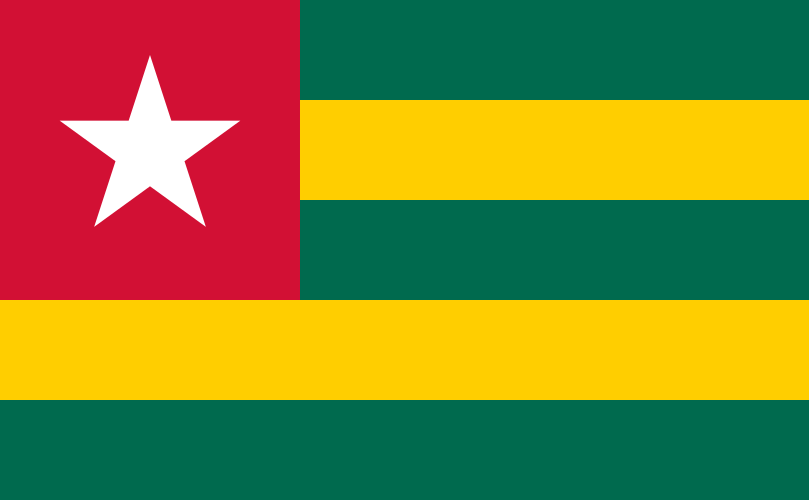
Population: 8,278,724
Total Land Area: 54,390 km2
Population/km2: 152.21
Official Visa Info: Togo Voyage national platform