
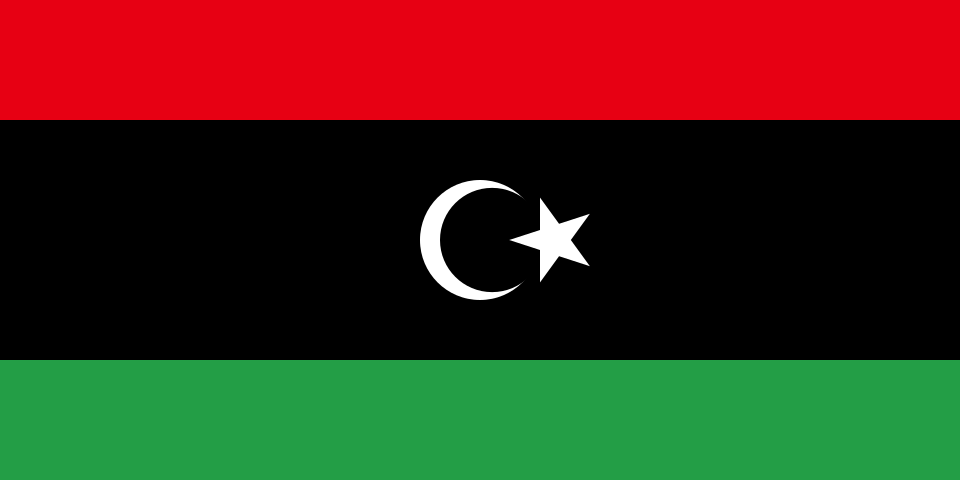
Libya
The State of Libya is navigating a prolonged and sometimes violent political transition. This follows a popular uprising against the regime of Muammar Qadhafi that lasted from February to October 2011 and included fighting throughout the country. The democratically elected interim government, headed by a Prime Minister, lacks the capacity to perform many traditional governmental responsibilities, including law enforcement. Armed militias, some with quasi-official status, exert significant influence. Arabic is the official language. Islamic ideals and beliefs provide the conservative foundation of the country's customs, laws, and practices.
Read the Department of State’s Fact Sheet on Libya for more information.
Transportation
TRAFFIC SAFETY AND ROAD CONDITIONS: While in a foreign country, U.S. citizens may encounter road conditions that differ significantly from those in the United States. The information below concerning Libya is provided for general reference only, and may not be totally accurate in a particular location or circumstance.
Driving in Libya can be hazardous, and there is a high accident rate. Enforcement of traffic laws is rare. As a result, it is often difficult to anticipate the actions of other drivers on Libyan streets and highways. Wind-blown sand can reduce visibility without warning. During the periodic rainstorms, roads will flood. Road conditions are poor, and limited public transportation is poor. Taxis are available, but many taxi drivers are reckless and untrained. English-speaking drivers are extremely rare. The sidewalks in urban areas are often in bad condition and cluttered.
Paved roads in rural areas are satisfactory; however, many rural roads are unpaved. Major highways along the seacoast and leading south merge into single-lane highways once they are outside major cities. These roads are heavily trafficked and can be precarious to navigate, especially at night and during the winter rainy season. The presence of sand deposits, as well as domestic and wild animals that frequently cross these highways and rural roads, makes them even more hazardous.
The availability of roadside assistance is extremely limited and offered only in Arabic. In urban areas and near the outskirts of major cities there is a greater possibility of assistance by police and emergency ambulance services, although emergency care providers are usually ill-equipped to deal with serious injuries or accidents. Very few streets are marked or have signage, and highway signs are normally available only in Arabic.
Please refer to our Road Safety Overseas for more information.
AVIATION SAFETY OVERSIGHT: As there is no direct commercial air service to the United States by carriers registered in Libya, the U.S. Federal Aviation Administration (FAA) has not assessed the government of Libya’s Civil Aviation Authority for compliance with International Civil Aviation Organization (ICAO) aviation safety standards. Further information may be found on the FAA’s safety assessment page. In addition, the FAA maintains prohibitions on flight operations over or within Libya by U.S. air carriers, commercial operators and airmen under a Special Federal Aviation Regulation. More information is available on the FAA website.
Safety and Security
The security situation in Libya remains unpredictable and unstable, and the Department of State advises U.S. citizens against all travel to Libya. If in Libya, make contingency emergency plans and maintain security awareness at all times.
Recent worldwide terrorism alerts, including the Department of State’s Worldwide Caution, have stated that extremist groups continue to plan terrorist attacks against U.S. interests in the Middle East region, including Libya. Any U.S. citizen who travels to Libya should maintain a strong security posture by being aware of surroundings, avoiding crowds and demonstrations, keeping a low profile, and varying times and routes for all required travel.
The Libyan government has not been able to build its military and police forces and improve security following the 2011 revolution. Many military-grade weapons remain in the hands of private individuals, UN-designated terrorists, and other armed groups, including antiaircraft weapons that may be used against civilian aviation. Crime levels remain high in many parts of the country. In addition to the threat of crime, kidnapping is a highly credible threat and various groups have called for attacks against U.S. citizens and U.S. interests in Libya.
The internationally recognized House of Representatives has relocated to Tobruk, and its government is based in Bayda. Government authorities lack control over much of the country. Tripoli and its environs are controlled by a coalition of militias known as Operation Dawn, and affiliated authorities calling themselves the “National Salvation Government.”
Clashes are ongoing throughout the country and attacks by armed groups can occur nationwide. Hotels frequented by westerners have been caught in the crossfire. Tripoli and other urban areas have witnessed fighting between armed groups and government forces as well as terrorist attacks. Checkpoints controlled by militias are common outside of Tripoli, as well as inside the capital at times. Most international airports are closed, and flights out of operational airports are sporadic and may be cancelled without warning. The United States is very concerned about the targeting of commercial transportation in Libya. The U.S. government prohibits U.S. commercial aviation operations within Libyan airspace.
Along with airports, seaports and roads can close with little or no warning. The escalation of violence in Libya against civilian commercial interests raises serious concerns about the safety of maritime vessels and their crew. U.S. mariners are advised to exercise extreme caution while transiting in or near Libyan territorial waters. The Libyan National Army announced on January 7, 2015 that all vessels in Libyan waters require army approval for transit, following the January 4, 2015 bombing of a Greek-operated oil tanker near Derna, Libya, that killed two crewmen. Vessels are advised to proceed with extreme caution when approaching all Libyan oil terminals and ports and are encouraged to adhere to the recommendations in the U.S. Coast Guard’s Port Security Advisory 1-14 issued April 1, 2014. Mariners planning travel to Libya should check the U.S. Coast Guard Homeport Website for any Port Security Advisory Updates and the NGA Broadcast Warnings Website (select “Broadcast Warnings”) for any special warnings or Maritime Administration Advisories before arrival.
Violent extremist activity in Libya remains high, and violent extremist groups in Libya have made several specific threats against U.S. government officials, citizens, and interests in Libya. On January 27, 2015, the Corinthia hotel in Tripoli was attacked by a group affiliated with ISIL claiming responsibility, resulting in the death of nine individuals including five foreigners, one of whom was a U.S. citizen. In October and December 2013, violent extremist groups in Libya made specific threats against U.S. government officials and U.S. non-governmental organizations (NGOs) operating in Libya. Because of the presumption that foreigners, especially U.S. citizens, in Libya may be associated with the U.S. government or U.S. NGOs, travelers should be aware that they may be targeted by violent extremist groups seeking to injure, kidnap or kill U.S. citizens, and should act accordingly with extreme caution. On December 5, 2013, a U.S. citizen teacher resident in Benghazi was killed in a drive-by shooting near his home. Sporadic episodes of civil unrest have occurred throughout the country and attacks by armed militants can occur in many different areas; hotels frequented by westerners have been caught in the crossfire. On November 15, 2013, fighting between militias and protesters in Tripoli resulted in the deaths of approximately 50 people with hundreds more injured.
Various militias have supplanted the police in maintaining internal security. Militia members operate checkpoints within and between major cities. Libyan militia members are poorly trained and may be unaffiliated with the interim government, which has not yet fully reconstituted the national army and police. There are frequent reports of violent (and sometimes fatal) clashes between rival militias and occasional reports of vigilante revenge killings. Militia groups sometimes detain travelers for arbitrary or unclear reasons, without access to a lawyer or legal process. The State Department advises carrying proof of citizenship and valid immigration status at all times. The State Department has extremely limited capacity to assist U.S. citizens who are detained by militia groups.
U.S. citizens should avoid areas of demonstrations and exercise caution if in the vicinity of any large gatherings, protests, or demonstrations, as even demonstrations intended to be peaceful can turn confrontational and escalate into violence. U.S. citizens traveling to or remaining in Libya should use caution and limit nonessential travel within the country, make their own contingency emergency plans, and maintain security awareness at all times.
If travel in desert and border regions of Libya is critically necessary, exercise caution and comply with local regulations. Terrorist organizations, including ISIL affiliated groups and al-Qaeda in the Islamic Maghreb, continue to threaten the region. Recent terrorist attacks have occurred in the border region, where extremists have kidnapped Westerners. Please note the travel warnings for neighboring countries, Algeria, Tunisia, Chad, Niger, and Sudan.
To stay connected:
- Enroll in the Smart Traveler Enrollment Program so we can keep you up to date with important safety and security announcements.
- Follow the Bureau of Consular Affairs on Twitter and Facebook.
- Bookmark the Bureau of Consular Affairs website, which contains the current Travel Warnings and Travel Alerts as well as the Worldwide Caution.
- In the event of an emergency, contact us at 1-888-407-4747 toll-free within the United States and Canada, or via a regular toll line, 1-202-501-4444, from other countries.
- Take some time before traveling to consider your personal security and check for useful tips for traveling safely abroad.
CRIME: Crime levels in Libya are high. There have been reports of armed robbery, carjacking, burglary, kidnapping, murder, and other crimes. Crimes of opportunity are commonplace, particularly against people who appear to be wealthy or of foreign nationality. The Libyan police and internal security institutions have not reconstituted themselves since the revolution. Thousands of criminals who were released from prisons by the former regime or who escaped following the revolution remain at large. Hundreds of thousands of small arms looted from government storage facilities are now in the hands of the local population, contributing to the rise in violent crime.
Do not buy counterfeit and pirated goods, even if they are widely available. Not only are the bootlegs illegal in the United States, if you purchase them you may be breaking local law.
VICTIMS OF CRIME: If you or someone you know becomes the victim of a crime abroad, you should contact the local police and the nearest U.S. embassy or consulate. We can:
- Replace a stolen passport.
- Help you find appropriate medical care if you are the victim of violent crimes such as assault or rape.
- Put you in contact with the appropriate police authorities, and if you want us to, contact family members or friends.
- Help you understand the local criminal justice process and direct you to local attorneys, although it is important to remember that local authorities are responsible for investigating and prosecuting the crime.
There is no functioning local equivalent to the “911” emergency line in Libya. Individuals experiencing medical emergencies generally need to obtain transport from a taxi or associate to a medical facility.
Please see our information for victims of crime, including possible victim compensation programs in the United States.
Population: 6,871,292
Total Land Area: 1,759,540 km2
Population/km2: 3.91