
Zambia
Zambia is a developing country in southern Africa with a democratic government. The official language is English although many Zambians in rural areas exclusively speak local Bantu languages. Outside of Lusaka, Livingstone (Victoria Falls), and well-known game parks, tourist facilities are not fully developed. Read the Department of State’s Fact Sheet on Zambia for additional information on U.S. – Zambia relations.
Transportation
TRAFFIC SAFETY AND ROAD CONDITIONS: While in Zambia, you will encounter road conditions that differ significantly from those in the United States. In Zambia, vehicles drive on the left side of the road, and vehicles in traffic circles travel clockwise. It is illegal to turn left on a red light. Driving on Zambian roads can be hazardous. Most roads do not have shoulders or sidewalks, forcing pedestrians and livestock to use the roadways both day and night. It is a traffic violation to splash a pedestrian when driving through water. While the main roads in Lusaka and the principal highways linking Lusaka with the major provincial capitals are generally maintained, many secondary roads are in poor repair. During the rainy season (end of October to mid-March), travelers who do not have a four-wheel drive vehicle will encounter problems driving on rural roads. Even in daylight, passing another vehicle can be particularly dangerous given the general condition of roads.
Driving at night can be hazardous and is discouraged. Even in Lusaka there are few streetlights, and pedestrians on the edge of the road are difficult to see. When breakdowns occur, local drivers place a few branches behind the car to indicate trouble but these are difficult to see after dark. As a result, many drivers use their high beams at night to detect stopped vehicles and pedestrians but often fail to dim their high beams when approaching other cars. Cars with non-functioning headlights and taillights are another hazard.
U.S. citizens have been involved in a number of serious auto accidents. There are no emergency services for injured or stranded drivers. Auto accident victims are vulnerable to theft by those who pretend to be helpful. It is advisable to have a cell phone when undertaking a trip outside of town, although some parts of the country do not yet have cell phone service.
City traffic is comprised mostly of cars and minibuses; motorcycles are rare. Some luxury buses travel between Lusaka and Livingstone and the Copperbelt. Minibuses serve as the primary means of inter-city travel in Zambia but are often overcrowded, poorly maintained, and seldom punctual. Drivers often pass using road shoulders or opposing traffic lanes and frequently stop with little or no warning to pick up or drop off passengers. If you hear sirens indicating an official motorcade while you are driving, you should come to a stop and, if possible, pull to the side of the road.
Seat belts are mandatory, as are helmets for motorcyclists. A child's seat is not mandatory by law but is essential for safeguarding children. Using a cell phone while operating a vehicle is illegal and carries a minimum fine equivalent to $60. The speed limit is 50 km/30 mph in Lusaka and 100 km/60 mph outside of city limits; however, speed limits are rarely respected, and most cars drive 80 km/50 mph in the city and 120 km/75 mph outside of town. Many vehicles operate at even faster speeds on the road from Lusaka to Livingstone.
If you are stopped by police while driving and asked to pay a fine, you should be provided an official receipt or directed to the nearest police station where you can make payment. Drivers under the influence of alcohol who are involved in accidents are tested at Lusaka's University Teaching Hospital (UTH) and then taken to court.
To take a vehicle into Zambia, you must obtain a temporary import permit (TIP) at the border, or, depending on the country of origin, a carnet de passage. If you are not the owner of the vehicle, you must have a letter from the owner authorizing the use of the vehicle in Zambia. You must also purchase third-party insurance at the border. Residents of Zambia should obtain a driver’s license after obtaining a residence or study permit. Cars must have small reflective stickers attached to the bumper (white on front, red on back), and drivers should always carry two reflective triangles (used to warn other drivers if your car breaks down). Traffic officer checkpoints are fairly frequent outside of urban centers and you risk a fine if found to be driving without reflective stickers, triangles, a spare tire, or non-working headlights or indicator lights.
The Zambia Road Transport and Safety Agency (RTSA) requires U.S. citizens who apply for driver licenses in Zambia to provide a statement of authentication of their U.S. state-issued driver license. Information regarding authentications is available at the Office of Authentications website.
Please refer to our Road Safety page for more information. For additional information on travel to and within Zambia, see Zambia’s Tourism Board travel page.
AVIATION SAFETY OVERSIGHT: As there is no direct commercial air service to the United States by carriers registered in Zambia, the U.S. Federal Aviation Administration (FAA) has not assessed the Government of Zambia’s Civil Aviation Authority for compliance with International Civil Aviation Organization (ICAO) aviation safety standards. Further information may be found on the FAA’s safety assessment page.
Safety and Security
The U.S. Embassy recommends that travelers exercise caution when traveling throughout the country. Spontaneous demonstrations occasionally take place in Lusaka and elsewhere in the country, sometimes in response to ongoing political disputes or around elections due to clashes between political groups and partisans. Remember, even demonstrations intended to be peaceful can turn confrontational and escalate into violence. You should avoid the vicinity of demonstrations. You should also stay current with media coverage of local events and be aware of your surroundings at all times.
The Embassy has received several reports of the use and attempted use of “date rape” drugs on unsuspecting females in a variety of bars and restaurants. There are several “date rape” drugs on the market, and these are easily purchased or obtained in Zambia. Common symptoms of these drugs are: drunken feeling, loss of consciousness, memory problems, confusion, dizziness, excessive sweating, nausea, and loss of motor skills. Rapists use the drug to render a victim easier to attack. If you feel that you have been a victim of a "date rape" drug attack, seek medical attention immediately. The Embassy maintains a list of medical professionals.
The U.S. Embassy discourages travelers from driving off-road or on remote, lightly-used tracks near the borders with the Democratic Republic of the Congo (DRC) and Angola as there may still be undetected land mines and unexploded ordnance. U.S. citizens who must drive in these areas are encouraged to drive in convoys and carry satellite telephones. See our Country-Specific Information for the DRC and Angola for additional information on travel to these countries.
To stay connected:
- Enroll in the Smart Traveler Enrollment Program so we can keep you up to date with important safety and security announcements.
- Follow the Bureau of Consular Affairs on Twitter and Facebook.
- Bookmark the Bureau of Consular Affairs website, which contains the current Travel Warnings and Travel Alerts as well as the Worldwide Caution.
- Follow the U.S. Embassy in Zambia on Twitter and visiting the Embassy’s website.
- In the event of an emergency, contact us at 1-888-407-4747 toll-free within the United States and Canada, or via a regular toll line, 1-202-501-4444, from other countries. Take some time before traveling to consider your personal security and checking for useful tips for traveling safely abroad.
CRIME: Travel in many sections of Lusaka, Livingstone, and most other major cities, as well as in the major game parks, is generally safe during daylight hours. However, expatriates have been the victim of armed robberies in Livingstone, Copperbelt Province, and elsewhere. Victims are seldom seriously injured but stolen property is rarely recovered.
Carjacking remains an ongoing problem, especially in Lusaka and Livingstone. In most cases, carjackers will block the rear of a victim’s vehicle while it waits to pass through a security gate into a residence and then assailants will threaten the driver and take the car. A pattern of particularly violent and aggressive carjacking appears to be developing. In recent months, there have been two identical incidents in which women were carjacked, robbed at gunpoint, abducted, beaten, and sexually assaulted. These incidents have taken place in the Libala and Ibex Hill areas in Lusaka but can occur anywhere. In each instance, the victim’s vehicle was forced to a stop and blocked by a stolen vehicle driven by four armed criminals. The perpetrators of these crimes have not been apprehended. The level of violence involved is particularly worrisome.
Drivers are advised to lock their car doors, close their windows, and remain vigilant when entering or exiting a residence.
Travelers using public transportation or visiting high pedestrian traffic areas are advised to be vigilant against robbery and pick-pocketing. Vehicle thefts and burglaries occur throughout the country, including “smash and grab” thefts from vehicles either parked or stopped at intersections or in traffic. Try not to leave valuables visible in unattended vehicles.
You should use caution when traveling near the border with the DRC. Although rebel militias are no longer active in the Katanga province of the DRC, armed criminal elements remain in the border area.
Do not buy counterfeit and pirated goods, even if they are widely available. Not only are the bootlegs illegal in the United States, if you purchase them you may also be breaking local law.
VICTIMS OF CRIME: If you or someone you know becomes the victim of a crime abroad, you should contact the local police and the nearest U.S. embassy or consulate. We can:
Replace a stolen passport. Help you find appropriate medical care if you are the victim of violent crimes such as assault or rape. Put you in contact with the appropriate police authorities, and if you want us to, contact family members or friends. Help you understand the local criminal justice process and direct you to local attorneys, although it is important to remember that local authorities are responsible for investigating and prosecuting the crime. The local equivalent to the “911” emergency line in Zambia is 999. Police response, particularly outside major cities, may be delayed due to a lack of vehicles and other resources.
Please see our information on victims of crime, including possible victim compensation programs in the United States.
The local equivalent to the “911” emergency line in Zambia is 999; however, emergency lines often do not work. Police response, particularly outside major cities, may be delayed due to a lack of vehicles and other resources.
Please see our information on victims of crime, including possible victim compensation programs in the United States.
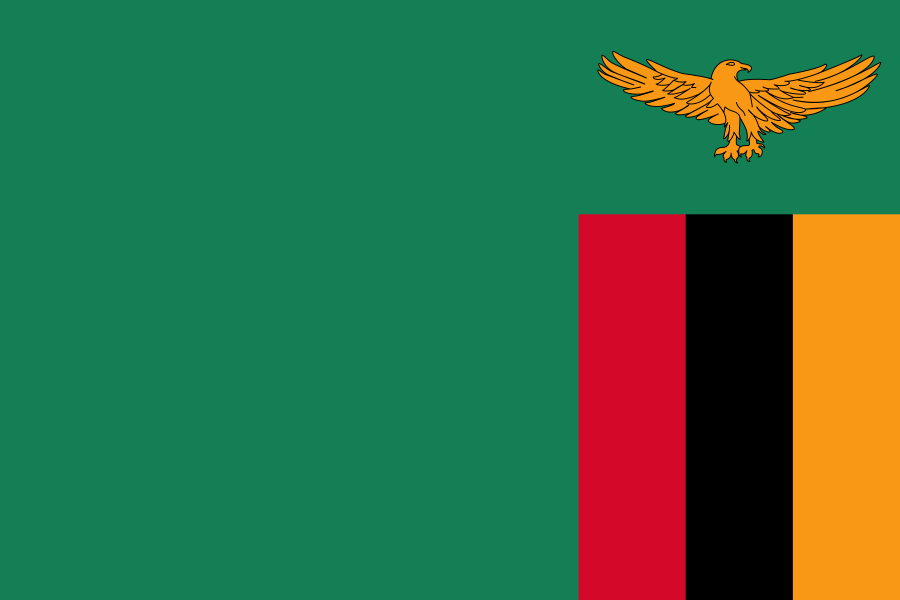
Population: 18,383,955
Total Land Area: 743,390 km2
Population/km2: 24.73
Official Visa Info: Department of Immigration