
Ghana
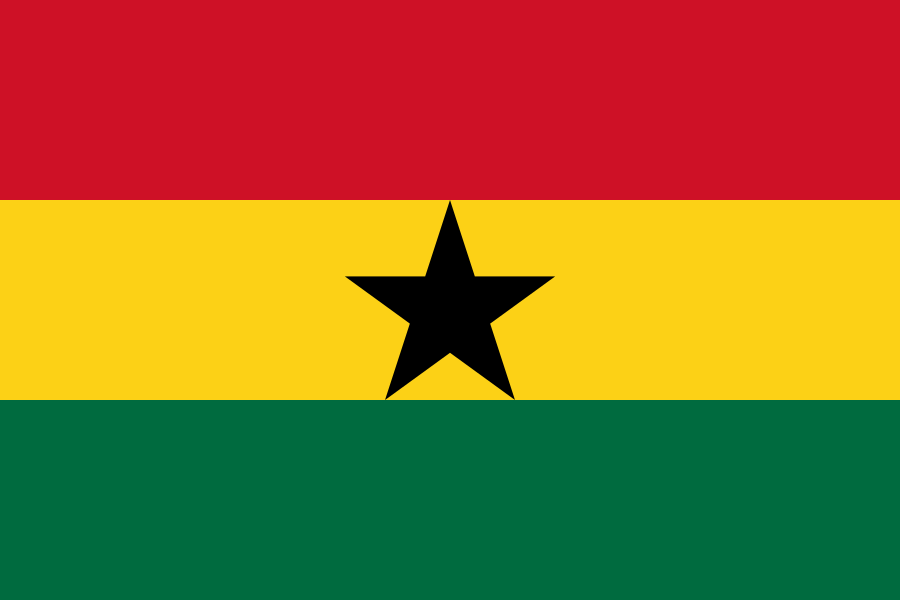
Ghana is a developing country on the west coast of Africa. The capital is Accra. Tourist facilities are available in the population centers of the greater Accra region, Kumasi in the Ashanti region, and in the Cape Coast area of the Central region. They are limited in the more remote areas of the country. Read the Department of State’s Fact Sheet on Ghana for additional information on U.S.-Ghana relations.
Transportation
TRAFFIC SAFETY AND ROAD CONDITIONS: While in a foreign country, U.S. citizens may encounter road conditions that differ significantly from those in the United States.The information below concerning Ghana is provided for general reference only, and may not be totally accurate in a particular location or circumstance.
Primary roads are generally paved and well maintained.However, some side roads within major cities and many roads outside of major cities are in poor condition.The road from Accra to the central region tourist area of Cape Coast continues to be the site of many accidents.Travel after daylight hours, particularly outside the major cities, is extremely hazardous due to poor street lighting and the unpredictable behavior of pedestrians, bicyclists and farm animals, particularly goats and sheep.Aggressive drivers, poorly maintained vehicles, and overloaded vehicles pose serious threats to road safety.
Another hazard is pedestrians who intentionally bump vehicles and pretend to be hit. They then attempt to extort money from the vehicle occupants.Scams of this nature most commonly occur in congested urban areas.
The safety standards of the small private buses that transit roads and highways are uncertain.Travelers are encouraged to consider this when making travel arrangements.
Armed robbers have targeted travelers following their arrival at Kotoka airport.An increasingly used tactic is to deliberately cause a minor road traffic accident to make a car stop, and to then rob the occupants.If your car is hit by another car it is best to drive to the nearest police station to sort out the incident.Otherwise, all drivers, particularly at night, should remain vigilant, and drive with doors locked and windows up.
There has been an increase in incidents of highway robbery on the road from Kintampo to Tamale in the Brong Ahafo and Northern regions.Travelers along this route should exercise caution.
Travelers are routinely stopped at police checkpoints throughout Ghana, and vehicles and passengers may be searched.Drivers must possess an international driver’s license (available from AAA and the American Automobile Touring Alliance).There have been incidences of fraud related to international drivers’ licenses.As a result, when foreign drivers apply for their Ghanaian driver’s license they may be asked to have their international driver’s license or their home country driver’s license confirmed by their embassy.The U.S. Embassy in Ghana is unable to authenticate such state issued or international drivers’ licenses and advises U.S. citizen to contact the National Identification Authority in Ghana or have their U.S. driver’s license authenticated in the U.S. prior to arriving in Ghana.Foreign nationals should carry documentation of their status, such as a passport and a visa.
Please refer to our Road Safety page for more information. Also, we suggest that you visit the website of the country’s national tourist office.
AVIATION SAFETY OVERSIGHT: The U.S. Federal Aviation Administration (FAA) has assessed the government of Ghana’s Civil Aviation Authority as not being in compliance with International Civil Aviation Organization (ICAO) aviation safety standards for oversight of Ghana’s air carrier operations.Further information may be found on the FAA’s safety assessment page.
Safety and Security
Due to the potential for violence, U.S. citizens should avoid political rallies and street demonstrations and maintain situational awareness to events or activities around them at all times.
There are a number of ongoing chieftaincy disputes in Ghana that generally involve competition over limited resources. Some of these disputes have erupted into violence and unrest during recent years, most notably in Yendi in the Northern Region and Bawku in the Upper East Region. Visitors should exercise caution when traveling in these areas and remain alert to outbreaks of unrest.
Travelers should also be aware that the standards of construction are often lower than those found in the United States. These lower standards have contributed to building collapses, fires, and reports of electrical shock.
To stay connected:
- Enroll in the Smart Traveler Enrollment Program so we can keep you up to date with important safety and security announcements.
- Follow the Bureau of Consular Affairs on Twitter and Facebook.
- Bookmark the Bureau of Consular Affairs website, which contains the current Travel Warnings and Travel Alerts as well as the Worldwide Caution.
- In the event of an emergency, contact us at 1-888-407-4747 toll-free within the United States and Canada, or via a regular toll line, 1-202-501-4444, from other countries.
- Take some time before traveling to consider your personal security and checking for useful tips for traveling safely abroad.
CRIME: Pick-pocketing, purse-snatching, and financial scams are the most common forms of crime confronting visitors. Travelers have reported these types of theft in taxis, at crowded markets, beaches, parks, and tourist attractions. Incidences of violent crime, such as armed robbery, are on the rise, including reports of armed robberies in expatriate residential and shopping areas, some beaches (including Kokrobite), and, specifically, the Osu and Ablekuma/Dzorwulu neighborhoods after 10 p.m. Victims who resist attackers face a significant risk of serious physical injury. Take security measures, such as traveling in groups and avoiding travel at night. Avoid travel in communal taxis. Travelers who limit their display of jewelry and handle their cash discreetly reduce their vulnerability to crime. Pay close attention to those around you or following you, particularly after exchanging money, making a purchase, or withdrawing money from an ATM. Travelers should carry limited amounts of cash and only photocopies of key documents.
Thefts of both luggage and travel documents occur at Kotoka International Airport in Accra and in hotels across Ghana. All U.S. citizens should ensure that documents are kept secure at all times (including when leaving the airport) and that baggage is never left unattended. Travelers should be wary of all offers of unsolicited assistance at the airport unless from uniformed porters or officials. All permanent staff at the airport are issued current ID cards bearing their name and photograph. ID cards without a photograph are not valid. Travelers who are met at the airport should confirm the identity of their driver, either by requesting proper identification or otherwise verifying that the driver is an official from an organization or a hotel. There have been increasing incidences of impostors who approach travelers before the main arrivals area claiming to be the traveler's driver or contact. The impostor will have obtained the traveler's name from the board displayed by the official driver in the arrivals area outside the airport. The impostor then attempts to extort money from the traveler once the traveler is in the impostor's vehicle.
Use of credit cards in Ghana should be avoided if possible, as a growing number of travelers have been victims of credit card fraud.
In recent years, U.S. citizens have reported substantial financial losses from questionable transactions involving gold and other precious metals. The Government of Ghana maintains strict regulations on these natural resources. All agents must be licensed and all transactions must be certified. (See Special Circumstances below.)
Perpetrators of business fraud often target foreigners, including U.S. citizens. Such fraud schemes are now prevalent throughout West Africa, including Ghana. Please refer to the Country Commercial Guide for Ghana for further information.
U.S. citizens frequently consult the U.S. Embassy regarding questionable business offers sent from Ghana. These are scams and typically begin with an unsolicited communication (usually by e-mail) from an unknown individual who describes a situation that promises quick financial gain, often by assisting in the transfer of a large sum of money or valuables out of the country. A series of “advance fees” must be paid in order to conclude the transaction, such as fees to open a bank account or to pay certain taxes. In fact, the final payoff does not exist; the purpose of the scam is simply to collect money from the victim. The Embassy has also received reports of fraudulent charities soliciting contributions through the Internet or direct mail. If you receive such business offers or charity requests, check with the U.S. Embassy in Ghana ((233)-(030)-274-1570) for an assessment of the offer’s credibility before you commit any funds, provide any goods or services, or undertake any travel.
Another type of fraud is committed by persons claiming to live in Ghana or traveling to Ghana on business, and who profess friendship or romantic interest over the Internet. Once a relationship has been established, the correspondent typically asks the U.S. citizen to send money for living expenses, travel expenses, visa costs or family emergencies. Sometimes a “hospital” or “doctor” telephones to say that the friend has suffered an “accident” and needs immediate financial assistance to cover medical bills. There are other variations of this scam, but the common goal is to fraudulently obtain as much money as possible from the victim. U.S. citizens have reported losing thousands of dollars through such scams. The anonymity of the Internet means that the victim cannot be sure of the real name, age, marital status, nationality, or even gender of the correspondent. In most cases reported to the Embassy, the correspondent turned out to be a fictitious persona created to lure U.S. citizens into sending money.
Visitors to Ghana should also be wary of overly-friendly locals offering tours, discounted lodging, or other services that seem too good to be true. Tourists are often targeted by touts and scam artists. Some U.S. citizens have been victims of false criminal accusations and have lost time and money as they seek to resolve these difficult situations.
For additional information, please see the Department of State’s International Financial Scams page.
Although the Embassy is unaware of any attacks in Ghanaian waters, piracy in the waters of neighboring countries remains a problem. The Department alerts travelers to the threat of piracy in the Gulf of Guinea and advises caution if approached by an unknown vessel while at sea. See our fact sheet on International Maritime Piracy for further information.
VICTIMS OF CRIME: If you or someone you know becomes the victim of a crime abroad, you should contact the local police and the nearest U.S. embassy or consulate. We can:
- Replace a stolen passport.
- Help you find appropriate medical care if you are the victim of violent crimes such as assault or rape.
- Put you in contact with the appropriate police authorities, and if you want us to, contact family members or friends.
- Help you understand the local criminal justice process and direct you to local attorneys, although it is important to remember that local authorities are responsible for investigating and prosecuting the crime.
Please see our information for victims of crime, including possible victim compensation programs in the United States.
Population: 31,072,940
Total Land Area: 227,540 km2
Population/km2: 136.56
Official Visa Info: Ghana Immigration Service (with Ministry of Foreign Affairs)