
Liberia
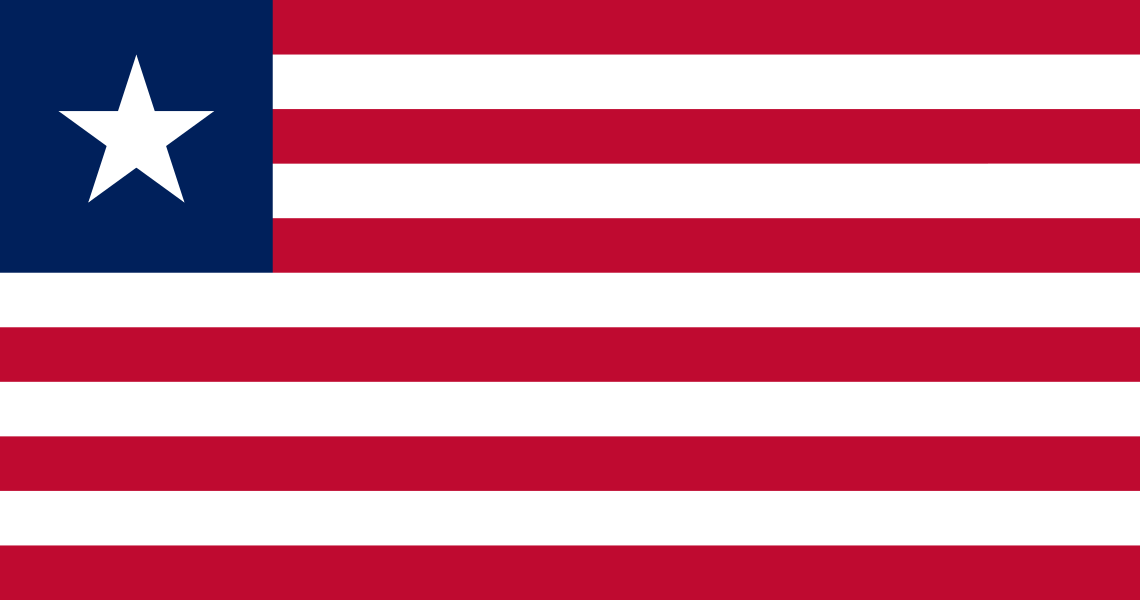
Liberia is a country in West Africa that suffered from years of instability and conflict from 1990 to 2003, with attendant destruction of buildings, roads, infrastructure, and public institutions. After comprehensive peace accords ended the conflict in August 2003, a United Nations peacekeeping force (UNMIL) was deployed to facilitate disarmament and demobilization, help arrange democratic elections, and provide for security of the country. In late 2005, Liberians elected Ellen Johnson-Sirleaf as president. She was re-elected in November 2011, and her administration continues to make progress in rebuilding the country.
Despite over ten years of peace and economic growth, Liberia is still one of the poorest countries in the world and many basic services (e.g., public power, water and sewage, and landline phones) are either limited or unavailable. Facilities for foreign visitors are adequate in the capital city, Monrovia, but virtually non-existent in the rest of the country. The official language of Liberia is English. Read the Department of State’s Fact Sheet on Liberia for additional information.
Transportation
TRAFFIC SAFETY AND ROAD CONDITIONS: While in a foreign country, U.S. citizens may encounter road conditions that differ significantly from those in the United States. The information below concerning Liberia is provided for general reference only, and may not be accurate in a particular location or circumstance.
Driving in Liberia presents a danger to residents and visitors, as traffic laws are either nonexistent or not enforced. Traffic accidents are frequent and often result in injury or loss of life. Potholes and poor road surfaces are common, making safe driving extremely challenging. Cars, trucks, motorcycles, and taxis are often overloaded with people and goods, and vehicles make frequent stops without signaling. Drivers overtake on the right lanes as well as the left lanes. Many vehicles operate with threadbare tires, and blowouts are frequent. Public taxis are poorly maintained and usually overloaded. All drivers should approach intersections with extreme caution. Public street lights have been installed in some locations in Monrovia and there are a few traffic lights around city. However, drivers outside of Monrovia should remain vigilant as pedestrians, animals, and unrestricted speed limits are attributed to many fatal collisions.
Drivers and pedestrians are cautioned that high-speed car convoys carrying government officials require all other vehicles to pull off the road until they have passed.
Travelers should expect time-consuming detours around the many bridges and roads damaged by war, neglect, or the heavy annual rains occurring between May and November. Travelers can expect strict enforcement of border controls by Liberian, Ivorian, Sierra Leonean, and Guinean authorities. Corruption has been reported at many border locations and travelers may be asked for money prior to crossing the border. At times, border crossings to neighboring countries are closed.
Please refer to our Road Safety page for more information. Also, we suggest that you visit the website of Liberia’s national tourist office.
AVIATION SAFETY OVERSIGHT: As there is no direct commercial air service to the United States by carriers registered in Liberia, the U.S. Federal Aviation Administration (FAA) has not assessed the government of Liberia’s Civil Aviation Authority for compliance with International Civil Aviation Organization (ICAO) aviation safety standards. Further information may be found on the FAA’s safety assessment page.
Safety and Security
The Department of State urges U.S. citizens to plan proposed travel to Liberia carefully and to exercise caution when traveling in Liberia. Before traveling to Liberia, U.S. citizens are urged to make arrangements for transportation from the international airport into the city center. Taxis are the only form of public transportation available at the international airport, which is located 40 miles outside of Monrovia. Taxis generally carry multiple passengers to various stops and are poorly maintained. See section on traffic safety and road conditions for additional information. U.S. citizens traveling to Liberia are also urged to confirm reservations at a reputable hotel, as rooms can be scarce and difficult to find without advance plans.
U.S. citizens who travel to or reside in Liberia should realize that Liberia's police force has limited resources. UN Police (UNPOL) officers serve as advisors to the Liberia National Police, but they do not have the authority to arrest or detain, and most are unarmed. The Liberia National Police has a strong presence in Monrovia, but less of a presence outside of the capital city. The police can be both a source of assistance as well as a source of problems for visitors. Concerns about police corruption continue, and travelers may be detained by police officers soliciting bribes. U.S. citizens are encouraged to carry a photocopy of their passports with them at all times so that, if questioned by local officials, proof of identity and citizenship is readily available. If detained or arrested, U.S. citizens should ask to contact the U.S. Embassy immediately.
U.S. citizens in Liberia should be aware of their surroundings at all times and use caution when moving around, especially at night. Travel outside of Monrovia after dark is strongly discouraged as roads are in poor condition and there are few public street lights.
U.S. citizens should avoid crowds, political rallies, and street demonstrations, and should maintain security awareness at all times.
To stay connected:
- Enroll in the Smart Traveler Enrollment Program so we can keep you up to date with important safety and security announcements.
- Follow the Bureau of Consular Affairs on Twitter and Facebook.
- Bookmark the Bureau of Consular Affairs website, which contains the current Travel Warnings and Travel Alerts as well as the Worldwide Caution.
- In the event of an emergency, contact us at 1-888-407-4747 toll-free within the United States and Canada, or via a regular toll line, 1-202-501-4444, from other countries.
- Take some time before traveling to consider your personal security and check for useful tips for traveling safely abroad.
The Department of State urges U.S. citizens to take responsibility for their own personal security while traveling overseas.
CRIME: While incidence of crime in Liberia is high, most crimes that occur within the expat community are crimes of opportunity (which increase during the hours of darkness), to include residential burglary or armed robbery (with use of a knife or machete). Criminal activity has been reported in both urban and rural areas. The Liberia National Police have limited capacity to respond to crime events.
Perpetrators of business fraud often target foreigners, including U.S. citizens. Formerly associated with Nigeria, these fraud schemes are now prevalent throughout western Africa and pose a danger of both financial loss and physical harm. An increasing number of U.S. citizens have been the target of such scams. The best way to avoid becoming a victim of fraud is to use common sense – if it looks too good to be true, it probably is. U.S. citizens should carefully check any unsolicited business proposal originating in Liberia before committing any funds, providing any goods or services, or undertaking any travel, particularly if the proposal involves mining or the sale of gold and diamonds. There has also been an increase in the number of Liberian-American Internet relationships in which there are eventual requests for financial assistance under fraudulent pretenses. For additional information, please see the Department of State's Bureau of Consular Affairs brochure on Resources for Victims of International Financial Scams.
Petty corruption is rampant. Poorly paid government officials and private company employees may ask for fees for doing their job, and travelers may be inconvenienced for not paying bribes.
Don’t buy counterfeit and pirated goods, even if they are widely available. Not only are the bootlegs illegal in the United States, you may also be breaking local law.
VICTIMS OF CRIME: If you are the victim of a crime abroad, you should contact the local police and the nearest U.S. embassy or consulate. This includes the loss or theft of a U.S. passport. The embassy/consulate staff can help you find appropriate medical care, contact family members or friends, and explain how funds may be transferred. Although the investigation and prosecution of the crime is solely the responsibility of local authorities, consular officers can help you understand the local criminal justice process and find an attorney if needed.
The local equivalent to the “911” emergency line in Liberia is also 911. However, emergency services are not provided reliably or consistently. Also, there is no landline telephone service in Liberia, and cellular phone communication is subject to occasional disruptions in service. A call to 911 in Liberia may go unanswered, and you should employ other resources to obtain emergency assistance.
Please see our information for victims of crime, including possible victim compensation programs in the United States.
Population: 5,057,681
Total Land Area: 96,320 km2
Population/km2: 52.51