
Slovenia
Slovenia is a parliamentary democracy and a member of the European Union. Tourist facilities are widely available throughout the country. Slovene is the official language; English is not widely spoken outside of major cities and tourist attractions. Additional information on the country can be found on the Department of State’s Fact Sheet on Slovenia.
Transportation
TRAFFIC SAFETY AND ROAD CONDITIONS: While in Slovenia, you may encounter road conditions that differ significantly from those in the United States. The information below concerning Slovenia is provided for general reference only, and may not be totally accurate in a particular location or circumstance.
Driving: Slovenia has a well-developed road network that is safe for travel. Highways connect to neighboring cities and countries, and are clearly marked; road signs and traffic rules are consistent with those used throughout Europe. As the number of cars in Slovenia continues to rise, roads are becoming more heavily congested during the weekends and during rush hours. Parking is difficult and can be expensive in the center of Ljubljana. Third-party liability insurance is required for all vehicles; coverage is purchased locally. Travelers driving rented automobiles from Croatia into Slovenia are generally able to purchase Slovene insurance at the border. At the smaller border crossings or during peak travel times, however, it can take several hours to arrange such coverage. Travelers should be alert to aggressive drivers both in cities and on highways. Many of the serious accidents in Slovenia occur as a result of high-speed driving. Emergency roadside assistance and towing services are available by dialing 1987. Dial 112 for an ambulance or fire brigade, and 113 for police. By Slovenian law, the maximum legal blood-alcohol limit for drivers is 0.05 (0.00 percent for novice drivers with less than two years of experience, any driver under 21 years, and drivers of trucks and buses).
Traffic moves on the right. The speed limit is 50kph/30 mph in most urban areas and 130 kph/80 mph on expressways (the avtocesta). Motorists are required to have their headlights on during the daytime; drivers and passengers alike must wear seat belts; motorcyclists and their passengers must wear approved helmets. The use of hand-held cellular telephones while driving is prohibited in Slovenia and turning right on red is not allowed.
Between November 15 and March 15, the use of winter tires is mandated by law. All-season tires are permitted if they carry the MS mark and have at least 4 mm of tread. In addition, local police may require chains in heavy snow. Failure to possess the proper tires/chains may result in a substantial fine and the suspension of the cited vehicle's use. Insurance may be deemed void if a vehicle which is involved in an accident between November 15 and March 15 is not fitted with winter tires.
Vignettes: Highway vignettes (which are purchased in the form of windshield stickers) are obligatory for all passenger vehicles using expressways in Slovenia. A one-year vignette costs €110 (153 USD) for Class A vehicles (cars) and €220 (305 USD) for Class B vehicles, which are two-track vehicles with vehicle height above front axle of 1.30 meters or more (about 6ft).) A monthly vignette costs €30 (42 USD), and a weekly vignette costs €15 (21 USD). For motorcycles, a one-year vignette is €47.50 (67 USD), a half-year vignette is €25 (35 USD), and a weekly vignette is €7.50 (6 USD). One of the most common problems faced by U.S. citizens visiting Slovenia is being pulled over on a highway for driving without a vignette. Drivers without a vignette may be fined between €300-800 (417-1,114 USD) and must also immediately purchase a vignette. Simply buying a vignette and placing it on the dashboard is not sufficient – the vignette must be permanently affixed to the windshield of the vehicle. Vignettes can be purchased in Slovenia at gas stations, newsstands, automobile clubs, post offices (Posta Slovenije), and some toll stations, as well as at some gas stations in neighboring countries.
Driver’s licenses: U.S. citizens visiting or residing in Slovenia must be in possession of both a valid U.S. driver’s license and an International Driving Permit in order to drive legally in Slovenia. This combination of a U.S. driver’s license and an International Driving Permit is valid for a maximum of one year, after which time individuals are required to obtain a Slovenian driver’s license. Two automobile associations are authorized by the U.S. Department of State to issue International Driving Permits: the American Automobile Association and the American Automobile Touring Alliance (through the National Auto Club).
Current information about traffic and road conditions is available in English from the Automobile Association of Slovenia by calling (01) 530-5300 and from the Traffic Information Center for Public Roads.
Taxis: While Ljubljana's taxis are generally safe, clean, and reliable, taxi drivers at the airport, some hotels, and main railway stations have been known to overcharge tourists by shutting off their meters. When using a taxi, you should first ask for an estimate of the total cost and check to see that the meter is running during the journey.
Please refer to our Road Safety page for more information. Also, we suggest that you visit the website of Slovenia's national tourist office and the Slovenian Roads Agency.
Bicycling: Bicycling is popular in Slovenia, and cities have well-developed bicycling networks with marked bicycle lanes along most roads. Slovenia has more rules governing cyclists than the United States, and police are authorized to ticket cyclists who do not follow them. There are special rules regarding children and bicycles. Please visit Slovenia’s Bicycle Safety page for a list of rules and advice for cyclists.
AVIATION SAFETY OVERSIGHT: As there is no direct commercial air service to the United States by carriers registered in Slovenia, the U.S. Federal Aviation Administration (FAA) has not assessed the Government of Slovenia’s Civil Aviation Authority for compliance with International Civil Aviation Organization (ICAO) aviation safety standards. Further information may be found on the FAA’s safety assessment page.
Safety and Security
While Slovenia has not had any incidents of international or indigenous terrorism, it shares open borders with three Schengen Zone neighbors. This allows for the possibility of terrorist groups entering/exiting the country with anonymity. We remind U.S. citizens to remain vigilant with regard to their personal security and to exercise caution while traveling in Slovenia.
While civil disorder is rare in Slovenia, there are occasional strikes, protests, and other public demonstrations. Protests in Ljubljana are usually held in areas around Kongresni Trg (Congress Square), opposite the Slovenian Parliament, and sometimes near the U.S. Embassy. While most demonstrations are peaceful and not anti-American in nature, some participants have occasionally expressed anti-U.S. sentiments. As all demonstrations can potentially turn confrontational or even violent, U.S. citizens are urged to avoid these events whenever possible, and to exercise caution when in the vicinity of any such gathering. For additional information, we encourage U.S. citizens to check the Embassy’s website or call the Embassy at 386-1-200-5595 (or 200-5556 after hours and on weekends/holidays.)
To stay connected:
- Enroll in the Smart Traveler Enrollment Program so we can keep you up to date with important safety and security announcements.
- Follow the Bureau of Consular Affairs on Twitter and Facebook.
- Bookmark the Bureau of Consular Affairs website, which contains the current Travel Warnings and Travel Alerts as well as the Worldwide Caution.
- Follow the U.S. Embassy in Slovenia on Twitter and visit the Embassy’s website.
- In the event of an emergency, contact us at 1-888-407-4747 toll-free within the United States and Canada, or via a regular toll line, 1-202-501-4444, from other countries.
- Take some time before traveling to consider your personal security and check for useful tips for traveling safely abroad.
CRIME: Slovenia’s overall crime rate is low and violent crimes are relatively uncommon. Most crimes tend to be directed towards obtaining personal property, such as purse snatching, pick-pocketing, and residential and vehicle break-ins. Visitors should take normal security precautions and report any incidents to the local police.
Vehicle break-in/theft is a continuing problem in Slovenia. You should always lock your vehicles, use vehicle anti-theft devices, park in well-lighted areas, and if possible, secure vehicles in residential or hotel garages. To guard against residential burglaries, it is advisable to implement preventative security measures such ensuring all entrances such as doors, windows, and garages, are closed and locked. Theft at rest areas on highways and at major shopping centers is on the rise. Thieves usually operate in pairs—one distracts the driver while the other steals from the vehicle.
We urge U.S. citizens to exercise caution with so-called "gentlemen's clubs." A few such establishments have presented foreign customers with grossly inflated bar bills, sometimes in the thousands of dollars, and threatened those customers who refuse to pay.
Incidents of violent crime, while still relatively infrequent, are possible. U.S. citizens have reported incidents of sexual assault in at least one nightclub in recent years. Use caution when accepting open drinks at bars or clubs, and don’t leave your drinks unattended.
Don’t buy counterfeit and pirated goods, even if they are widely available. Not only are the bootlegs illegal in the United States, if you purchase them you may also be breaking local law.
VICTIMS OF CRIME: If you or someone you know becomes the victim of a crime abroad, you should contact the local police and the Embassy (see the Department of State’s list of embassies and consulates). The Consular Section at the Embassy in Ljubljana can be reached during the workday by calling 386-1-200-5595 and afterhours by calling 386-1-200-5556. To contact the police in Slovenia in the event of an emergency, dial 113. For medical emergencies, dial 112.
We can:
- Replace a stolen passport;
- Help you find appropriate medical care if you are the victim of a violent crime such as assault or rape;
- Put you in contact with the appropriate police authorities, and if you want us to, we can contact family members or friends; and
- Help you understand the local criminal justice process and direct you to local attorneys, although it is important to remember that local authorities are responsible for investigating and prosecuting the crime.
Please see our information on victims of crime, including possible victim compensation programs in the United States.
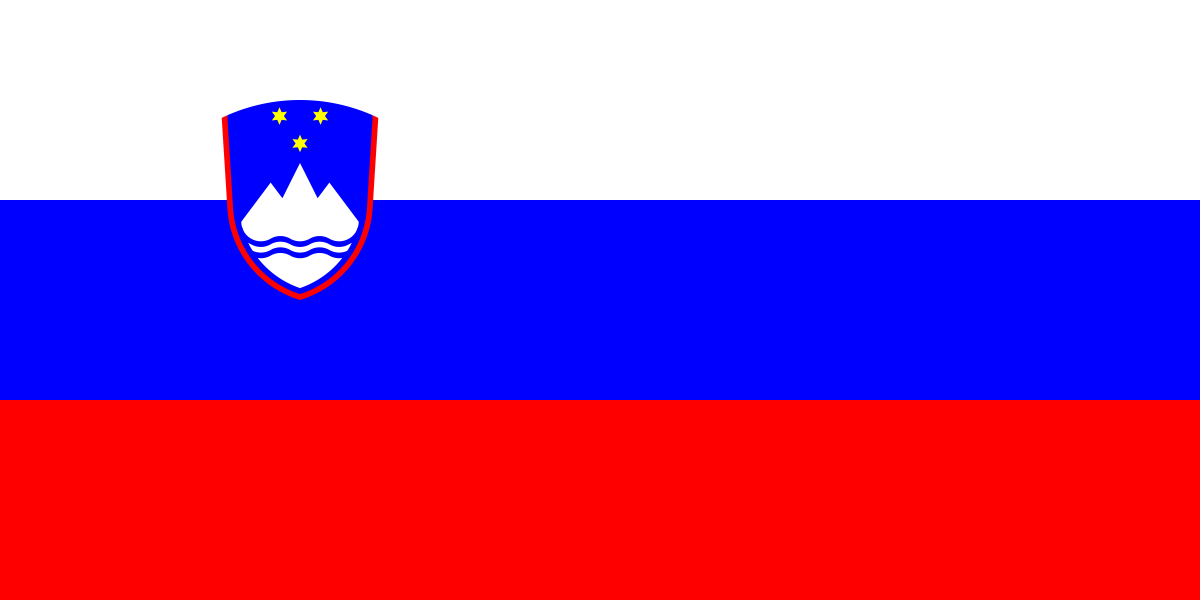
Population: 2,078,938
Total Land Area: 20,140 km2
Population/km2: 103.22
Official Visa Info: Ministry of the Interior / MFA