Bhutan
Bhutan is a small, land-locked Himalayan country which completed its transition from an absolute monarchy to a constitutional monarchy in 2008. The United States does not have diplomatic relations with Bhutan and there is no U.S. diplomatic presence there. Consular issues relating to Bhutan, including assistance to U.S. citizens, are handled by the U.S. Embassy in New Delhi. Read the Department of State’s Fact Sheet on Bhutan for additional information.
Transportation
TRAFFIC SAFETY AND ROAD CONDITIONS: While in Bhutan, you may encounter road conditions that differ significantly from those in the United States. The information below concerning Bhutan is provided for general reference only and may not be totally accurate in a particular location or circumstance.
General road conditions outside urban areas are poor, and emergency services generally are not available. Because of the mountainous terrain, roads tend to have steep drop-offs and blind curves. During heavy rains there is a risk of falling rocks and landslides which can block roads. However, because Bhutan requires tourists to arrange their trips through registered tour operators and travel in groups with experienced drivers, most tourists will not drive themselves.
Please refer to our Road Safety page, Tourism Council for Bhutan, and Bhutan’s Ministry of Economic Affairs for more information.
AVIATION SAFETY OVERSIGHT: As there is no direct commercial air service to the United States by carriers registered in Bhutan, the U.S. Federal Aviation Administration (FAA) has not assessed the government of Bhutan’s Civil Aviation Authority for compliance with International Civil Aviation Organization (ICAO) aviation safety standards. Further information may be found on the FAA’s safety assessment page.
Safety and Security
In July 2013, an encounter took place between suspected militants of the IK Songbijit faction of the National Democratic Front of Bodoland and the Royal Bhutan Army (RBA) near the Bhutan border with India.
In September and October 2012, two small bombs were detonated in southern border towns of Lhamoizingkha and Samtenling Gewog (Bhur) in Gelephu Dungkhag. In both incidents, an improvised explosive device (IED) was placed near a bridge and no one was injured. Pamphlets were reportedly discovered at the two locations which indicated the intention was to destroy the bridges. These two incidents occurred in areas near the border, far from tourist destinations, and resulted in little damage. The government has blamed various groups for these bombings. In the past, groups demanding the repatriation of Nepali-speaking Bhutanese refugees currently living in camps in Nepal have resorted to protests and small-scale violence.
To stay connected:
- Enroll in the Smart Traveler Enrollment Program so we can keep you up to date with important safety and security announcements.
- Follow the Bureau of Consular Affairs on Twitter and Facebook.
- Bookmark the Bureau of Consular Affairs website, which contains the current Travel Warnings and Travel Alerts as well as the Worldwide Caution.
- In the event of an emergency, contact us at 1-888-407-4747 toll-free within the United States and Canada, or via a regular toll line, 1-202-501-4444, from other countries.
- Take some time before traveling to consider your personal security and checking for useful tips for traveling safely abroad.
CRIME: There is relatively little crime in Bhutan. Petty crime, such as pick-pocketing and purse snatching, is occasionally reported, although violent crime is uncommon. Crimes including burglaries, theft, robbery, stolen vehicles, and assault related to skin color, ethnic origin and religion have increased in recent years. Police report an increase in the number of drug/alcohol abuse and marijuana-related arrests.
Reasonable precautions should be taken when visiting major towns and, in particular, when going out at night. The number of reported rape cases has increased every year for the last five years. In 2008, 23 rape cases were reported; the number increased to 51 in 2011 and 50 in the first ten months of 2012.
In December 2004, Bhutan became the first nation in the world to ban tobacco sales. Foreigners caught selling tobacco products to Bhutanese nationals can be charged with smuggling and the tobacco seized treated as contraband.
VICTIMS OF CRIME: If you or someone you know becomes the victim of a crime abroad, you should contact the local police and the nearest U.S. embassy or consulate. We can:
- Replace a stolen passport.
- Help you find appropriate medical care if you are the victim of violent crimes such as assault or rape.
- Put you in contact with the appropriate police authorities, and if you want us to, contact family members or friends.
- Help you understand the local criminal justice process and direct you to local attorneys, although it is important to remember that local authorities are responsible for investigating and prosecuting the crime.
- Because there is no U.S. Embassy presence in Bhutan, getting your lost or stolen U.S. passport replaced can be complicated and costly. If you are without a passport you will be required to seek permission to exit Bhutan from Bhutanese immigration authorities, and also obtain advance permission to enter the receiving country from that country’s immigration authorities. The receiving country’s immigration officials may or may not grant such permission. If permission is not granted, a consular officer from the U.S. Embassy or Consulate in the receiving country must meet you at the receiving country airport prior to immigration checks to bring you a new passport. The State Department charges fees for this call-out service, which can total several hundred dollars per hour, in addition to the passport fees.
The local equivalent to the “911” emergency line for Bhutan police in Bhutan is 113. The emergency number for ambulance service is 112.
Please see our information for victims of crime, including possible victim compensation programs in the United States.
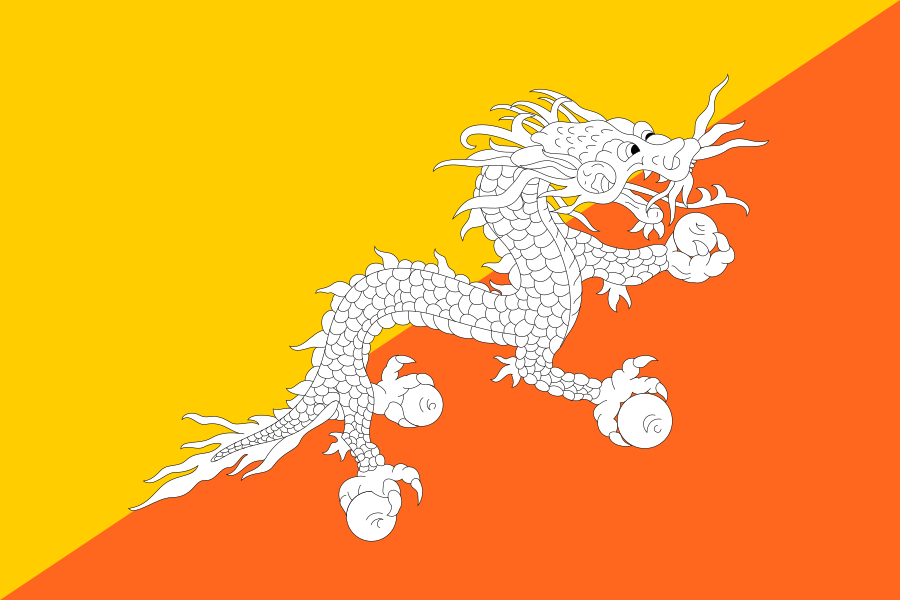
Population: 771,608
Total Land Area: 38,117 km2
Population/km2: 20.24
Official Visa Info: Department of Immigration, Ministry of Home Affairs