
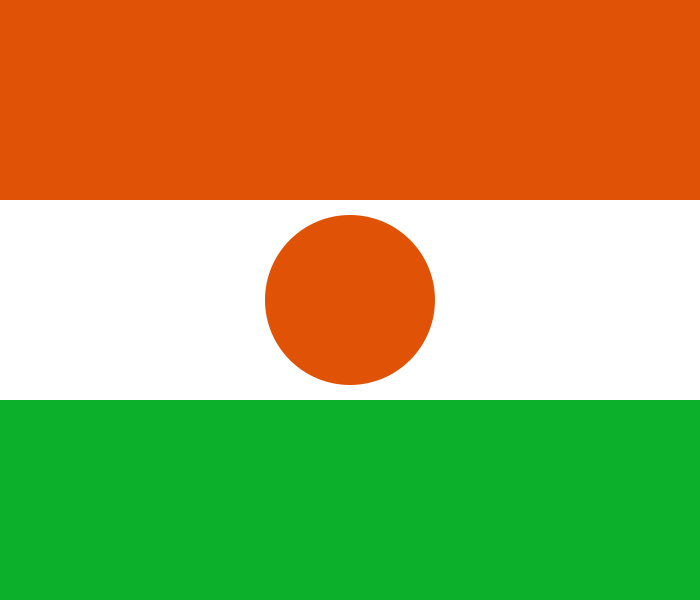
Niger
Niger is a developing, landlocked African nation whose northern expanse includes the Sahara Desert. Tourist facilities are minimal, particularly outside the capital city, Niamey, and the ancient caravan city of Agadez. Visitors should be aware of the ongoing terrorist and kidnapping for ransom threats in Niger as well as the presence of landmines in the region of Agadez. Conditions of insecurity persist in the northern and western portions of Niger, particularly along the porous border between Niger and Mali, as well as eastern parts of Niger along the border of Nigeria around Diffa. French is the official language; English is not widely used. Read the Department of State’s Fact Sheet on Niger for additional information on U.S.-Niger relations.
Transportation
TRAFFIC SAFETY AND ROAD CONDITIONS: While in Niger, you may encounter road conditions that differ significantly from those in the United States. The information below concerning Niger is provided for general reference only, and may not be totally accurate in a particular location or circumstance.
Road safety throughout Niger is a concern, and visitors are strongly urged to avoid driving at night outside of major cities. The public transportation system, urban and rural road conditions, and the availability of roadside assistance are all poor. The main causes of accidents are driver carelessness, excessive speed, poorly maintained vehicles, and poor to non-existent road surfaces. Other factors include the hazardous mix of bicycles, mopeds, unwary pedestrians, donkey carts, animals (cattle, goats, camels), and buses on roads that are generally unpaved and poorly lit. Overloaded tractor-trailers, “bush taxis,” and disabled vehicles are additional dangers on rural roads, where speeds are generally higher. Travel outside Niamey and other cities often requires four-wheel-drive vehicles, which creates an additional security risk, since these vehicles, especially Toyota Land Cruisers, are high-theft items. Driving at night is always hazardous and should be avoided. Banditry is a continuing problem in northern and eastern Niger, as well as along border areas. There have been occasional car-jackings and highway robberies throughout the country.
While taxis are available at a fixed fare in Niamey, most are in poor condition and do not meet basic U.S. road safety standards. Inter-city “bush-taxis” are available at negotiable fares, but these vehicles (minibuses, station wagons, and sedans) are generally older, unsafe models that are overloaded, poorly maintained, and driven by reckless operators seeking to save time and money. A national bus company (SNTV) operates coaches on inter-city routes and, since being reorganized in 2001, has provided reliable service and experienced no major accidents. Air Transport, Rimbo, and Garba Messagé are private bus companies operating in Niger. There is some concern regarding the youth of drivers and the speed with which the private buses travel the Nigerien roads. The U.S. Embassy strongly recommends against traveling outside of any city at night, as most roads and vehicles do not meet U.S. safety standards, and unlit vehicles, livestock, and pedestrians are common on roads.
Please refer to our Road Safety page for more information.
AVIATION SAFETY OVERSIGHT: As there is no direct commercial air service to the United States by carriers registered in Niger, the U.S. Federal Aviation Administration (FAA) has not assessed the government of Niger’s Civil Aviation Authority for compliance with International Civil Aviation Organization (ICAO) aviation safety standards. You can find further information on the FAA’s safety assessment page.
Safety and Security
Travelers to Niger are urged to exercise extreme caution due to the seriousness of the kidnapping threats against Westerners. In 2011, two French citizens were kidnapped by Islamist extremists from a restaurant in Niamey; they were killed by their captors during a rescue attempt while leaving the city. Extremists have kidnapped other Westerners near Niamey as well. U.S. citizens should reduce exposure to locations routinely frequented by Westerners such as restaurants and nightclubs. In an effort to mitigate terror and kidnapping threats, U.S. government employees are permitted to stay only in hotels having an armed Nigerien security presence. The border region with Mali continues to be of specific concern since the Malian government's temporary loss of control over its northern region in early 2012 and the ongoing international military intervention that began in early 2013. The border is porous, and terrorists have attacked several Western-owned facilities in Arlit and Agadez, northern Niger; there are frequent and ongoing reports of terrorists and affiliates crossing into and through Niger. Niger’s southeastern border with Nigeria is also poorly controlled, and Boko Haram has conducted several cross-border attacks into the Diffa and Lake Chad areas of Niger. The Government of Niger has increased its security forces in the border areas, but the situation remains unstable and travel there is not advised. Conditions of insecurity persist in the northwestern areas of Niger, as well as the southern border with Nigeria, and various extremist groups have utilized suicide bombings among other tactics in both areas.
Due to security threats, the U.S. Embassy continues to restrict the travel of U.S. government employees and official visitors in the areas north of Niamey and east of and including Maradi. U.S. government travel to these regions requires armed escort. Travel of U.S. government employees and official visitors outside of Niamey requires coordination with the Regional Security Office and, depending on the specific location, approval by the Ambassador.
Travelers should exercise caution in border areas between Niger and Nigeria in general, but especially when traveling east of Maradi. The Embassy strongly urges U.S. citizens to avoid travel to the Diffa region due to terrorist activity and kidnappings. Although the U.S. government places the highest priority on the safe recovery of kidnapped U.S. citizens, it is U.S. policy not to make concessions to kidnappers. Consequently, the type of assistance that the U.S. government can provide to kidnapped victims is limited.
As noted in the Department of State’s Worldwide Caution, both the United States and the European Union have designated the Islamist extremist group al-Qaida in the Lands of the Islamic Maghreb (AQIM) as a terrorist organization. In November 2013, both Boko Haram and al Murabitun were added to State Department’s list of terrorist organizations (In November 2013, Department of State announced the designation of Nigerian-based Boko Haram and Ansaru as foreign terrorist organizations.) AQIM has declared its intention to attack Western targets throughout the Sahel (including Mali, Mauritania, and Niger), and has claimed responsibility for several terrorist events in Niger, such as prison breaks, suicide attacks and ongoing armed conflict in northern Mali.
For travel in any remote area of the country, the Department of State urges you to use registered guides and to travel with a minimum of two vehicles equipped with global positioning systems (GPS) and satellite phones (if possible). Travelers are advised to avoid restricted military areas and to consult local police authorities regarding itinerary and security arrangements.
Avoid street demonstrations and maintain security awareness at all times. Large and small street demonstrations occur frequently in Niger, often near government buildings, university campuses, or other gathering places such as public parks. In January 2015, protests throughout Niger took place, ostensibly in response to the publication in Charlie Hebdo of a cartoon deemed offensive to Muslims and the Nigerien President’s participation in the big Paris rally of support to France after a terrorist attack on the office of Charlie Hebdo. These protests resulted in the burning of numerous churches, bars, and other buildings as well as 10 deaths.
Demonstrations often occur spontaneously. Large student demonstrations typically occur between December and May. You should be particularly vigilant at these times and avoid travel within the city if you hear reports of demonstrations. During previous student demonstrations, rock-throwing demonstrators have targeted non-governmental organization (NGO) and diplomatic vehicles bearing “IT” or “CD” plates. Many past demonstrations have involved rock throwing and tire burning, especially at key intersections in Niamey.
You should maintain security awareness at all times and avoid large public gatherings and street demonstrations. Remember, even demonstrations intended to be peaceful can turn confrontational without warning. While the Embassy endeavors to alert U.S. citizens to demonstrations when possible, due to the spontaneous nature of many street demonstrations it is not possible to inform U.S. citizens each time a demonstration occurs. Additionally, the government of Niger may block SMS, cellphone and social media access in an attempt to control protests, making communication difficult. Local radio and television stations are good sources for information. Security messages issued in connection with demonstrations and strikes will be posted on the Embassy or Consulate’s website separately under a section entitled, “Demonstration Notices.”
Note to Non-Governmental Organization Workers: Following the murder of a French tourist in the region of Agadez in 2005, the Government of Niger began requiring not only that NGOs be registered and officially recognized, but also that they inform the Nigerien government of each mission they plan to undertake in Niger. The U.S. Embassy strongly recommends that NGO workers take the following steps to avoid detention and/or expulsion by Nigerien authorities:
- Make sure that your NGO has registered and received official recognition from the Government of Niger. For details on how to do this, please visit the Office of Decentralized Cooperation and Non-Governmental Organizations (Direction De La Cooperation Decentralisée et Des Organisations Non Governementales) in the Ministry of Foreign Affairs and Cooperation (Ministère des Affaires Etrangères et de la Coopération).
- Carry with you a copy of the official recognition (Arrêté) of the right of your NGO to operate in Niger.
If your NGO is a national NGO, i.e., its headquarters is in Niger, verify that the group has informed the Ministry of Planning, Land Management, and Community Development (Ministère du Plan, de l’Aménagement du Territoire et du Développement Communautaire) at least two weeks prior to the start of a mission in Niger. This notice should be in writing and should include the purpose of the mission, the names of the individuals who will be working for the NGO on the mission, the dates of the mission, where the mission will take place, and the types and license plate numbers of the vehicles involved in the mission. The Ministry of the Interior should be copied on this notice of mission.
NGOs should ask for a receipt of each notification provided to the Ministry of Foreign Affairs and Cooperation, the Ministry of the Interior, or the Ministry of Planning, Land Management, and Community Development.
The U.S. Embassy strongly recommends that NGO workers present themselves at the regional governor’s office at the beginning their mission in a particular region of Niger, in addition to the requirements listed above. Again, NGO workers should ask for a receipt of their written presentation to the regional governor. It would also be wise to provide the regional governor with the same written notification that was provided to the ministries listed above.
Because of safety and security concerns, Peace Corps ended its operations in Niger in January 2011.
To stay connected:
- Enroll in the Smart Traveler Enrollment Program so we can keep you up to date with important safety and security announcements.
- Follow the Bureau of Consular Affairs on Twitter and Facebook.
- Bookmark the Bureau of Consular Affairs website, which contains the current Travel Warnings and Travel Alerts as well as the Worldwide Caution.
- Follow the U.S. Embassy in Niger on Twitter and visiting the Embassy’s website.
- In the event of an emergency, contact us at 1-888-407-4747 toll-free within the United States and Canada, or via a regular toll line, 1-202-501-4444, from other countries.
- Take some time before traveling to consider your personal security and checking for useful tips for traveling safely abroad.
CRIME: The crime rate, primarily for thefts, robberies, and residential break-ins, is high. Foreigners are vulnerable to bribery attempts and extortion by law enforcement authorities. Thefts and petty crimes are common day or night. Armed attacks can be committed at any time of day, generally by groups of two to four persons, with one assailant confronting the victim with a weapon while the others provide surveillance or a show of force. Tourists should not walk alone anywhere in Niger, but areas in Niamey around the Gaweye Hotel, the National Museum, on or near the Kennedy Bridge, and the Petit Marché area are of particular concern. These areas are especially prone to muggings. Walking at night is not recommended, as streetlights are scarce and criminals have the protection of darkness to commit their crimes. Recent criminal incidents in Niger have included carjacking, home invasions and muggings. Travelers should keep electronics out of sight, and always keep vehicle doors locked and windows rolled up when stopped at stoplights. Use caution and common sense at all times to avoid thieves and pickpockets.
As in many countries around the world, counterfeit and pirated goods are widely available. You will find these products being sold on the streets and in local shops and market places. Transactions involving such products may be illegal under local law. In addition, carrying them back to the United States may result in forfeitures and/or fines.
VICTIMS OF CRIME: If you or someone you know becomes the victim of a crime abroad, contact the local police and the nearest U.S. embassy or consulate. We can:
- Replace a stolen passport.
- Help you find appropriate medical care if you are the victim of a violent crime such as assault or rape.
- Put you in contact with the appropriate police authorities and, if you want us to, we can contact family members or friends.
- Help you understand the local criminal justice process and direct you to local attorneys, although it is important to remember that local authorities are responsible for investigating and prosecuting the crime.
There is no local equivalent to a “911” emergency line in Niger. U.S. citizens can try calling local police by dialing “17” on Nigerien phones or +227-20-72-25-53, but calls to these numbers often go unanswered, especially outside of normal working hours. The Embassy highly recommends hiring guards for your residence if you are planning to live in Niger.
Please see our information on victims of crime, including possible victim compensation programs in the United States.
Population: 24,206,644
Total Land Area: 1,266,700 km2
Population/km2: 19.11