
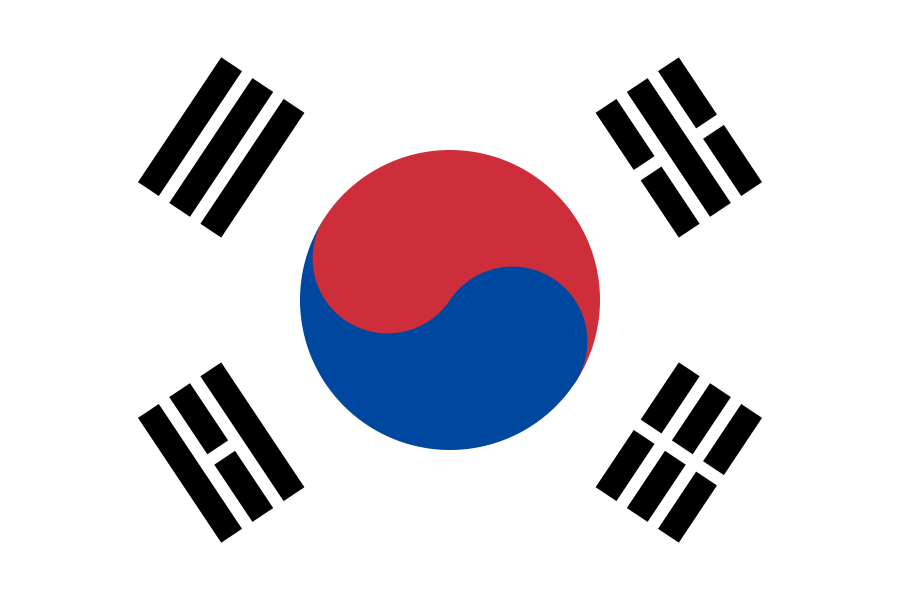
South Korea
The Republic of Korea (South Korea or ROK) is a highly developed, stable, democratic republic with powers shared between the president and the legislature. South Korea is a modern economy where tourist facilities are widely available. English is rarely spoken outside the main tourist and business centers.
You can find information about tourism in the Republic of Korea through the Korea Tourism Organization (KTO) website (in English) or by calling 1-800-868-7567 from the United States and Canada. The KTO operates a free, 24-hour Korea Travel Hotline available by dialing 1330 within Korea or +82-2-1330 from outside Korea. The 1330 Korea Travel Hotline has English-language speakers who can provide tourism information, assist with travel reservations, address safety and medical needs, handle tourist complaints, and provide English translation services. The KTO operates several Tourist Information Centers throughout Korea that can provide in-person assistance. In Seoul, the Metropolitan Government operates the Seoul Global Center (SGC) to assist foreigners with a variety of services. You can reach the SGC English language helpline by calling (02) 1688-0120 or 02-2075-4180. The SGC is open from 9:00 a.m.–6:00 p.m. Monday through Friday and is located at 38 Jong-ro, Jongno-gu, Seoul, near Jonggak metro station, Exit 1.
Read the Department of State’s Fact Sheet on the Republic of Korea for additional information on U.S.-Republic of Korea relations.
Transportation
TRAFFIC SAFETY AND ROAD CONDITIONS: While in the Republic of Korea, you may encounter road conditions that differ significantly from those in the United States. The ROK's roads are well-paved, traffic lights are functional, and most drivers comply with basic traffic laws. The Republic of Korea, however, has a significantly higher traffic fatality rate than does the United States. Causes of accidents include excessive speed, frequent lane changes without signaling, running red lights, aggressive bus drivers, and weaving motorcyclists. You should be aware that motorcyclists sometimes drive on the sidewalks, and drivers of all types of vehicles do not always yield to pedestrians in marked crosswalks. It is safer to use pedestrian underpasses and overpasses where available.
Some traffic laws in the Republic of Korea differ from traffic laws in the United States. Left-hand turns are generally prohibited except where a green arrow indicates otherwise. You may turn right on a red light after coming to a complete stop. Seat belts are mandatory. Children riding in the front seat of vehicles must wear a seat belt or use an appropriate child car seat. Passengers on motorcycles must wear helmets. If you are a short-term visitor and wish to drive in the Republic of Korea, you must have an international driving permit issued in the United States by the American Automobile Association (AAA) or the American Automobile Touring Alliance (AATA). Otherwise, you must have an ROK driver's license.
In all accidents involving an automobile and a pedestrian or motorcycle, the driver of the automobile, regardless of citizenship, is presumed to be at fault. Police investigations of traffic accidents usually involve long waits at police stations. Police may take the passport of a foreigner involved in a traffic accident if there is any personal injury or a dispute about the cause of the accident. Criminal charges and heavy penalties are common in accidents involving injury, even if negligence is not proven. If you are arrested due to an accident involving serious injury or death, you may be detained until the conclusion of the police investigation and legal process. When driving in the Republic of Korea, you may wish to carry a disposable camera to document any traffic accidents, even minor ones.
You are considered legally intoxicated in the Republic of Korea when you have a blood-alcohol level of 0.05% or higher. The ROK police actively enforce drunken driving laws and set up DUI checkpoints that are difficult to avoid. All drivers are required to submit to a breathalyzer test. Refusal to take the breath-test can result in cancellation of your license. Driving while intoxicated can result in significant fines and license suspension or even cancellation.
For specific information about ROK driver's permits, vehicle inspection, road tax, and mandatory insurance, you can refer to our Road Safety page. Also, you may wish to visit the website of the Korea Tourism Organization (KTO) or call the office at 1-800-868-7567 and contact the national authority responsible for road safety.
AVIATION SAFETY OVERSIGHT: The U.S. Federal Aviation Administration (FAA) has assessed the Government of the Republic of Korea's Civil Aviation Authority as being in compliance with International Civil Aviation Organization (ICAO) aviation safety standards for oversight of the ROK's air carrier operations. Further information may be found on the FAA's Safety Assessment Page.
Safety and Security
Public Demonstrations:The Republic of Korea (ROK) is a modern democracy with active public political participation, and political demonstrations are common. Even demonstrations intended to be peaceful can turn confrontational. Avoid demonstrations whenever possible, and exercise caution if you find yourself caught up in one.
North Korea (DPRK): An armistice agreement, monitored by the United Nations, has maintained general peace on the Korean peninsula since 1953. Tensions have occasionally flared up because of provocative acts by the Democratic People's Republic of Korea, including ballistic missile tests, nuclear tests, and limited armed incursions into ROK-held territory. Some of these provocations have escalated into geographically limited skirmishes taking place primarily around isolated islands off the northwest coast of the ROK.
The Republic of Korea maintains a high level of readiness to respond to any military threats from the DPRK. Military training exercises are routinely conducted throughout the Republic of Korea during the year and include civil defense drills, which are normally held four times a year. The DPRK often issues strongly-worded and threatening messages in connection with these exercises. Please see our Fact Sheet on North Korea for more information.
Emergency Preparedness: The U.S. Embassy in Seoul maintains a web page with local information about emergency preparedness. Stay informed by bookmarking Disaster Preparedness page and following local current events during your time in Korea.
During the monsoon season from June - August and the typhoon season from May - November, heavy rains and flooding sometimes occur in the Republic of Korea. See general information about natural disaster preparedness at the U.S. Federal Emergency Management Agency (FEMA) website.
If the Embassy becomes aware of any specific and credible threat to your safety and security, we will inform through our website, through social media, or by email if you register your contact details through the Smart Traveler Enrollment Program (STEP).
Follow us on U.S. Embassy Seoul's "Americans in Korea" Facebook page.
To stay connected:
- Enroll in the Smart Traveler Enrollment Program so we can keep you up to date with important safety and security announcements.
- Follow the Bureau of Consular Affairs on Twitter and Facebook.
- Bookmark the Bureau of Consular Affairs website, which contains the current Travel Warnings and Travel Alerts as well as the Worldwide Caution.
- Follow the U.S. Embassy in ROK on Twitter Twitter US Embassy Seoul and by visiting the Embassy’s website
- In the event of an emergency, contact us at 1-888-407-4747 toll-free within the United States and Canada, or via a regular toll line, 1-202-501-4444, from other countries.
- Take some time before traveling to consider your personal security and checking for useful tips for traveling safely abroad.
CRIME: For most visitors, the Republic of Korea remains a very safe country. When you travel, stay alert to any unusual activity around your home, hotel, or business, and report any significant incidents to the local police. For emergency assistance in the Republic of Korea, dial 112.
Compared to the United States, the crime rate in the Republic of Korea is low. The most common crimes (pick-pocketing, purse snatching, and thefts from hotel rooms or homes) occur more frequently in major metropolitan areas, tourist areas, and crowded markets.
In 2014, 18 U.S. citizens reported to the U.S. Embassy in Seoul that they were sexually assaulted. Most were young women assaulted by acquaintances after drinking alcohol socially. The ROK has specialized police and hospital units to assist victims. Women traveling alone should review our travel tips for Women Travelers.
Reduce the likelihood of becoming a crime victim by taking the same common-sense security precautions you would take in the United States. Use caution in crowded entertainment, nightlife, and shopping districts throughout Korea. Exercise caution when traveling alone at night; consider traveling in groups. Only use legitimate taxis or public transportation.
Don't buy counterfeit and pirated goods, even if they are widely available. It is against Korean law to purchase these goods and against U.S. law to bring them into the United States. The Computer Crime and Intellectual Property Division in the U.S. Department of Justice has more information on this serious problem.
VICTIMS OF CRIME: If you or someone you know becomes the victim of a crime abroad, you should contact the local police and the nearest U.S. embassy or consulate. We can:
- Replace a stolen passport.
- Help you find appropriate medical care if you are the victim of violent crimes such as assault or rape.
- Put you in contact with the appropriate police authorities, and if you want us to, contact family members or friends.
- Provide you with the on-line help for American victims of crime in South Korea;
- Help you understand the local criminal justice process and direct you to local attorneys, although it is important to remember that local authorities are responsible for investigating and prosecuting the crime.
The local equivalent to the "911" emergency line in the Republic of Korea is "112" or 02-112 from a cell phone.
Please see our information for victims of crime, including possible victim compensation programs in the United States.
Population: 51,269,185
Total Land Area: 97,230 km2
Population/km2: 527.30