
Montenegro
Montenegro is a small country in the Western Balkans that has experienced significant political and economic changes over the past two decades. It is a parliamentary democracy aspiring to Euro-Atlantic integration via membership in the European Union (EU) and NATO. There are many tourist facilities in Montenegro, but they vary in quality and some may not be up to Western standards. Hotel accommodations are plentiful on the coast and in Podgorica, the capital, but limited in smaller towns, especially in the North. English usage is limited except for Montenegro’s main tourist centers and the capital. Read the Department of State’s Fact Sheet on Montenegro for additional information on U.S.-Montenegro relations.
Transportation
TRAFFIC SAFETY AND ROAD CONDITIONS: While in Montenegro, you may encounter road conditions and driving styles that differ significantly from those in the United States. Roads in Montenegro are often poorly maintained, especially in rural areas. Dangerous areas for road travel include a road through the Moraca Canyon, north of Podgorica. This twisting, two-lane road is especially overcrowded in the summer, and is the site of frequent rockslides. In the winter, the Moraca Canyon and northern parts of Montenegro are covered with snow, which may slow traffic and make the road hazardous. Roads leading to Montenegro’s coastal areas are in better condition, but are overcrowded during summer season. Drivers should exercise extreme caution, as it is common for Montenegrin drivers to attempt to pass on winding roads and hills. Local drivers can be reckless and aggressive, and accidents are frequent.
The use of seat belts is mandatory for all passengers and cell-phone usage while driving is prohibited. Traffic law requires that vehicle lights must be switched on at all times while driving. Right turns on red lights are strictly forbidden unless a distinct green arrow is seen. At unmarked intersections, the right of way is always given to the vehicle entering from the right. Each vehicle must have a reflective fluorescent vest to be used in the event of an emergency road stop, as well as a European car accident report form. Children under 5 years old must be transported in a safety seat that is attached to a vehicle safety belt. Vehicles must have winter tires and carry snow chains between November 15 and March 30.
Additionally, pedestrians crossing streets in designated crosswalks have the right of way. Drivers must stop to allow these pedestrians to cross, although you will find that many pedestrians cross where there is no crosswalk.
Police in Montenegro will test a driver’s blood alcohol level on site and arrest any driver if the concentration of alcohol in the blood is greater than 0.03 percent, a very strict standard, significantly lower than the U.S. limit of 0.08 percent.
Metered taxi service is safe and reasonably priced, although foreigners are sometimes charged higher rates. Although there are some taxi stands in each of the cities, taxis generally do not pick up passengers on the street and must be ordered by phone or SMS. We recommend negotiating a price prior to traveling by taxi between cities, although some taxi companies have a price list of most intercity destinations on a control board.
Travelers in the region may wish to consider the safety of public transportation, including trains, buses, and ferries, in view of aging and poorly maintained equipment.
Roadside assistance is available by dialing 19807, 382 (0)20 234 467 or 382 (0)20 234 999. Other emergency numbers are police: 122; fire department: 123; and ambulance: 124.
Please refer to our Road Safety page for more information. Also, we suggest that you visit the website of Montenegro’s National Tourism Organization and the Auto-moto Association of Montenegro, the national authority responsible for road safety.
AVIATION SAFETY OVERSIGHT: As there is no direct commercial air service to the United States by carriers registered in Montenegro, the U.S. Federal Aviation Administration (FAA) has not assessed the government of Montenegro’s Civil Aviation Authority for compliance with International Civil Aviation Organization (ICAO) aviation safety standards. Further information may be found on the FAA’s safety assessment page.
Safety and Security
Demonstrations related to political activities, labor conditions, or sporting events are usually peaceful, though some have exhibited low levels of violence. Non-Montenegrins are rarely the target of violence, but there is always the danger of being in the wrong place at the wrong time. While most Montenegrins are open and hospitable to foreigners, visitors might encounter anti-foreign sentiment.
Montenegrin nightclubs are popular with foreign tourists; patrons should be aware that these establishments can be crowded and may not comply with Western standards for occupancy control and fire safety.
To stay connected:
- Enroll in the Smart Traveler Enrollment Program so we can keep you up to date with important safety and security announcements.
- Follow the Bureau of Consular Affairs on Twitter and Facebook.
- Bookmark the Bureau of Consular Affairs website, which contains the current Travel Warnings and Travel Alerts as well as the Worldwide Caution.
- Follow the U.S. Embassy in Montenegro on Twitter and visiting the Embassy’s website
- In the event of an emergency, contact us at 1-888-407-4747 toll-free within the United States and Canada, or via a regular toll line, 1-202-501-4444, from other countries.
- Take some time before traveling to consider your personal security and checking for useful tips for traveling safely abroad.
CRIME: Crime levels in Podgorica are generally low and comparable to those found in other small European cities. Residential break-ins present the greatest security concern for U.S. citizens in Montenegro; however, the frequency of such crimes is still relatively low. Violent crime is infrequent. Police have a limited ability to provide services in English.
Cases of credit card fraud and theft at ATMs are minimal in the winter months, but there is a significant increase in theft at ATMs during the tourist season between May and September. Visitors should ensure that they protect their PINs at all times when using ATMs, and monitor card activity.
Don’t buy counterfeit or pirated goods, even if they are widely available. Not only are the bootlegs illegal to bring back into the United States, if you purchase them you may also be breaking local law.
VICTIMS OF CRIME: If you or someone you know becomes the victim of a crime abroad, you should contact the local police and the nearest U.S. embassy or consulate. We can:
- Replace a stolen passport;
- Help you find appropriate medical care if you are the victim of violent crimes such as assault or rape;
- Put you in contact with the appropriate police authorities, and if you want us to, we can contact family members or friends; and
- Help you understand the local criminal justice process and direct you to local attorneys, although it is important to remember that local authorities are responsible for investigating and prosecuting the crime.
The local equivalents to the “911” emergency line in Montenegro are 122 for police, 123 for the fire department, and 124 for an ambulance.
Please see our information on victims of crime, including possible victim compensation programs in the United States.
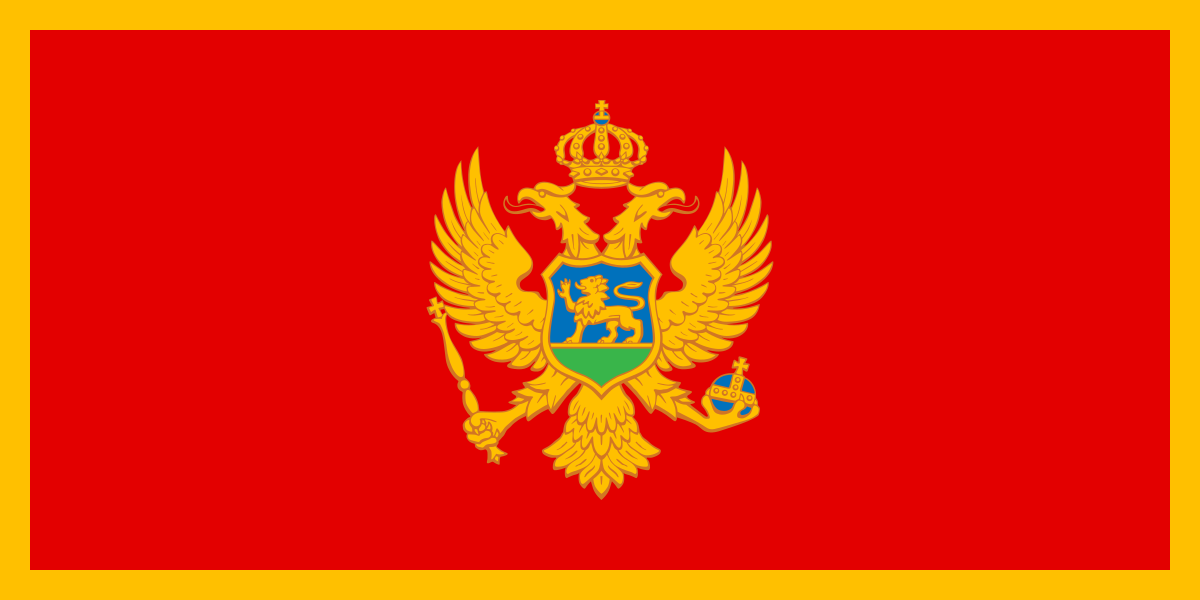
Population: 628,066
Total Land Area: 13,450 km2
Population/km2: 46.70
Official Visa Info: Ministry of Interior / MFA