
New Zealand
New Zealand is a stable parliamentary democracy, which recognizes the British monarch as head of state. It has a modern economy with many tourist conveniences and efficient local services. Read the Department of State Fact Sheet on New Zealand for additional information.
Transportation
TRAFFIC SAFETY AND ROAD CONDITIONS: While in New Zealand, you may encounter road conditions that differ significantly from those in the United States. All traffic travels on the left in New Zealand, and you should exercise extra caution if you are accustomed to driving on the right. Driving on the wrong side of the road is a leading cause of serious injury and death for U.S. tourists. Proceed carefully through intersections. Traffic circles are common throughout New Zealand. When approaching a traffic circle, always yield to traffic coming from the right--noting that traffic already in the circle has the right-of-way--and merge to the left into the circle. Right turns on a red traffic signal are not permitted.
Renting a car or a camper is a popular way to enjoy New Zealand's natural beauty, but if you are unfamiliar with local conditions, you should be extremely careful. New Zealand has only 100 miles of multi-lane divided motorways. Most intercity travel is on narrow, two-lane roads. While these roads are in good condition, New Zealand's rugged terrain means motorists often encounter sharper curves and steeper grades than those found on the U.S. Interstate Highway System. Make sure to follow the posted speed limit signs. The speed limits are much lower than they are in the United States. You should also use caution to avoid animals when driving in rural areas. Please note that there is very limited cell phone coverage on large portions of scenic highway in the South Island, which is remote and has little traffic.
Roadside sobriety checks by police are common and driving under the influence of drugs or alcohol can lead to immediate jail time in New Zealand. Please be aware that the blood alcohol limit in New Zealand is lower than that in most U.S. states.Furthermore, New Zealand prohibits driving while texting as well as driving while using a cell phone.
Make sure to look carefully in all directions before crossing a street or roadway, and always use crosswalks. Pedestrians do not have the right of way except in crosswalks. New Zealand law requires that cars stop for pedestrians who are in a crosswalk and that cars stop at least two meters (approximately 6 feet) from a crosswalk that is in use.
Please refer to our Road Safety page for more information. Also, we suggest that you visit the website of the country’s New Zealand national tourist office and the Land Transport Safety Authority website.
AVIATION SAFETY OVERSIGHT: The U.S. Federal Aviation Administration (FAA) has assessed the government of New Zealand’s Civil Aviation Authority as being in compliance with International Civil Aviation Organization (ICAO) aviation safety standards for oversight of New Zealand's air carrier operations. Further information may be found on the FAA’s safety assessment page.
Safety and Security
While in New Zealand you should review your personal security practices, be alert to any unusual activity, and report any significant incidents to local police.
To stay connected:
- Enroll in the Smart Traveler Enrollment Program so we can keep you up to date with important safety and security announcements.
- Follow the Bureau of Consular Affairs on Twitter and Facebook.
- Bookmark the Bureau of Consular Affairs website, which contains the current Travel Warnings and Travel Alerts as well as the Worldwide Caution.
- Follow the U.S. Embassy in Wellington on Twitter and visiting the Embassy’s website.
- In the event of an emergency, contact us at 1-888-407-4747 toll-free within the United States and Canada, or via a regular toll line, 1-202-501-4444, from other countries.
- Take some time before traveling to consider your personal security and check for useful tips for traveling safely abroad.
CRIME: The crime rate in New Zealand is relatively low, but theft from cars, recreational vehicles, and hostels is common, especially in areas frequented by tourists. Do not leave passports or other valuable items in unattended vehicles. Violent crime against tourists is rare; however, if you are traveling alone, you should be especially vigilant and avoid isolated areas.
VICTIMS OF CRIME: If you or someone you know becomes the victim of a crime abroad, you should contact the local police and the nearest U.S. embassy or consulate. We can:
- Replace a stolen passport.
- Help you find appropriate medical care if you are the victim of violent crimes such as assault or rape.
- Put you in contact with the appropriate police authorities, and if you want us to, contact family members or friends.
- Help you understand the local criminal justice process and direct you to local attorneys, although it is important to remember that local authorities are responsible for investigating and prosecuting the crime.
In New Zealand, a private organization called Victim Support works both independently and with the New Zealand Police to assist victims of crime. Victim Support is available 24 hours a day by calling 0800-842-846 (0800-Victim) or emailing help@victimsupport.org.nz.
Please see our “Victim of Crime” webpage and also our “Help for U.S. Citizen Victims of Crime Overseas,” including possible victim compensation programs in the United States.
The local equivalent to the “911” emergency line in New Zealand is 111.
Please see our information for victims of crime, including possible victim compensation programs in the United States.
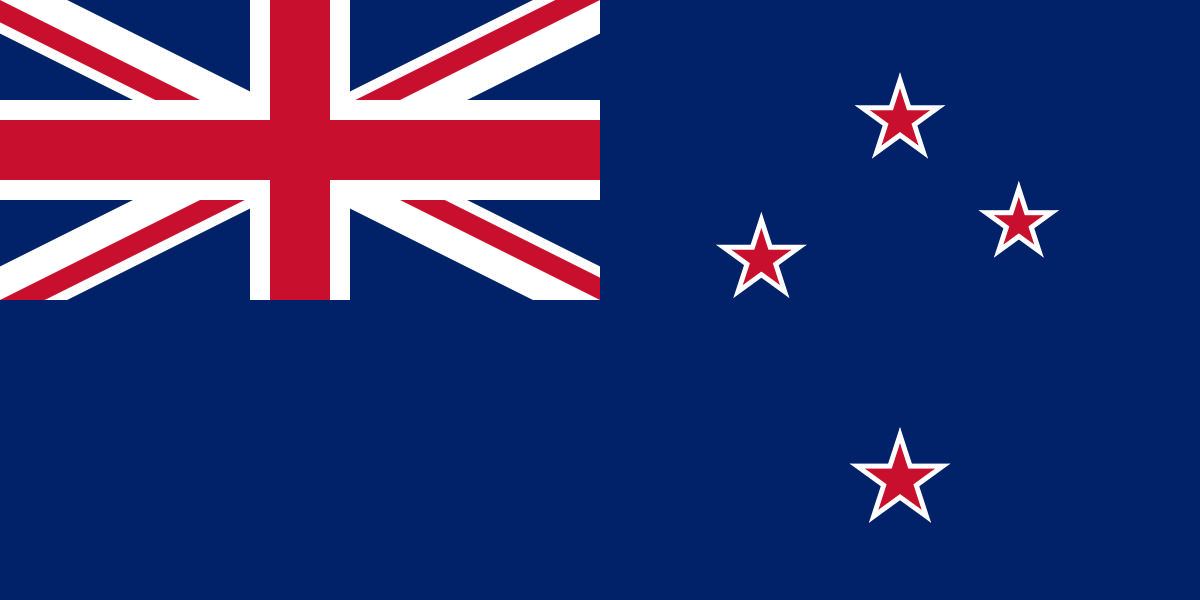
Population: 4,822,233
Total Land Area: 263,310 km2
Population/km2: 18.31
Official Visa Info: Immigration New Zealand (INZ)