
Egypt
Egypt is a republic with a developing economy. It has extensive facilities for tourists. Read the Department of State’s Fact Sheet on Egypt for additional information on U.S.-Egypt relations.
Transportation
Traffic Laws: Although the enforcement of traffic laws generally is lax, foreigners are subject to extra scrutiny and driving under the influence of alcohol or drugs could result in arrest or detainment.
Road Conditions and Safety Driving in Egypt is extremely hazardous. Egypt has one of the highest occurrences of road fatalities per mile driven in the world. Intercity roads are generally in good condition, but unmarked surfaces, stray animals, sandstorms and fog, and disabled vehicles without lights or reflectors are among the many hazards present on highways, especially after dark.
Driving Cairo’s busy maze of streets can be an extreme challenge to foreigners, especially those used to a culture of structured rules and regulations. Even residents of Cairo must use extreme care and situational awareness to navigate the capital’s hectic streets. Impatient drivers typically ignore traffic rules, which police seldom enforce. Most traffic lights in Cairo do not function; instead, police officers, using finger and hand movements to direct traffic, normally staff the main intersections.
Vehicle accidents remain a significant safety concern.
Visitors thinking about driving in Cairo should carefully consider other options, such as a taxi or hired driver. If visitors decide to drive, it is essential that they take the utmost precautions and drive defensively. Drivers should be prepared for: unlit vehicles at night; few if any road markings; vehicles traveling at high rates of speed; vehicles traveling the wrong way on one-way streets, divided highways, and connecting ramps; pedestrians dodging in and out of traffic; and a variety of domesticated animals wandering the roadways. Motorists should be especially cautious during the rare winter rains, which can cause extremely slippery road surfaces and localized flooding; Egyptian drivers are not familiar with driving in wet conditions, making such periods particularly hazardous.
Pedestrians should also exercise extreme caution especially in high-volume/high-velocity streets like Cairo’s Corniche, which follows the eastern bank of the Nile River.
Public Transportation: Public buses and microbuses are not safe, and U.S. Embassy personnel are prohibited from using them. Embassy personnel are also prohibited from traveling on Cairo’s metro system. Trains are a particularly unsafe means of transportation, with regular accidents that sometimes involve mass casualties and Embassy personnel are prohibited from traveling by train.
Embassy personnel are prohibited from traveling outside the greater Cairo area by motor vehicle with a few exceptions and are generally required to travel between cities via commercial air. Furthermore, U.S. Embassy policy prohibits personal travel via privately-owned vehicle to any part of the Sinai Peninsula or the Western Desert.
Carjackings are reported with some frequency. While generally occurring during late night or early morning hours, carjackings can also occur in the middle of the day. Carjackings have been reported by Egyptians, foreign private sector personnel, and the diplomatic community. In most cases, perpetrators target newer sport utility vehicles, sometimes with the intent to extract a ransom from the owner. Other instances suggest that perpetrators target transport vehicles in order to steal cargo. Recent incidents suggest that the best response to ensure one’s personal safety is to surrender the vehicle immediately. Reports have not indicated that any violence or harm has come to those victims who posed no resistance.
Please refer to our Road Safety page for more information.
AVIATION SAFETY OVERSIGHT: The U.S. Federal Aviation Administration (FAA) has assessed the government of Egypt’s Civil Aviation Authority as being in compliance with International Civil Aviation Organization (ICAO) aviation safety standards for oversight of Egypt’s air carrier operations. Further information may be found on the FAA’s safety assessment page.
Safety and Security
Political Violence, Demonstrations, and Public Disorder: Political protests can occur without warning anywhere in Egypt. Egypt’s demonstrations law prohibits gatherings of more than ten persons without advance notification to the Ministry of Interior. Demonstrations have led to violent clashes between police and protesters, resulting in deaths, injuries, and property damage. Peaceful demonstrators and bystanders may be subject to questioning, detention, arrest, and conviction for participating in or being in proximity to unauthorized demonstrations. It is illegal to photograph police stations, military barracks, and certain other sensitive public buildings, and enforcement of this law is particularly strict at demonstrations.
U.S. citizens are urged to remain alert to local security developments and to be vigilant regarding their personal security by knowing the locations of police and fire stations, hospitals, and other places to relocate to feel secure. U.S. citizens should also carry identification and a cell phone or other means of communication that works in Egypt, and it is advisable to pre-program the U.S. Embassy’s number and email into the device.
Terrorism: There are a number of terrorist organizations known to be operating in Egypt and terrorist attacks can occur anywhere in the country. Terrorists have used explosive devices, car-bombs and drive-by shootings to target police, security and government officials, and government and diplomatic buildings, resulting in deaths, injuries, and damage to infrastructure and persons, including civilians. In November 2014, a leading Egyptian terrorist organization pledged allegiance to the Islamic State in Iraq and the Levant, increasing the risk that terrorist attacks could target U.S. and Western interests, including civilians, and the country’s tourist industry. In June, 2015, terrorists attempted to attack the Karnak temple in Luxor, but were successfully engaged by the police before entering the temple complex. Also in June, Egypt’s Prosecutor General was killed in Cairo when a bomb placed by the side of a road exploded as his motorcade was passing. In July, a car bomb severely damaged the Italian consulate in Cairo. In August, an expatriate oil worker was murdered by jihadist elements in the western desert, just outside metropolitan Cairo.
Responsibility for terrorist attacks has been attributed primarily, but not exclusively, to jihadists operating out of the Sinai Peninsula, which remains a particularly restive area. Terrorists are also active in Egypt’s western desert - the large, mostly isolated area west of greater Cairo and the Nile Valley - including in the vicinity of various oasis towns. There are active military operations against terrorist elements in this region. In September 2015, foreign tourists traveling in the western desert were mistakenly attacked by Egyptian military forces pursuing terrorists; nine tourists were killed and several others wounded. There are also active military operations being conducted in Egypt’s border areas with Gaza and Libya.
The Egyptian government maintains a heavy security presence at major tourist sites, especially the resort town of Sharm El-Sheikh and the many temples and archaeological sites located in and around Cairo, Luxor, Aswan and Abu Simbal.
Alexandria: The Consulate General in Alexandria is open for limited operations and does not provide consular services at this time.
Restricted Areas:
- The U.S. Embassy restricts its employees and their family members from traveling outside of Cairo without prior approval and advises all U.S. citizens to carefully consider the security implications of travel outside of the greater Cairo metropolitan area.
- U.S. Embassy personnel in Egypt are currently prohibited from traveling anywhere in the Sinai Peninsula (including Sharm El Sheikh, pending the outcome of the investigation into the October 31 crash of a Russian passenger jet) or in the western desert region.
- Egypt’s borders are under military control; movement of non-military persons and vehicles is substantially restricted, and in some cases prohibited, within these areas. U.S. citizens should not travel in these border zones.
- Travelers must obtain permission and a travel route from the Egyptian Military Intelligence and the Tourist Police Headquarters via a local or overseas travel agency to access Egypt's frontiers, including the borders with Libya, Sudan, Israel, and parts of the Sinai off paved roads.
- The highest concentrations of World War II-era unexploded landmines are located in the World War II battlefields along the Mediterranean coast west of Alexandria, the Eastern Desert between Cairo and the Suez Canal, and much of the Sinai Peninsula. Travelers are urged to be especially prudent in these areas.
Crime:
- Crime levels in Cairo are moderate.
- The vast majority of criminal acts against foreigners are crimes of opportunity, such as purse snatching and pickpocketing.
- Harassment of women, including foreigners, remains a serious problem. Incidents of harassment range from lewd comments and gestures to indecent exposures and inappropriate physical contact.
- Harassment can occur anywhere, but particularly serious incidents have occurred at demonstrations.
- Tourists should be alert to being overcharged for various services and for being victimized in scams common to tourist destinations world-wide.
- Tourists should expect to encounter aggressive vendors at Egypt’s many temples and archaeological sites. Some will offer “free” gifts to tourists that once accepted lead to demands for money. Most sites have specially designated tourist police who can assist in uncomfortable situations.
See the Department of State and the FBI pages for information on scams.
Victims of Crime:
Report crimes to the local police at 122 and contact the U.S. Embassy at +(20) 2-2797-3300.
Remember that local authorities are responsible for investigating and prosecuting the crime.
Failure to report crimes before leaving Egypt will make it impossible to seek prosecution at a later date. U.S. citizen tourists can forward their complaints for investigation by the Tourist Police Headquarters. For crimes involving children, you may call the child emergency help line at 16000. For issues involving violence against women and/or general complaints, dial 0800 888 3888.
See our webpage on help for U.S. victims of crime overseas.
If you are a victim of a crime, we can:
- help you find appropriate medical care
- assist you in reporting a crime to the police
- contact relatives or friends with your written consent
- explain the local criminal justice process in general terms
- provide a list of local attorneys
- provide our information on victim’s compensation programs in the U.S.
- provide an emergency loan for repatriation to the United States and/or limited medical
- support in cases of destitution
- help you find accommodation and arrange flights home
- replace a stolen or lost passport
Domestic Violence:
- U.S. citizen victims of domestic violence may contact the Embassy for assistance.
For further information:
- Enroll in the Smart Traveler Enrollment Program (STEP) to receive security messages and make it easier to locate you in an emergency.
- Call us in Washington at 1-888-407-4747 toll-free in the United States and Canada or 1-202-501-4444 from other countries from 8:00 a.m. to 8:00 p.m. Eastern Standard Time, Monday through Friday (except U.S. federal holidays).
- See the State Department's travel website for Worldwide Caution, Travel Warnings, and Travel Alerts.
- Follow us on Twitter and Facebook.
- See traveling safely abroad for useful travel tips.
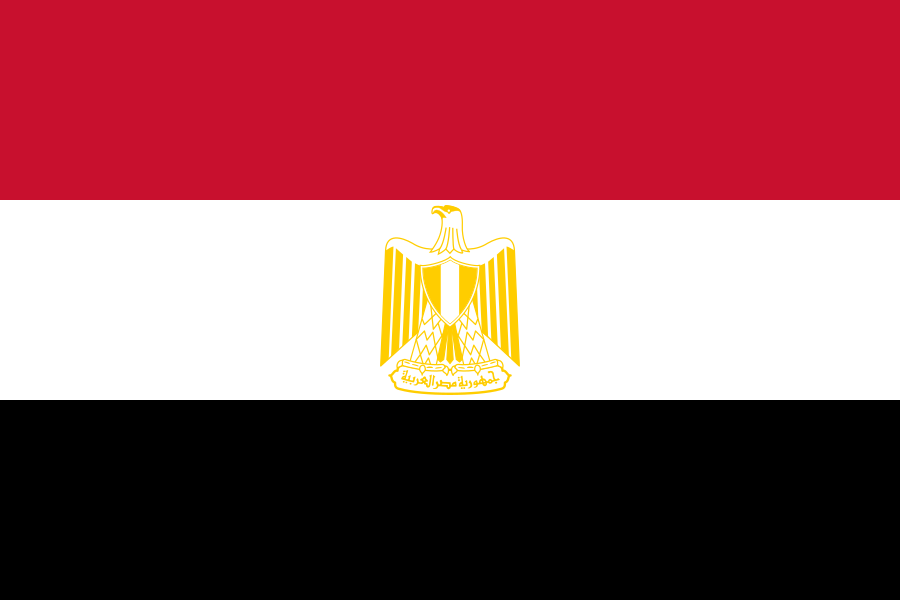
Population: 102,334,404
Total Land Area: 995,450 km2
Population/km2: 102.80
Official Visa Info: Ministry of Interior / official e-Visa portal