
Namibia
Namibia is a southern African country with a moderately developed economy. Facilities for tourism are good and generally improving in quality. The capital is Windhoek. Read the Department of State’s Fact Sheet on Namibia for additional information on U.S. – Namibia relations.
Transportation
TRAFFIC SAFETY AND ROAD CONDITIONS: While in Namibia, you may encounter road conditions that differ significantly from those in the United States. The information below concerning Namibia is provided for general reference only, and may not be completely accurate in a particular location or circumstance.
In Namibia, driving is done on the left-hand side of the road. Many of Namibia's rural roads are gravel. Although these roads are generally well maintained, controlling a vehicle on gravel is significantly more difficult than on pavement. Drivers should not drive in excess of 80km per hour (45 mph) on gravel roads, should reduce speed significantly for curves or turns, and should heed all warning signs. Hitting a sand patch or driving around a curve too fast can easily result in a rollover or spinout. Many accidents on gravel roads occur when tourists exceed safe speeds on corners or in areas recently damaged by rains. Visitors are reminded that motor vehicle accidents – often, single car accidents – are one of the primary causes of injury and death in Namibia, and drivers are therefore strongly urged to drive with caution.
For those driving outside the capital, distances between cities can be considerable, and often gasoline is only available at a few service stations along a route. Fuel availability can be affected by power outages as well. All travelers are encouraged to plan their route to ensure a sufficient supply of fuel, and to carry five liters of water per person when traveling on dirt roads to guard against dehydration if an accident or breakdown should occur.
Turning at a red traffic light is not permitted in Namibia. Seat belts are required for all vehicle occupants. Motorcyclists are required by law to wear protective helmets. While child car seats are not required, they are recommended. It is an offense to use a mobile phone while driving; the fine is the equivalent to over U.S. $100.
To drive legally while in Namibia, visitors staying more than 90 days need an international driving permit. International driving permits must be obtained prior to leaving the United States and are available from either the American Automobile Association or the American Automobile Touring Alliance. Short-term visitors do not need an international driving permit; a valid U.S. driver's license is sufficient.
Roads in Namibia are generally well maintained. However, few have shoulders or “pull-off” lanes for broken down vehicles. Wildlife and livestock wandering on roads is a special driving hazard in Namibia, especially at night. An encounter at high speeds with antelope or cattle can be fatal. The salt-surfaced roads at the coast can also be deceptively dangerous, especially when they have been made slick by morning or evening mist. Robberies have occurred at roadside "rest stops," so motorists are advised to take rest breaks in towns and/or at gasoline stations. Embassy Windhoek has a policy against its staff members driving after dark outside Windhoek. This is due to the dangers of other vehicles, gravel roads, intermittent flooding, crime, and animals on the main highways. U.S. citizen visitors to Namibia are encouraged to drive only during daylight hours.
Most major roads are undivided with one lane in each direction. Drivers should remain alert for passing vehicles and exercise caution when passing slow moving vehicles. Accidents involving drunk drivers are common, especially on major roads where there are high speed limits. Driving under the influence is illegal in Namibia. A charge of culpable homicide can be made against a driver involved in an accident resulting in death.
Roadside assistance and emergency medical services outside Windhoek may be unreliable or non-existent. Assistance on main roads that link Namibia's larger towns, however, is generally good. Travelers with mobile phones may call 112 in an emergency and will be connected to the appropriate service (e.g. police, hospital etc.). In addition, the Motor Vehicle Accident (MVA) Fund can help with ambulances, tows, and police services. The MVA’s phone number is 081 9682 from a local phone. Public transportation is not widely available outside the capital. Taxis and municipal buses are the only forms of public transportation in Windhoek. Schedules and routes are limited. Car rentals or radio taxis are generally the best means of transport but may be relatively expensive. The Embassy has received reports of foreign citizens being robbed by drivers of taxis hailed on the streets of Windhoek. The Embassy has not received any such reports regarding radio taxis.
Flashing of high beams and similar signals could mean anything from a friendly greeting to a warning. When encountering a motorcade, motorists are encouraged to make way immediately and follow promptly any instructions given by the officials present.
Because of the possibility of intoxicated and/or reckless drivers, sexual assault, and/or robbery, the poor mechanical condition of some motor vehicles, and the high incidence of single-vehicle rollover accidents, U.S. citizens are urged to avoid hitchhiking in Namibia.
Please refer to our Road Safety page for more information. Also, we suggest that you visit the website of Namibia’s national tourist office.
AVIATION SAFETY OVERSIGHT: As there is no direct commercial air service to the United States by carriers registered in Namibia, the U.S. Federal Aviation Administration (FAA) has not assessed the government of Namibia’s Civil Aviation Authority for compliance with International Civil Aviation Organization (ICAO) aviation safety standards. Further information may be found on the FAA’s safety assessment page.
Safety and Security
U.S. citizens wishing to cross into neighboring countries (Angola, Botswana, South Africa, and Zambia) from Namibia should do so only at official border crossing areas and should consult the State Department's Country Specific Information for information about entrance requirements for these countries.
Though street demonstrations are rare in Namibia, U.S. citizens should avoid them when they occur. U.S. citizens traveling in Namibia are urged to contact the U.S. Embassy’s consular section in Windhoek for the latest safety and security information.
To stay connected:
- Enroll in the Smart Traveler Enrollment Program so we can keep you up to date with important safety and security announcements.
- Follow the Bureau of Consular Affairs on Twitter and Facebook.
- Bookmark the Bureau of Consular Affairs website, which contains the current Travel Warnings and Travel Alerts as well as the Worldwide Caution.
- Follow the U.S. Embassy in Namibia on Twitter and visit the Embassy’s website.
- In the event of an emergency, contact us at 1-888-407-4747 toll-free within the United States and Canada, or via a regular toll line, 1-202-501-4444, from other countries.
- Take some time before traveling to consider your personal security and checking for useful tips for traveling safely abroad.
CRIME: Crime is a serious concern in Namibia, but visitors who employ common-sense preventive measures normally enjoy an incident-free stay. Incidents of violent crime directed specifically against U.S. citizens or other foreigners are rare. The most common crimes are property-motivated crimes of opportunity, including pick-pocketing, purse snatching, vehicle theft, and vehicle break-ins. Such crimes most commonly occur in the central business districts of cities, or other areas frequently visited by foreign tourists, both at night and during the day. Residential break-ins are also prevalent in Namibia. Maintain security awareness in your residence and hotel room. Always secure doors and security gates, and use alarms when available.
Basic precautions remain the best deterrents against becoming a victim. Be alert to your surroundings, avoid dark or isolated areas, don’t leave valuables in parked cars, and keep car doors locked and windows up while driving. Physically lock vehicles rather than using the auto-lock function on remote keys. Safeguard purses, wallets, and cellular phones while in public. Drivers should also exercise caution at rest stops between towns; whenever possible, avoid driving or making rest stops by the road at night.
For security reasons, the U.S. Embassy strongly discourages the use of shared, public taxis for U.S. Government personnel assigned to or visiting Namibia and strongly advises all U.S. citizens against using shared, public taxis in Namibia. On the other hand, radio taxis and other pre-booked transportation are used regularly by U.S. Embassy personnel and generally are safe. Taxis hailed on the street will often pick up more than one passenger. Criminals posing as public taxi drivers have occasionally robbed passengers in the past. Generally, travelers are more likely to find a legitimate and safe taxi service if pre-booked through a hotel. Whatever your circumstance, be cautious and aware of your surroundings if utilizing car services; take note of the vehicle license and taxi registration numbers, as well as the name of your driver.
ATM and Credit Card Fraud is becoming more sophisticated and more common in Namibia. ATM users should be suspicious of any unknown person approaching while at an ATM, even if that person appears to be offering assistance. A variety of distraction schemes have been used to steal money or information from tourists at ATMs. Perpetrators may also use card-reading or card-trapping devices attached to ATMs to procure PIN codes or other important personal information. Carefully inspect an ATM before using it and, whenever possible, try to use ATMs which are enclosed and in highly trafficked areas. While most business establishments deal honestly, some may have individual employees who use card-reading machines to steal information when patrons pay with a credit card. This can be done with hand-held devices in a matter of seconds. Whenever possible, pay with cash. If you must use a credit card, it is best to observe the transaction closely as it is processed, and to ensure that the card is not taken out of your sight. Many banks and credit card companies have the capacity to send automatic “alerts” by e-mail or text message when a card has been used. Before traveling, inquire whether your bank or credit card issuer will provide such services.
Don’t buy counterfeit and pirated goods, even if they are widely available. Not only are the bootlegs illegal in the United States, if you purchase them you may also be breaking local law.
VICTIMS OF CRIME: If you or someone you know becomes the victim of a crime abroad, you should contact the local police and the nearest U.S. embassy or consulate. We can:
- Replace a stolen passport.
- Help you find appropriate medical care if you are the victim of violent crimes such as assault or rape.
- Put you in contact with the appropriate police authorities, and if you want us to, contact family members or friends.
- Help you understand the local criminal justice process and direct you to local attorneys, although it is important to remember that local authorities are responsible for investigating and prosecuting the crime.
The local equivalent to the “911” emergency line in Namibia is 112. Cell phone coverage in Namibia is generally good in areas near main roads. Mobile phone users may call 112 in an emergency and be connected to the appropriate service (e.g., police, hospital, etc.). It is not necessary to dial an area code when calling this number.
Tourist Protection Units (TPUs) are mandated to carefully monitor criminal activity in areas frequented by tourists and to assist tourists victimized by crime. TPUs exist in Windhoek and in Swakopmund. If you are a victim of crime in one of these cities, please contact:
Tourist Protection Unit – Windhoek (inside Windhoek Main Police Station)
061-209-4345
Tourist Protection Unit - Swakopmund
064-405-558
Please see our information for victims of crime, including possible victim compensation programs in the United States.
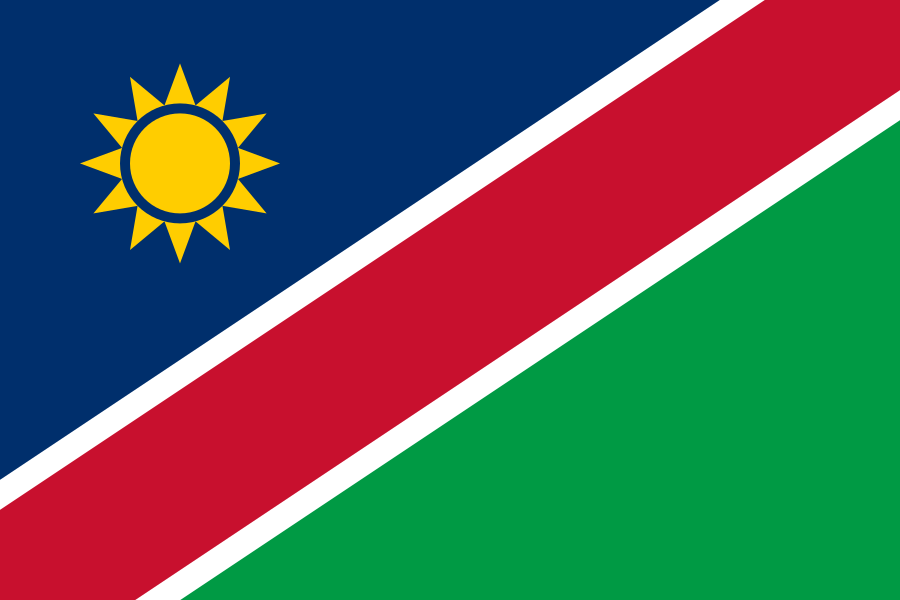
Population: 2,540,905
Total Land Area: 823,290 km2
Population/km2: 3.09
Official Visa Info: Ministry of Home Affairs, Immigration, Safety & Security (MHAISS)