
Australia
Australia is a highly developed, stable democracy with a federal-state system. Tourist facilities are widely available. Read the Department of State’s Fact Sheet on Australia for additional information on U.S.-Australia relations.
Transportation
TRAFFIC SAFETY AND ROAD CONDITIONS: While in Australia, you may encounter road conditions that differ significantly from those in the United States. The information below concerning driving in Australia is provided for general reference only and may not be totally accurate in a particular location or circumstance.
Traffic operates on the left side of the road, and all vehicles use right-hand drive. Please use caution when crossing streets and when driving. When crossing roads on foot, make sure you look carefully in all directions. Wearing a seat belt is mandatory, and fines apply for not wearing them. Speed limits and laws regarding driving while intoxicated are rigorously enforced, and random breath testing of a driver's blood alcohol limit is a common occurrence. Roads and streets are frequently narrower and less graded than U.S. highways. Outside major metropolitan areas, most highways are two-lane roads with significant distances between destinations. Speed limits vary throughout Australia and are measured in kilometers, not miles. Be aware that speed cameras are everywhere and you will be ticketed for driving over the speed limit.
When driving in Australia, exercise caution while passing or merging with adjacent traffic. If driving in rural areas, be cautious of free-roaming animals, such as kangaroos, and "road-trains" (several semi-truck trailers connected together). Passing road-trains is dangerous, and you should pull over to allow on-coming road-trains to pass to avoid being sideswiped. A number of fatalities have occurred in the Northern Territory where vehicles driven at high rates of speed have skidded and overturned after hitting loose gravel on the shoulder of the road. If you have no experience with a 4-wheel drive vehicle, you should exercise common-sense when driving in the Australian outback.
Texting or holding your phone while driving is against the law in Australia, but you can use a hands-free system to communicate while driving. For specific information concerning Australian driving permits, vehicle inspection, road tax, mandatory insurance, and the rental and operation of motor vehicles in Australia, visit the Australian Tourist Commission website.
Each state/territory has different rules about using a foreign driver’s license and the conditions under which a visitor might have to get an international driver’s license. In some cases, you can apply for a driver’s license from the state in Australia where you intend to remain for the duration of your stay in Australia. More information about driving rules and regulations is available by state.
Please refer to our Road Safety page for additional resources.
AVIATION SAFETY OVERSIGHT: The U.S. Federal Aviation Administration (FAA) has assessed the government of Australia's Civil Aviation Authority as being in compliance with International Civil Aviation Organization (ICAO) aviation safety standards for oversight of Australia’s air carrier operations. Further information may be found on the FAA’s safety assessment page.
Safety and Security
International and domestic-based terrorists have targeted, and will likely continue to target, the country. Authorities have conducted several counterterrorism operations in Sydney, Melbourne, and Brisbane since 2014, arresting multiple individuals suspected of being involved in attack planning. Also, the Australian government remains concerned by the threat of foreign fighters returning to the country from conflict areas abroad, who may seek to conduct an attack against Western interests if given the opportunity. Like the United States, Australia shares its national threat levels with the general public to keep everyone informed and to explain the context for the various increased security measures. Australia has an alert system for possible terrorist attacks. The threat levels range from “not expected” to “certain.” The Australian Attorney General's Office website has up-to-date information regarding the current terrorism threat level. Depending on the alert, you should maintain a high level of vigilance and take appropriate steps to increase your security awareness. You may also contact the Australian National Security Hotline at 61-1-800-123-400.
U.S. citizens in Australia should remain vigilant with regard to their personal security and exercise caution. Australian law enforcement authorities continue to take actions to guard against a terrorist attack and are using a range of tactics to mitigate the threat. Australian law protects the right of individuals and groups to engage in peaceful protest and to publicly express their views. Demonstrations and political rallies are generally approved by local authorities and well publicized. However, even demonstrations intended to be peaceful can turn confrontational and possibly escalate into violence. You should avoid the areas of demonstrations if possible, and be careful within the vicinity of any demonstrations. You should stay current with media coverage of local events and be aware of your surroundings at all times.
To stay connected:
- Enroll in the Smart Traveler Enrollment Program so we can keep you up to date with important safety and security announcements.
- Follow the Bureau of Consular Affairs on Twitter and Facebook.
- Bookmark the Bureau of Consular Affairs website, which contains the current Travel Warnings and Travel Alerts as well as the Worldwide Caution.
- Follow the U.S. Embassy in Australia on Twitter and visit the Embassy’s website.
- In the event of an emergency, contact us at 1-888-407-4747 toll-free within the United States and Canada, or via a regular toll line, 1-202-501-4444, from other countries.
- Take some time before traveling to consider your personal security and checking for useful tips for traveling safely abroad.
CRIME: Although U.S citizens are not specifically targeted for crime, you should be aware that robberies, burglaries, assault, and auto theft are common in Australia’s larger cities. Weapons are increasingly used in such crimes, which also may be associated with drug trafficking, gang activities, and drug or alcohol usage. Foreign visitors in popular tourist areas are targets for pickpockets, purse-snatchers, and petty thieves. Be careful when consuming alcohol with unfamiliar people, as drink spiking can occur; take appropriate security precautions, especially at night, to avoid becoming a target of opportunity. Also, be careful when visiting bars or clubs in the entertainment areas of major cities, as “bar brawls” and other assaults sometimes occur in the late hours of the night or early morning when patrons are intoxicated.
VICTIMS OF CRIME: If you or someone you know becomes the victim of a crime abroad, you should contact the local police and the nearest U.S. embassy or consulate. We can:
- Replace a stolen passport.
- Help you find appropriate medical care if you are the victim of violent crimes such as assault or rape.
- Put you in contact with the appropriate police authorities, and if you want us to, we can contact family members or friends.
- Help you understand the local criminal justice process and direct you to local attorneys, although it is important to remember that local authorities are responsible for investigating and prosecuting the crime.
- Every state in Australia has an assistance program for victims of crimes and these programs will be able to generally assist you, even if you are only visiting Australia. For more information on local programs in Australia, please visit the Victim Assistance Online website.
The local equivalent to the “911” emergency line in Australia is: 000 (Triple 0). To call for fire/police/ambulance services throughout Australia, dial “000” for urgent assistance.
Please see our information on victims of crime, including possible victim compensation programs in the United States.
Scams: Fraudulent schemes have increased dramatically in Australia. Scammers use social engineering to cultivate a relationship and build trust with a potential victim before asking the individual to send money or participate in what may seem like a legal enterprise, such as delivering a package or money for them, but which is actually associated with drug trafficking or money laundering. Other common scams include fake lotteries, dating and social networking scams, and fake assistance needed for loved ones or friends. Check out the Department of State’s brochure on International Financial Scams, which includes useful tips on how to avoid becoming the victim of a scam.
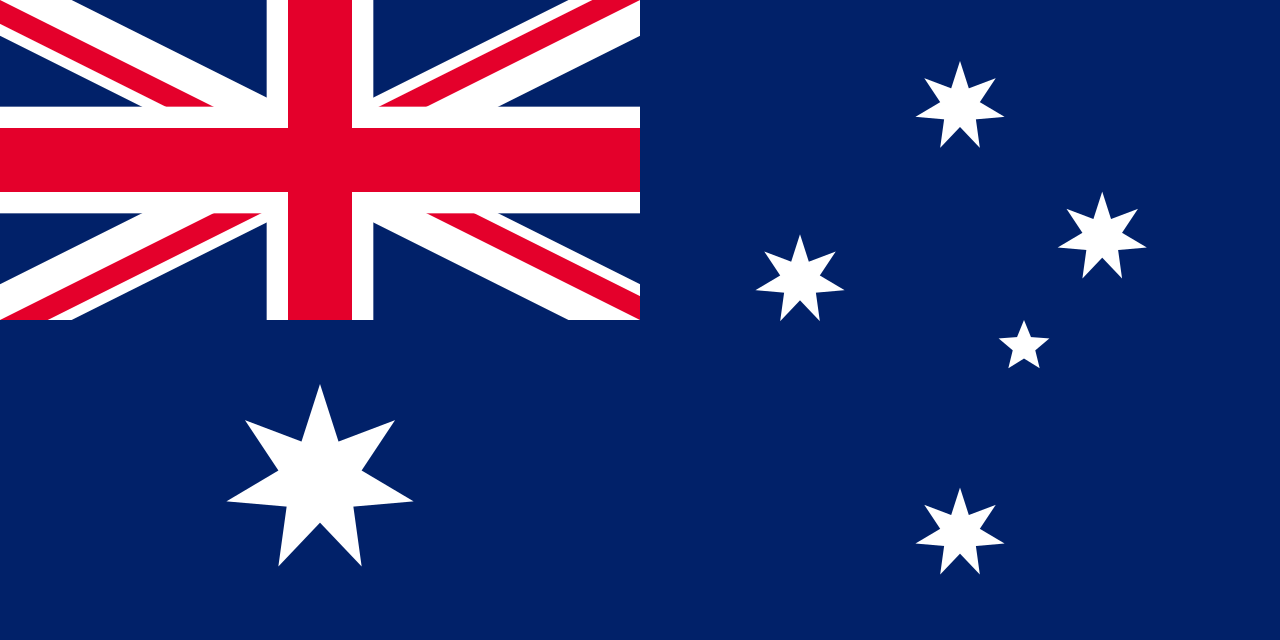
Population: 25,499,884
Total Land Area: 7,682,300 km2
Population/km2: 3.32
Official Visa Info: Department of Home Affairs