Mozambique
Mozambique is a developing country in southern Africa that has been steadily rebuilding its economy and civic institutions since ending a 16-year civil war in 1992. The country stabilized following Mozambique's first multi-party elections in October 1994, and the current president was reelected in October 2009. The latest presidential elections took place on October 15, 2014. The new president is expected to take office in January 2015. Despite high economic growth rates in recent years, Mozambique remains among the world's poorest countries. Facilities for tourism in Maputo, the capital city, are steadily improving but remain limited in other areas. Many goods and services have extremely limited availability. The official language is Portuguese, although English is spoken in many tourist areas, and in some rural areas only local languages are widely spoken. Read the Department of State’s Fact Sheet on Mozambique for additional information on U.S. - Mozambique relations.
Transportation
TRAFFIC SAFETY AND ROAD CONDITIONS: While in Mozambique, U.S. citizens may encounter road conditions that differ significantly from those in the United States. The information below concerning Mozambique is provided for general reference only, and may not be totally accurate in a particular location or circumstance.
Serious traffic accidents are one of the greatest threats to U.S. citizens in Mozambique and occur regularly throughout the country. Accidents involving drivers and pedestrians are common, sometimes resulting in casualties. Pedestrians often walk in the road and may not be visible to motorists, especially at night. If a serious accident occurs, or if a driver hits a pedestrian, crowds quickly gather. Some drivers involved in accidents of this nature have felt threatened by the crowds and fled the accident scene. We urge any driver involved in an accident to immediately report the accident to the nearest police station and to contact the Embassy. Notwithstanding a Mozambican law that requires parties to an accident to render assistance, visitors should exercise their best judgment. Render assistance if necessary and practical, but only if you feel you can do so without placing yourself at risk.
Drivers should obey police signals to stop at checkpoints, which are common throughout Mozambique. Foreigners visiting Mozambique for more than 90 days are required to have an International Driver’s License or to obtain a Mozambican driver’s license.
The EN4 toll road between Maputo and South Africa is well-maintained. The road network connecting provincial capitals is in fair condition, but can be riddled with potholes and other obstacles. U.S. government personnel are prohibited from traveling outside cities after dark because of the increased risk of banditry, poor road conditions in some areas, poor maintenance of many vehicles in the country (e.g., no headlights or rear lights), as well as the threat imposed by livestock grazing on roadsides. Travel outside Maputo often requires a four-wheel drive vehicle, which creates an additional security risk since these vehicles are high-theft items. Public transportation is limited and often has poor safety standards.
The U.S. Embassy advises U.S. citizens not to use “chapas” (local minibuses) as a method of transportation due to frequent, often fatal accidents involving these vehicles.
Please refer to our Road Safety Page for more information. We also suggest that travelers visit the web site of the Mozambique’s national tourist office and national authority responsible for road safety.
AVIATION SAFETY OVERSIGHT: As there is no direct commercial air service to the United States by carriers registered in Mozambique, the U.S. Federal Aviation Administration (FAA) has not assessed the government of Mozambique’s Civil Aviation Authority for compliance with International Civil Aviation Organization (ICAO) aviation safety standards. Further information may be found on the FAA’s safety assessment page.
Safety and Security
Overland travel after dark is extremely dangerous due to road conditions and the increased potential for crime, such as vehicle hijacking. There is an increased potential for accidents due to unseen holes and obstructions, poor lighting conditions, pedestrians on the highways, and other vehicles driving without headlights or with intoxicated drivers. Visitors should be vigilant when driving on city streets as well as the main thoroughfares connecting Mozambique to/from South Africa and other neighboring countries as incidents of vehicle theft, including assault and robbery, have been reported. Both Mozambique and South Africa are considered to have critical levels of crime. Although US citizens have never been targeted, there have been a number of kidnapping incidents reported in recent years. In most cases, criminals targeted wealthy businessmen and their family members in specific local communities. However, all travelers visiting the country should take appropriate security precautions, Please refer to the U.S. Citizen Messages on the U.S. Embassy Mozambique website for more information.
U.S. government personnel who work at the U.S. Embassy in Mozambique are strongly discouraged from overland travel outside Maputo city limits after dark, and are encouraged to travel in convoys of two or more vehicles when outside of the city. They are prohibited from using “chapas” (local minibuses) due to frequent accidents involving these vehicles. Although Mozambique has made great progress in ridding the country of landmines placed during the civil war, there are remaining pockets of residual landmines that still pose a threat. Overland travelers are advised to remain on well-traveled roads or seek local information before going off-road outside of Maputo and other provincial capitals. Road travel on the N-1 national highway in Sofala Province north of the Save River is discouraged because of ongoing security concerns.
Although demonstrations do occur in Mozambique, they are infrequent and there have been no recent demonstrations against U.S. interests. If any demonstrations do occur, they should be avoided.
Police frequently conduct document checks of drivers, travelers, and pedestrians, often with the intention of soliciting bribes. It is illegal to pay bribes and travelers are discouraged from doing so. It is also required to have proper identification on your person at all times (see Local Laws and Special Circumstances).
To stay connected:
- Enroll in the Smart Traveler Enrollment Program so we can keep you up to date with important safety and security announcements.
- Follow the Bureau of Consular Affairs on Twitter and Facebook.
- Bookmark the Bureau of Consular Affairs website, which contains the current Travel Warnings and Travel Alerts as well as the Worldwide Caution.
- Follow the U.S. Embassy in Mozambique on Twitter and by visiting the Embassy’s website.
- In the event of an emergency, contact us at 1-888-407-4747 toll-free within the United States and Canada, or via a regular toll line, 1-202-501-4444, from other countries.
- Take some time before traveling to consider your personal security and checking for useful tips for traveling safely abroad.
CRIME: Although the vast majority of visitors complete their travels in Mozambique without incident, the most serious threat facing U.S. citizens visiting Mozambique is crime. Street crimes, including mugging, purse-snatching, and pick-pocketing are common, both in Maputo and in secondary cities. Carjackings have become rare, but still happen. Visitors must be vigilant when out in public areas and should not display jewelry or other items —even those of low value, like cell phones and personal music devices. Avoid isolated areas. Visitors should not walk at night, even in well known tourist areas. Joggers and pedestrians have frequently been mugged, even during daylight hours. It is recommended to avoid walking along the Marginal south of the Southern Sun Hotel, even in groups, and to be very cautious along Avenida Friedrich Engels and Rua Caracol. All roads and pathways paralleling green space near the southern edge of the city are considered extremely dangerous for pedestrians due to the large number of homeless and criminal elements living amongst the foliage. U.S. citizens have been assaulted and robbed during daylight hours.
Mozambican police do not operate at the standard that U.S. citizens are accustomed to in the United States. Visitors should not expect the same level of police service.
Many airline trips from Mozambique to the United States, Europe, or African destinations transit Johannesburg, South Africa. Baggage pilferage is an ongoing problem at Johannesburg's Oliver Tambo International Airport. Travelers are encouraged to secure their luggage, use an airport plastic wrapping service, and avoid placing currency, electronics, jewelry, cameras, cosmetics, running shoes, or other valuables in checked luggage. Having a complete inventory of items placed in checked baggage can aid in processing a claim if theft does occur.
Don’t buy counterfeit and pirated goods, even if they are widely available. Not only are the bootlegs illegal in the United States, if you purchase them you may also be breaking local law.
VICTIMS OF CRIME: If you or someone you know becomes the victim of a crime abroad, you should contact the local police and the nearest U.S. embassy or consulate. We can:
- Replace a stolen passport.
- Help you find appropriate medical care if you are the victim of violent crimes such as assault or rape.
- Put you in contact with the appropriate police authorities, and if you want us to, contact family members or friends.
- Help you understand the local criminal justice process and direct you to local attorneys, although it is important to remember that local authorities are responsible for investigating and prosecuting the crime.
There is no local equivalent to the “911” emergency line in Mozambique.
Please see our information for victims of crime, including possible victim compensation programs in the United States.
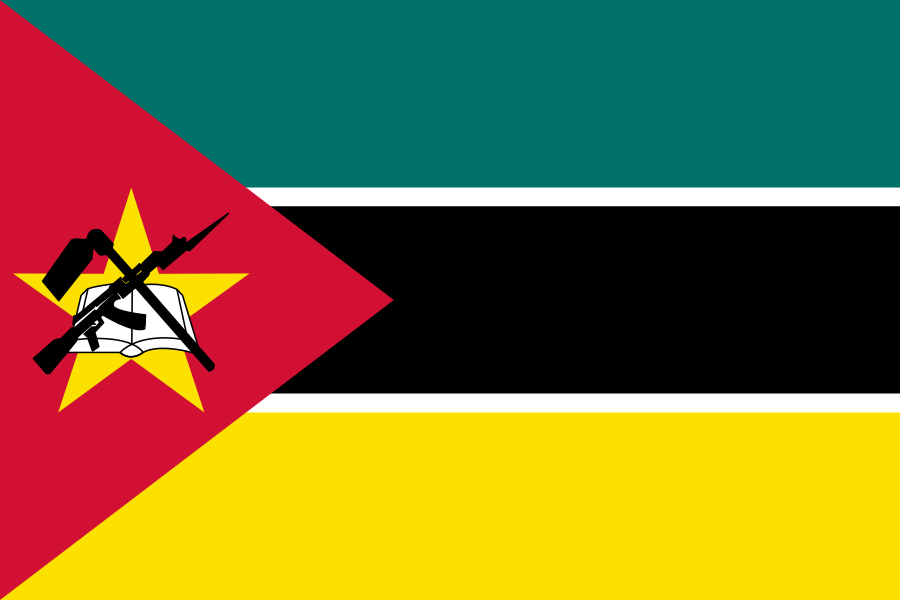
Population: 31,255,435
Total Land Area: 786,380 km2
Population/km2: 39.75
Official Visa Info: Serviço Nacional de Migração (SENAMI)