
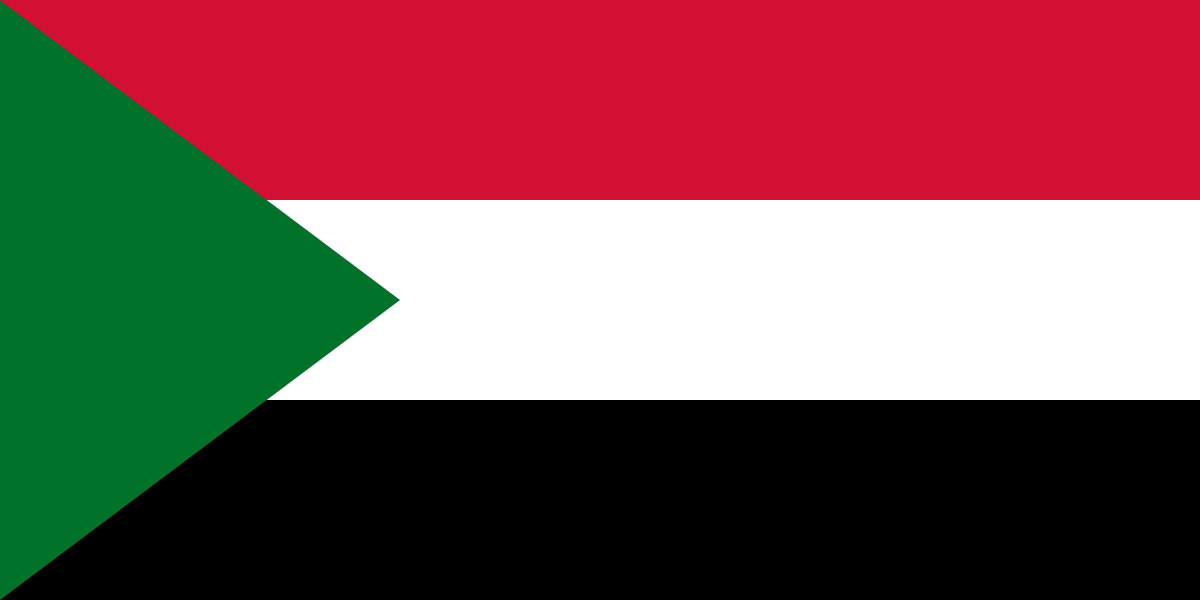
Sudan
Sudan is a diverse, developing country in northeastern Africa. The capital city is Khartoum. In July 2011, Sudan divided into two nations as a part of a peace agreement signed in 2005. The new nation of South Sudan was formed following a referendum on secession held in January 2011. A multi-party conflict continues in the Darfur region in western Sudan and in the states of South Kordofan and Blue Nile. Violence in the nation of South Sudan inhibits land travel across Sudan’s southern border. Transportation networks and other forms of infrastructure are poor and do not meet western standards. Even where available, water and electric services suffer frequent outages. Read the Department of State’s Fact Sheet on Sudan for additional information on U.S.- Sudan relations.
Transportation
TRAFFIC SAFETY AND ROAD CONDITIONS: While in Sudan, you may encounter road conditions that differ significantly from those in the United States.
Road conditions throughout Sudan are hazardous due to erratic driver behavior, pedestrians, and animals in the roadways, and vehicles that are overloaded or lack basic safety equipment. Only major highways and some streets in the cities are paved; many roads are narrow, rutted, and poorly maintained. While there are functioning traffic signals on major streets in Khartoum, there are virtually none in other parts of the country. Local drivers often do not observe conventions for the right-of-way, stop on the road without warning, and frequently exceed safe speeds for road, traffic, and weather conditions. Driving at night is dangerous and should be avoided if possible; many vehicles operate without lights.
In northern and western Sudan, dust and sand storms, known as “haboobs,” greatly reduce visibility when they occur. Roads in these areas can be quickly covered with shifting sand at any season of the year. Roads in southern Sudan are often impassable during the rainy season which usually lasts from March to October. Spare tires, parts, and fuel should be taken when traveling in remote areas, as service stations are separated by long distances. U.S. citizens are subject to the laws of the country in which they are traveling, including traffic laws. In Sudan, vehicles have the steering wheel on the left side and drivers use the right side of the road.
Traffic from side streets on the right has the right-of-way when entering a cross street, including fast-moving main streets. Traffic on the right has the right-of-way at stops. Right turns on a red light are prohibited. Speed limits are not posted, but the legal speed limit for passenger cars on inter-city highways is 120 kph (about 75 mph), while in most urban areas, the limit is 60 kph (about 35 mph). The speed limit in congested areas and school zones is 40 kph (about 25 mph).
Many local drivers carry no insurance despite the legal requirement that all motor vehicle operators purchase third-party liability insurance from the government. Persons involved in an accident resulting in death or injury must report the incident to the nearest police station or police officer as soon as possible. Persons found at fault can expect fines, revocation of driving privileges, and jail sentences, depending on the nature and extent of the accident. Persons convicted of driving under the influence of alcohol face fines, jail sentences, and flogging.
U.S. citizens may use their U.S. driver's license for up to 90 days after arrival in Sudan, and then must carry either an International Driving Permit (IDP) or a Sudanese driver's license. There are no restrictions on vehicle types, including motorcycles and motorized tricycles.
Public transportation exists in cities and between major urban areas. Passenger facilities are basic and crowded, especially during rush hours and periods of seasonal travel. Schedules are unpublished and subject to change without notice. There is routine passenger train service on the route from Khartoum to Wadi Halfa (on the border with Egypt) and to Port Sudan (on the Red Sea). Bus service between major cities is regular and inexpensive. Intra-city bus service in the major urban areas is by small and large buses, and vans. Many drivers of these vehicles have little training and are reckless, and the vehicles are often poorly maintained. Most buses and bus stops are privately operated and unmarked. Taxis are available in the major cities at hotels, tourist sites, and government offices. Motorized rickshaws, in common use in Khartoum, are unsafe. Travelers are encouraged to hire cars and drivers from reputable sources with qualified drivers and safe vehicles. While there is some public transit to rural communities by irregularly scheduled mini-buses, many areas lack any public transportation.
You should be extremely careful in crossing roads in Sudan. Crosswalks do not exist, and incidents of cars striking pedestrians do occur.
Please refer to our Road Safety page for more information
AVIATION SAFETY OVERSIGHT: As there is no direct commercial air service to the United States by carriers registered in Sudan, the U.S. Federal Aviation Administration (FAA) has not assessed the government of Sudan’s Civil Aviation Authority for compliance with International Civil Aviation Organization (ICAO) aviation safety standards. Further information may be found on the FAA’s safety assessment page.
Safety and Security
The Department of State has issued a Travel Warning for Sudan warning U.S. citizens of the risks of travel to Sudan, urging U.S. citizens to avoid all travel to the Darfur region of Sudan, the Blue Nile, and Southern Kordofan States, and advising U.S. citizens to consider carefully the risks of travel in other areas of Sudan.
On January 1, 2008, a group of assailants shot and killed two U.S. Embassy employees – a USAID officer and a Sudanese national driver. The attack was found to be ideologically motivated, and the assailants were convicted and sentenced under Sudanese law in 2009. Only one of the four convicted assailants is in custody; one is believed to have been killed in Somalia, and two remain at large.
Aid workers and government employees from Western countries have been the targets of kidnappings in the Darfur region. In May 2010, a U.S. citizen employed by a humanitarian relief organization was kidnapped in Darfur, and was held for several months before being released. In July 2014, two American citizens traveling on a bus in Darfur were attacked by anti-government forces and seriously wounded.
Since June 2012, there have been increased incidents of anti-government protests, resulting in the arrest of at least one U.S. citizen. U.S. citizens should avoid crowds and demonstrations as they can become confrontational and quickly escalate into violence. Demonstrations may also occur in other areas of the country, and we recommend U.S. citizens throughout Sudan exercise caution.
Terrorist-affiliated individuals are known to operate in Sudan, some of whom may seek opportunities to carry out attacks against U.S. or western interests. Terrorist actions may include suicide operations, bombings, or kidnappings. You should be aware of the risk of indiscriminate attacks on civilian targets in public places, including tourist sites and locations where westerners are known to congregate, and commercial operations associated with U.S. or Western interests. You should exercise utmost caution at all times.
The Embassy’s ability to provide consular services outside of the Khartoum area, including emergency assistance, is severely limited. Many areas of Sudan are extremely difficult to access, and travel in these areas is hazardous. Outside the major cities infrastructure is extremely poor, medical care is limited, and there are few facilities for tourists.
Conflict among various armed groups and government forces continues throughout the entire Darfur region. Banditry and lawlessness are prevalent in all of Darfur. Over one and a half million Darfuris live in camps for internally displaced persons, and receive humanitarian assistance for basic needs such as food, water, and shelter. Expatriate humanitarian workers have been the targets of kidnapping, car-jacking, and burglary.
Occasional clashes between armed groups representing communal interests continue to occur in areas of central and eastern Sudan. Banditry also occurs. Sudan is Africa’s third-largest country in physical area, and shares porous land borders with Libya, Chad, the Central African Republic, South Sudan, Egypt, Ethiopia, and Eritrea. Conflict in these countries occasionally spills over into Sudan. Violence in the nation of South Sudan inhibits land travel across Sudan’s southern border.
The secession of South Sudan in July 2011 has been accompanied by an increase in armed violence in the states and territories on the northern South Sudan border, particularly in Abyei, Southern Kordofan, and Blue Nile. In ongoing disputes in these regions, the Sudanese Armed Forces have conducted airstrikes throughout the region, and have engaged in ground clashes with the Sudanese People’s Liberation Army/ North(SPLM/N). Non-governmental organizations have been expelled from the areas, and the United Nations operates with minimal staffing in government-controlled areas only.
U.S. citizens considering sea travel in Sudan's coastal waters should exercise caution as there have been incidents of armed attacks and robberies by unknown groups in recent years, including one involving U.S. vessels. Exercise extreme caution, as these groups are considered armed and dangerous. When transiting in and around the Horn of Africa and/or in the Red Sea near Yemen, vessels should convoy in groups and maintain good communications contact at all times. Marine channels 13 and 16 VHF-FM are international call-up and emergency channels, and are commonly monitored by ships at sea. 2182 MHz is the HF international call-up and emergency channel. Wherever possible, travel in trafficked sea-lanes, and avoid loitering in or transiting isolated or remote areas. In case of emergency, contact the nearest U.S. embassy or consulate. In the event of an attack, consider activating Emergency Position Indicating Radio Beacons.
The United States Maritime Administration (MARAD) has advised that elevated regional tensions have increased the risk of maritime attacks being conducted by extremists on vessels operating in the Gulf of Oman, North Arabian Sea, Gulf of Aden, and the Bab el Mandeb regions.
MARAD recommends vessels at anchor, operating in restricted maneuvering environments, or at slow speeds should be especially vigilant, and report suspicious activity. U.S. flag vessels that observe suspicious activity in the area are advised to report such suspicious activity or any hostile or potentially hostile action to COMUSNAVCENT battlewatch captain at phone number 011-973-1785-3879. Report all suspicious activities and events to the U.S. Coast Guard National Response Center at the following toll free telephone: 1-800-424-8802, direct telephone 202-267-2675, or TDD 202-267-4477. The complete advisory is available on the MARAD website at www.MARAD.DOT.gov.
Please see the State Department's Fact Sheet on Maritime Piracy.
To stay connected:
- Enroll in the Smart Traveler Enrollment Program so we can keep you up to date with important safety and security announcements.
- Follow the Bureau of Consular Affairs on Twitter and Facebook.
- Bookmark the Bureau of Consular Affairs website, which contains the current Travel Warnings and Travel Alerts as well as the Worldwide Caution.
- Follow the U.S. Embassy in Sudan on Twitter and by visiting the Embassy’s website.
- In the event of an emergency, contact us at 1-888-407-4747 toll-free within the United States and Canada, or via a regular toll line, 1-202-501-4444, from other countries.
- Take some time before traveling to consider your personal security and checking for useful tips for traveling safely abroad.
CRIME: There is a high risk of crime in certain areas of Sudan, particularly in the Darfur and border regions. Crimes against persons or property are infrequent in Khartoum and the surrounding area, but you should follow common-sense security measures, such as keeping an eye on backpacks or hand luggage. U.S. citizens should avoid all travel to the Darfur region of Sudan, the Blue Nile, and Southern Kordofan States, and should consider carefully the risks of travel in other areas of Sudan.
You should try to avoid crowded public areas and public gatherings, and avoid traveling alone outside of Khartoum if possible. Report instances of anti-U.S. acts or crimes targeting westerners to the U.S. Embassy, and report all incidents of crime to the Sudanese police.
When flying, you should maintain constant contact with your baggage and ensure it does not contain illicit items, such as alcohol, pornography, or military ordinance. U.S. citizens have been removed from international airlines and detained when suspect items have been detected in checked baggage.
Carjackings and armed robberies occur in western Sudan. Sexual assault is more prevalent in areas of armed conflict. Travelers who do not use the services of reputable travel firms or knowledgeable guides or drivers are especially at risk. Travel outside of Khartoum should be undertaken with a minimum of two vehicles so that there is a backup in case of mechanical failure or other emergency. Solo camping is always risky.
Do not buy counterfeit and pirated goods, even if they are widely available. Not only are the bootlegs illegal in the United States, if you purchase them you may also be breaking local law.
VICTIMS OF CRIME: If you or someone you know becomes the victim of a crime abroad, you should contact the local police and the nearest U.S. embassy or consulate. We can:
- Replace a stolen passport.
- Help you find appropriate medical care if you are the victim of violent crimes such as assault or rape.
- Put you in contact with the appropriate police authorities, and if you want us to, contact family members or friends.
- Help you understand the local criminal justice process and direct you to local attorneys, although it is important to remember that local authorities are responsible for investigating and prosecuting the crime.
The local equivalent to the “911” emergency line in Sudan is 999.
Please see our information for victims of crime, including possible victim compensation programs in the United States.
Population: 43,849,260
Total Land Area: 1,765,048 km2
Population/km2: 24.84