
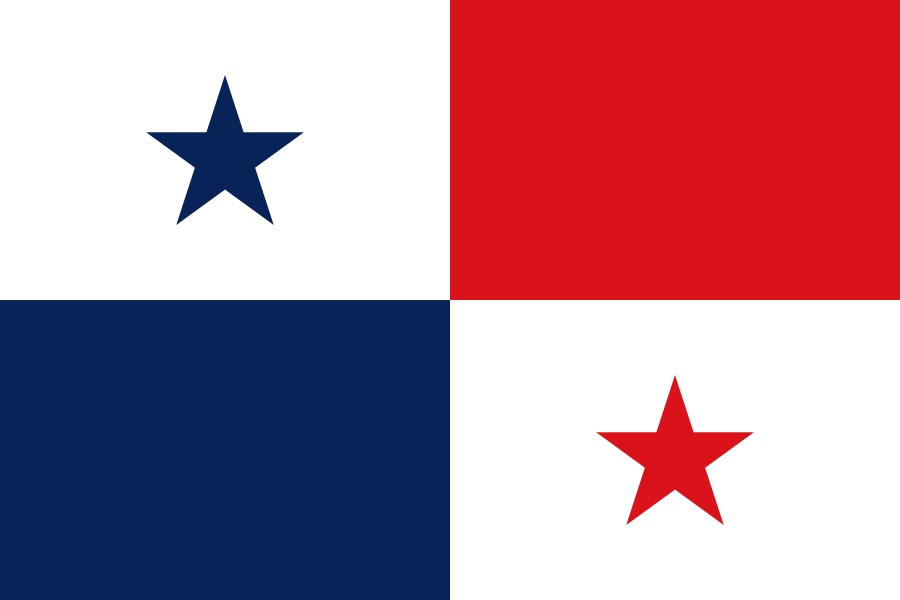
Panama
Panama is a democratic country with an executive branch led by a president elected to a 5-year term, a unicameral legislature, and judicial branch. The country is divided into 10 provinces and three indigenous territories known as comarcas. It became independent from Colombia on November 3, 1903. Panama has a rapidly developing economy, but also faces problems of corruption and has a weak, non-transparent judiciary. Outside the Panama City area, which has many first-class hotels and restaurants, tourist facilities vary in quality. Panama has two official currencies, the Balboa and the U.S. dollar. While both the Balboa and U.S. dollar units circulate in coin form, the U.S. dollar is the only paper currency in use. When traveling to or doing business in Panama, please take note of the many national and regional holidays as the government and most businesses close on these days. Read the Department of State’s Fact Sheet on Panama for additional information.
Transportation
TRAFFIC SAFETY AND ROAD CONDITIONS: While in Panama, you may encounter road conditions that differ significantly from those in the United States.
The information below concerning Panama is provided for general reference only, and may not be applicable for a particular location or circumstance. Travelers should carry identification with them at all times and be prepared to stop for unannounced checkpoints throughout the country, especially at night.
While U.S. citizen tourists are permitted to stay in Panama for up to 180 days without a visa, current Panamanian law allows foreigners to drive in Panama using their valid foreign driver’s license for a period of only 90 days. Driving without a valid driver’s license is illegal in all areas of Panama. Drivers stopped for driving while intoxicated may face the loss of their driver’s license, a monetary penalty, and vehicle impoundment. Talking on a cell phone or drinking an alcoholic beverage while driving also carries a fine.
Panama's roads, traffic and transportation systems are generally safe, but frequently traffic lights do not exist, even at busy intersections. Traffic in Panama moves on the right, as in the U.S., and Panamanian law requires that drivers and passengers wear seat belts.
Driving in Panama is often hazardous and difficult due to heavy traffic, undisciplined driving habits, poorly maintained streets and a shortage of effective signs and traffic signals. Use caution when driving at night; night driving is particularly hazardous on the old Panama City – Colon highway. Riding your bicycle on the streets is not recommended. As an alternative, there are a number of parks throughout the country where riding is permitted and safe.
Third party liability auto insurance is mandatory, but many drivers are uninsured. If an accident occurs, a recent law requires that the vehicles be moved off the roadway; failure to do so could result in a fine. Individuals involved in non-injury accidents should take a photo of both cars, if safe to do so, and then pull their vehicle off the roadway. Exchange information with the other driver and wait for the police to arrive. Emergency response in Panama is not regularly reliable. Police may take hours to respond to routine accidents, though response is often quicker for serious accidents. Ambulances will take all injured persons to a public hospital for treatment unless proof of health insurance is provided at the time of arrival.
Road travel is more dangerous during the rainy season (April to December) due to flooding. Rainy season occasionally makes city streets impassible and washes out some roads in the interior of the country. In addition, roads in rural areas are often poorly maintained and lack illumination at night. Such roads are generally less traveled and the availability of emergency roadside assistance is very limited. Heavier road traffic during Carnival through Easter Sunday makes road travel in the interior provinces more difficult and dangerous. Carnival starts the Saturday prior to Ash Wednesday and goes on for four days. If you are interested in receiving real time weather, earthquake, and high seas information from the Panamanian Government, please visit the SINAPROC website or follow @SINAPROC_PANAMA on Twitter.
There is often construction at night on Panama's portion of the Pan American highway. There are few signs alerting drivers to construction, and the highway is not well lit at night. When traveling on the highway, travelers should be aware of possible roadblocks. The Pan American Highway ends at Yaviza in the Darién Province of Panama and does not continue through to Colombia.
Traffic roundabouts are common in Panama, and extreme care should be taken when entering and exiting them. Generally speaking, vehicles already in the roundabout have right-of-way over those entering, but demanding your right-of-way may result in an accident. Most roundabouts have two lanes all the way around, so it is a good idea to plan your exit and get in the proper lane so that you do not have to cut across traffic to exit. Be especially careful of taxis, as the drivers can be very assertive. Taxis lack regulatory enforcement and are not always maintained in a safe operating condition.
Public transportation should be used with caution. While we do still receive reports of thefts and pick-pocketing, new metro buses, with bigger windows and better lighting, have been introduced, and according to PNP reports, seem to have reduced the instances of violent crime. The first rail line of the newly inaugurated Metro de Panama system started operation in April 2014. Riders should be aware that not all of the stations are currently operational and that trains will not stop at a station until construction is complete. Riders should determine if their desired stop is operational before riding. The metro, though equipped with state of the art security features, will traverse through and stop in some of the highest crime areas of the city. Confined spaces, such as on the metro trains, provide excellent environments/opportunities for pickpockets and other criminal activities. PNP have established a Metro Police Unit responsible for the security of the trains and platforms.
Public Transportation riders should always be aware of their surroundings, their possessions, and others traveling on the train with them regardless of the area where the train or bus is operating. Please refer to our Road Safety page for more information. Also, we suggest that you visit the websites of Panama’s Tourism Authority, Transportation Authority, and the national authority responsible for road safety in Panama (Spanish-only) for helpful information on road conditions in Panama.
AVIATION SAFETY OVERSIGHT: The U.S. Federal Aviation Administration (FAA) has assessed the government of Panama’s Civil Aviation Authority as being in compliance with International Civil Aviation Organization (ICAO) aviation safety standards for oversight of Panama’s air carrier operations. Further information may be found on the FAA’s safety assessment page.
Safety and Security
Avoid travel to remote areas of the Darién Province off of the Pan American Highway. U.S. Embassy personnel are not allowed to travel to the restricted border areas of the Darién and San Blas Provinces except on official business and only with prior approval of the Embassy’s Regional Security Officer and Deputy Chief of Mission. This restricted area encompasses the Darién National Park as well as some privately owned nature reserves and tourist resorts. The general remoteness of the region contributes to the potential hazards. Due to scarcity of roads, most travel is by river or by footpath. This, combined with spotty medical infrastructure outside of major towns, makes travel there potentially hazardous. While the number of actual incidents remains low, U.S. citizens, other foreign nationals, and Panamanian citizens are potentially at risk of violent crime, kidnapping, and murder in this general area.
There have been reports of Colombian terrorist groups, drug traffickers, and other criminals operating in the Panama-Colombia border area, increasing the danger to travelers. The Revolutionary Armed Forces of Colombia (FARC) has been known to make incursions into remote areas of Panama’s Darién Province. The Secretary of State has designated the FARC as a Foreign Terrorist Organization.
Similarly, U.S. citizens should not travel to the area of Panama referred to as the “Mosquito Coast,” an extremely remote and inaccessible area along the Panamanian north coast bounded by Boca de Rio Chiriquí on the west and Coclé Del Norte on the east and stretching inward from the coast for five kilometers. Embassy personnel are allowed to travel to this area only on official business and with prior approval of senior Embassy management. Access to the region is almost exclusively by boat and/or aircraft. The area may also have a few unimproved roads and/or paths that are not marked on maps. This may be particularly true in the mining area along the Petaquilla River. Sections of this coastline are used for narco-trafficking and other illegal activities.
From time to time, there may be demonstrations to protest internal Panamanian issues or, more rarely, manifestations of anti-American sentiment by small but vociferous groups. While most demonstrations are non-violent, it is nonetheless a good security practice to avoid demonstrations. The Panamanian National Police have used tear gas and/or riot control munitions in response to demonstrations, particularly when roadways are blocked or aggression is used against the police.
Protestors have on occasion blocked remote roadways and the Pan American Highway. During these road closures, the security situation can be tense with a potential for violence between Panamanian authorities and protestors. For the most recent information on possible road closures, the Embassy advises U.S. citizens to monitor local news and consult local police.
Visitors should be cautious when swimming or wading at the beach. Some beaches, especially those on the Pacific Ocean and those in Bocas del Toro Province, have dangerous currents that cause drowning deaths every year. These beaches often do not have posted warning signs or lifeguards.
On the Pacific and Atlantic coasts, boaters should be wary of vessels that may be transporting narcotics, illicit materials, and illegal immigrants to and from Colombia. Bales and wrapped packages containing narcotics have been found floating in the ocean or lying on remote beaches. Boaters and beachgoers are warned to avoid these items and not pick up or move these packages, and to immediately report their location to the Panamanian authorities.
Special permission is needed from the National Environment Authority to visit the National Park on Coiba Island. The island is an abandoned penal colony, although on occasion, prisoners are sent there to care for the animals. Boaters should avoid the southeastern coast of Kuna Yala Comarca (San Blas Islands), south of Punta Carreto, on the Atlantic Coast.
Local maritime search and rescue capabilities are limited and well below U.S. standards. If you are experiencing an emergency at sea or know of someone who is experiencing an emergency off the coast of Panama, please contact the U.S. Embassy immediately who will contact the Panamanian authorities.
To stay connected:
- Enroll in the Smart Traveler Enrollment Program so we can keep you up to date with important safety and security announcements.
- Bookmark the Bureau of Consular Affairs website, which contains the current Travel Warnings and Travel Alerts as well as the Worldwide Caution.
- Follow the Bureau of Consular Affairs on Twitter and Facebook, and follow the U.S. Embassy in Panama on Twitter and visit the Embassy’s website as well.
- In the event of an emergency, contact us at 1-888-407-4747 toll-free within the U.S. and Canada, or via a regular toll line, 1-202-501-4444, from other countries.
- Take some time before traveling to consider your personal security, and check for useful tips for traveling safely abroad.
CRIME: Panama remains relatively safe when compared to other Central American countries, yet crime rates are still higher than one would encounter in most of the United States. Violent crime in Panama started to rise in 2007. However, new efforts by Panama’s National Police (PNP) to combat this trend appear to have made an impact. The number of homicides in the country has declined continuously since 2010. Unfortunately, the rate of simple theft has risen, with smart phones being a particular target. The three provinces with the largest cities also had the highest overall crime rates: Panama, Colon, and Chiriqui. The entire city of Colon is a high crime area; travelers should use extreme caution when in Colon.
Police continue to conduct vehicle checkpoints at key intersections in the city in an effort to raise their visibility and hamper criminals’ movements. The high crime areas in and around Panama City are El Chorrillo, San Miguel, Santa Ana, Cabo Verde, Curundu, Veracruz Beach, Santa Librada, Rio Abajo, San Miguelito, Panama Viejo, and the Madden Dam Overlook.
Crimes are typical of those that plague metropolitan areas and include shootings, rapes, armed robberies, muggings, purse-snatchings, thefts from locked autos by breaking windows for entry, thefts of unsecured items, petty theft, and occasionally "express kidnappings" from ATM banking facilities, in which the victim is briefly kidnapped and robbed after withdrawing cash from an ATM. There has also been a recent spike in the number of credit card and ATM card fraud reports. Criminals are capturing credit and ATM card information to clone and create fraudulent cards. Kidnappings have occurred in Panama City, many of which appear related to drug or criminal activity.
There has also been a recent increase of thefts from cars. We encourage travelers and residents to take all valuables out of their cars and place them in their trunks before they get to their destinations. Drivers should keep their windows up and doors locked while in the car to prevent items from being stolen when stopped in traffic or at traffic lights.
Use caution when taking taxis. Use only licensed and registered taxis. Check to see that the number on the side of the taxi matches the number of the license plate. Ensuring the car is a registered taxi with a number on the side is a quick way to help prevent any incidences. Regular taxis are yellow in color. Also, never get into a taxi that already has a passenger and instruct the driver not to pick up any additional fares while en route to your destination. Many hotels also have “tourist taxis” that are not yellow but only pick up passengers in front of well-known hotels.
U.S. citizens are advised to never let a “helpful” stranger direct you to a particular taxi or taxi stand, and always negotiate the fare before getting in to ensure a fixed price.
The use of weapons (handguns and knives) is common in street robberies; however, gratuitous violence is uncommon as long as the victim complies and hands over the property. In 2013, there was an increase in violence during theft. Home burglaries and, more worrying, home-invasion robberies do appear to be on the rise, especially in the more affluent neighborhoods. Panama City has a curfew for those younger than 18 years of age that is generally from 8:00 p.m. to 6:00 a.m. Sunday through Thursday and 11:00 p.m. to 6:00 a.m. Friday and Saturday. The times are subject to change depending on your location within Panama. If you are concerned about the exact time, you may contact local police. This curfew applies to both Panamanian and foreign citizens. Under the law, students attending night classes must have a “carnet” or permit, issued by the school or, if employed, a Certificate of Employment. Minors who are picked up for a curfew violation are subject to detention at a police station until parents or legal guardians can arrange their released to them. Parents or legal guardians may be fined up to USD$50 for the first violation.
Panamanian customs authorities may enforce strict regulations concerning temporary importation into or export from Panama of items such as firearms and ammunition, cultural property, endangered wildlife species, narcotics, biological material, and food products. Contact the Embassy of Panama in Washington or one of Panama's Consulates in the United States for specific information regarding customs requirements.
Do not buy counterfeit and pirated goods, even if they are widely available. Not only are the bootlegs illegal in the United States, if you purchase them you may also be breaking local law. The Computer Crime and Intellectual Property Division in the U.S. Department of Justice has more information on this serious problem. For further information about customs regulations, please read our Customs Information page.
VICTIMS OF CRIME: If you or someone you know becomes the victim of a crime abroad, you should contact the local police and the nearest U.S. Embassy or Consulate. We can:
- Replace a stolen passport.
- For violent crimes such as assault or rape, help you find appropriate medical care.
- Put you in contact with the appropriate police authorities, and, if you want us to, we can contact family members or friends.
- Although the local authorities are responsible for investigating and prosecuting the crime, consular officers can help you understand the local criminal justice process and can direct you to local attorneys.
The Panamanian Government also sponsors a program to assist victims of crime. The program is managed by the Oficina de Asistencia a Víctimas de Crímenes (Office of Assistance to Victims of Crime), located at the Policia Tecnica Judicial in the Ancon area of Panama City. Its telephone number is 512-2222.
As in the United States, the emergency line in Panama is 911. The police can be reached directly by dialing 104.
Please see our information on victims of crime, including possible victim compensation programs in the United States.
Population: 4,314,767
Total Land Area: 74,340 km2
Population/km2: 58.04
Official Visa Info: Servicio Nacional de Migración