
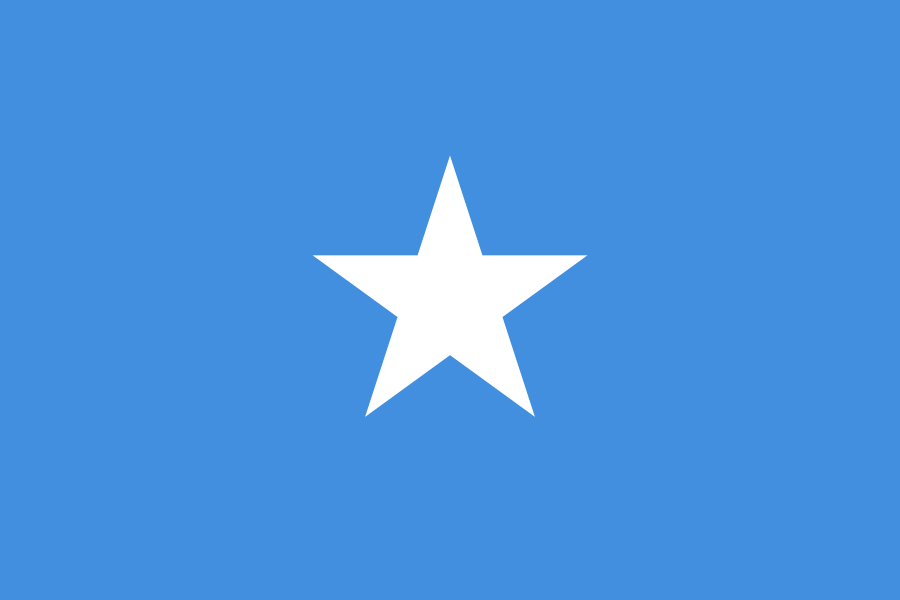
Somalia
The U.S. Department of State continues to warn U.S. citizens to avoid all travel to Somalia. Since the collapse of the central government in 1991, Somalia has been subject to widespread violence and instability. In 2012 the Transitional Federal Government was succeeded by a new federal government. In January 2013, the United States officially recognized the Somali government for the first time since 1991. However, the U.S. government does not maintain a diplomatic presence in Somalia at this time. Regional administrations, like the semi-autonomous state of Puntland and the self-declared “independent” region of Somaliland, have evolved in parts of the country. In August 2013, the federal government and Juba administration reached an agreement, which established the Interim Juba Administration in southern Somalia. Somalia's infrastructure and economy were seriously damaged by the civil war and its aftermath, but the private sector is trying to reemerge and has been boosted by an influx of diaspora returning to Somalia since the end of the transitional period of governance.
The African Union Mission in Somalia (AMISOM), with the assistance of Somali security forces, have liberated the capital city of Mogadishu and other key cities in southern and central Somalia from the control of al-Shabaab, a radical Islamist movement and designated foreign terrorist organization affiliated with al-Qa’ida, but the central government’s reach and ability to provide services remains limited. Al-Shabaab still maintains control of towns and villages in Somalia’s countryside and retains the capability to conduct terrorist attacks throughout Somalia and in neighboring countries. While al-Shabaab has lost ground in southern and central Somalia, it remains capable of waging terrorist acts and asymmetric warfare. Criminal groups conduct kidnapping for ransom and piracy, particularly in the regions of Galmuduug and Puntland, although the number of incidents have decreased with the introduction of land and sea-based initiatives to counter piracy. Inter- and intra-clan violence also frequently occurs throughout the country.
Read the Department of State Fact Sheet on Somalia for additional information on U.S. – Somalia relations.
Transportation
TRAFFIC SAFETY AND ROAD CONDITIONS: While in Somalia, you may encounter road conditions that differ significantly from those in the United States. There are no traffic lights anywhere in Somalia. The poor condition of most roads makes driving hazardous. Night driving can be dangerous due to the absence of lighting. In many areas, drivers risk explosion of Improvised Explosive Devices (IEDs) or landmines.
Please refer to our Road Safety page for more information.
AVIATION SAFETY OVERSIGHT: As there is no direct commercial air service to the United States by carriers registered in Somalia, the U.S. Federal Aviation Administration (FAA) has not assessed the government of Somalia’s Civil Aviation Authority for compliance with International Civil Aviation Organization (ICAO) aviation safety standards. Further information may be found on the FAA’s safety assessment page
Safety and Security
Since the United States does not have an Embassy or any other diplomatic presence in any part of Somalia, including Somaliland, the U.S. government cannot provide any consular services to U.S. citizens in Somalia. Limited services for U.S. citizens are available for travelers to Somalia at the U.S. Embassies in Nairobi and Djibouti.
While Somaliland has experienced a level of stability not present in other parts of Somalia, please note that the Department of State continues to warn U.S. citizens against all travel to Somalia, including the self-proclaimed “Independent Republic of Somaliland” - see the Department’s Travel Warning for Somalia. Travelers insisting on visiting Somaliland despite this warning should check current conditions in Somaliland before embarking on their journey. Terrorist attacks have occurred against international relief workers, including Westerners, throughout Somalia, including Puntland and Somaliland. In every year since 2008, there have been violent kidnappings and assassinations, including suicide bombings, of local and foreign staff working for international organizations. Additionally, there have been threats against Westerners in Somalia, including Somaliland. No area in Somalia should be considered immune from violence, and the potential exists throughout the country for hostile acts, either targeted or random, against U.S. and other Western nationals at any time. On April 7, two foreign UN employees were shot dead on arrival at an airport in Galcayo. Despite improved security in Mogadishu, insurgents conducted an increasing number of high profile attacks in 2013 and 2014, many of which targeted government officials and foreigners. These attacks consisted of complex assaults, improvised explosive device (IED) detonations and suicide bombings. Insurgents targeted various Somali government facilities in Mogadishu, including compounds and the Mogadishu airport, which house a majority of international aid workers and diplomats.
Terrorist operatives and armed groups in Somalia regularly demonstrate the intent and capacity to attack UN compounds and other places frequented by foreigners in Mogadishu, including the Mogadishu Airport. On October 15, al-Shabaab conducted a string of attacks in and around Mogadishu, first detonating a vehicular born improvised explosive device (VBIED) outside the popular Panorama restaurant frequented by high-level government officials killing four and injuring approximately ten. Around the same time, al-Shabaab ambushed the district police commander of Yaqshid along Wadada Warshadaha near Arafat and simultaneously, a NISA officer and his wife were killed in a car bomb attack at Afarta Jardino junction in Yaqshid District. Another government official was gunned down in Bakara Market, Hawlwadaag district. On May 24, 2014, an al-Shabaab suicide assault team attacked the Somalia's parliament building in Mogadishu. On March 15, a car bomb detonated near a hotel in central Mogadishu, popular with local government officials and businessmen, killing two. On February 27, a car bomb exploded outside a restaurant popular with Somali security services, killing twelve. On February 21, al-Shabaab militants attacked Villa Somalia, the official residential palace and principal workplace of the President of Somalia, and killed two government officials. On February 13, militants detonated a VBIED targeting a convoy carrying high-level UN officials as they waited to enter the main gate of Mogadishu airport. On January 1, unknown attackers launched an indirect fire attack on the airport.
Al-Shabaab has lost control of large portions of southern and central Somalia due to the success of the Africa Union Mission in Somalia (AMISOM)-led Operation Indian Ocean offensive; however, armed banditry, road assaults, kidnappings for ransom, shootings and grenade attacks on public markets, and detonations of anti-personnel and-vehicle land mines still occur in most parts of the country. Al-Shabaab remains engaged in active warfare against the central government and regional administrations, including Puntland and Galmuduug. Illegal roadblocks by armed men, sometimes in government uniforms, are common throughout Somalia and have resulted in serious injury or death.
Cross-border violence occurs periodically. The area near Somalia’s border with Kenya has been the site of numerous violent incidents, ranging from large-scale clashes between al-Shabaab and the central government to kidnappings, and grenade attacks on hostels used by international aid workers. U.S. citizens who decide to visit the area should be aware that they could encounter such incidents.
U.S. citizens considering seaborne travel around Somalia’s coast should exercise extreme caution, given the threat of vessel hijacking and/or piracy off south central Somalia and Puntland. In the event that seaborne travel is unavoidable, vessels should convoy in groups and maintain good communications contact at all times. Marine channels 12, 13 and 16 VHF-FM are international call-up and emergency channels and are commonly monitored by ships at sea. 2182 MHz is the HF international call-up and emergency channel. In the Gulf of Aden, use of transit routes farther offshore appears to reduce, but does not eliminate, the risk of contact with assailants. Wherever possible, travel in trafficked sea-lanes. Avoid loitering in or transiting isolated or remote areas. In the event of an attack, activate the Emergency Position Indicating Radio Beacon. Due to distances involved, there may be a considerable delay before assistance arrives. Vessels may also contact the Yemeni Coast Guard 24-hour Operations Center at 967-1-562-402. Operations Center staff members speak English.
The United States Maritime Administration (MARAD) has advised that elevated regional tensions have increased the risk of maritime attacks being conducted by extremist to vessels operating in the Gulf of Oman, North Arabian Sea, Gulf of Aden, and the Bab el Mandeb regions.
MARAD recommends vessels at anchor, operating in restricted maneuvering environments, or at slow speeds should be especially vigilant, and report suspicious activity. U.S. flag vessels that observe suspicious activity in the area are advised to report such suspicious activity or any hostile or potentially hostile action to Commander, U.S. Naval Forces Central Command (COMUSNAVCENT) battlewatch captain at phone number 011-973-1785-3879. All suspicious activities and events are also to be reported to the U.S. Coast Guard National Response Center at the following toll free telephone: 1-800-424-8802, direct telephone 202-267-2675, or TDD 202-267-4477. The complete advisory is available on the MARAD website at www.MARAD.DOT.gov.
To stay connected:
- Enroll in the Smart Traveler Enrollment Program so we can keep you up to date with important safety and security announcements.
- Follow the Bureau of Consular Affairs on Twitter and Facebook.
- Bookmark the Bureau of Consular Affairs website, which contains the current Travel Warnings and Travel Alerts as well as the Worldwide Caution.
- Follow the U.S. Embassy in Kenya on Twitter and visiting the Embassy’s website.
- In the event of an emergency, contact us at 1-888-407-4747 toll-free within the United States and Canada, or via a regular toll line, 1-202-501-4444, from other countries.
CRIME: Pervasive and violent crime is an extension of the general state of insecurity in Somalia. Serious, brutal, and often fatal crimes are very common. Kidnapping and robbery are a particular problem in Mogadishu, other areas of the south, and in Galmuduug and Puntland.
Don’t buy counterfeit and pirated goods, even if they are widely available. Not only are the bootlegs illegal in the United States, if you purchase them you may also be breaking local law.
VICTIMS OF CRIME: If you or someone you know becomes the victim of a crime abroad, you should contact the local police and the nearest U.S. embassy or consulate.
We can:
- Replace a stolen passport.
- Help you find appropriate medical care if you are the victim of violent crimes such as assault or rape.
- Put you in contact with the appropriate police authorities, and if you want us to, contact family members or friends.
- Help you understand the local criminal justice process and direct you to local attorneys, although it is important to remember that local authorities are responsible for investigating and prosecuting the crime.
Please see our information on victims of crime, including possible victim compensation programs in the United States.
Population: 15,893,222
Total Land Area: 627,340 km2
Population/km2: 25.33