
Haiti
Haiti covers the western third of the Caribbean island of Hispaniola. It is a developing country reknowned for its natural beauty and vibrant culture. Haiti’s close proximity to the United States, large Haitian Diaspora community in the United States, and extensive business and other ties draw hundreds of thousands of U.S. citizens as visitors to Haiti each year. Currently, most U. S. citizen visitors are members of the Haitian diaspora. Many other U.S. citizens visit as volunteers coming in organized trips to provide humanitarian aid. The infrastructure for tourist level accommodations is developing slowly and is not yet uniformly at the standard found in other Caribbean locations. Further development of Haiti’s tourism industry as well as other business sectors remains challenging due to insufficient infrastructure, a history of political instability, and vulnerability to natural disaster, in particular hurricanes.
Following the 2010 earthquake, United States and international engagement in Haiti focused on immediate relief. Since then, this engagement has transitioned to long-term reconstruction and development. Much of the country’s critical infrastructure, while slowly improving, remains inadequate due to earthquake damage or a continued state of deficiency predating the earthquake. Haiti’s medical and emergency response infrastructure particularly remains in poor condition.
The Department of State has issued a Travel Warning advising U.S. citizens of the lack of emergency response infrastructure and changing nature of crime involving U.S. citizens. Read more about U.S. relations with Haiti as well as the Department of State’s current Travel Warning for Haiti
Transportation
TRAFFIC SAFETY AND ROAD CONDITIONS: While in Haiti, you will encounter road conditions that differ significantly from those in the United States. The information below concerning Haiti is provided for general reference only and may not be totally accurate in a particular location or circumstance.
The main roads have been cleared of rubble following the January 2010 earthquake, although some rubble might remain in certain areas and affect traffic. A few roads remain impassable due to damage from the earthquake. People regularly walk on the side of the road and street-side vendors ply their wares on the existing sidewalks. Small animals (pigs, dogs, goats) are often encountered in the city and larger ones (cows and donkeys) will unexpectedly cross country roads. Cars are supposed to be driven on the right side of the road in Haiti, but few roads have lane indicators and drivers use whichever side of the road is open to them. Traffic is extremely congested in urban areas and hours-long traffic jams routinely develop throughout the country.
Driving in Haiti must be undertaken with extreme caution. Traffic is usually chaotic; those with no knowledge of Haitian roads and traffic customs should hire a driver through a local tour operator or hotel. Roads are generally unmarked and detailed and accurate maps are not widely available. Lanes are not marked and signs indicating the direction of traffic flow seldom exist. Huge potholes may cause drivers to execute unpredictable and dangerous maneuvers in heavy traffic. The Haitian government lacks adequate resources to assist drivers in distress or to clear the road of accidents or broken-down vehicles blocking the flow of traffic. While drinking and driving is illegal in Haiti, people frequently drive after drinking, especially at night.
Public transportation in Haiti consists primarily of “tap-taps” - privately owned buses or pick-up trucks that serve as share taxis in Haiti. “Tap taps” run regular routes within urban areas and between towns in the countryside. A handful of public buses exist in the capital. Neither is considered reliable nor safe. Regular marked taxis are virtually nonexistent. We strongly discourage the use of “tap-taps,” public buses, and taxis. Because they have no passenger restraints, there is a significant risk of ejection in any accident or even rough driving. In addition, they have been the nexus of numerous robberies and kidnappings in the past.
Never ride in open vehicles that lack seatbelts or on motorbikes without helmets. If you are visiting Haiti to assist in humanitarian projects, you should confirm that your sponsoring organization has arranged to provide safe, reliable transportation during your stay. U.S. citizens have suffered life-threatening injuries and some have been killed after being thrown from open vehicles or motorbikes during accidents in Haiti. Those who drive in Haiti should do so defensively and conservatively, should avoid confrontations such as jockeying for position, and remain aware of the vehicles around them. Drivers should carry the phone numbers of people to call for assistance in an emergency, as Haitian authorities are unlikely to respond to requests for assistance. When traveling outside of Port-au-Prince, drivers should caravan with other vehicles to avoid being stranded in the event of an accident or breakdown.
Although Haitian law requires that applicants pass both a written and a driving test to qualify for a driver’s license, many Haitian drivers appear unaware of traffic laws. Signaling imminent actions is not widely practiced and not all drivers use turn indicators or international hand signals properly. For instance, many drivers use their left blinker for all actions, including right turns and stops. Non-standard and non-intuitive hand signals are used to indicate a variety of actions. Drivers do not always verify that the road is clear before switching lanes, turning, or merging. When making a left-hand turn, drivers should be aware that traffic may pass on the left while they are attempting to turn. This is legal in Haiti. The driver passing on the left has the right of way even when the car being overtaken has its left-hand turn signal on and is attempting to turn left.
Speed limits are seldom posted and are generally ignored. Speeding is the cause of many fatal traffic accidents in Haiti, as are overloaded vehicles on winding, mountainous roads and vehicles without brakes. Poor maintenance and mechanical failures often cause accidents as well. Unlit vehicles pose a particular threat at night.
Right of way is not widely observed in Haiti, and there are few operational traffic lights or traffic signs. It is advisable at most intersections to stop and verify that there is no oncoming traffic even if it appears that you have the right of way. Drivers can be quite aggressive and will seldom yield. Walls built to the edge of roads frequently make it impossible to see around corners, forcing drivers to edge their cars into the road at intersections to check for oncoming traffic.
In addition to vehicles, a variety of other objects may appear on the road in Haiti, such as wooden carts dragged by people or animals, small ice cream carts, animals, mechanics working on vehicles parked on the street, and vendors and their wares. Haiti’s unwritten rule of the road is that any vehicle that breaks down must be left exactly where it stopped until it can be repaired, even if it creates an enormous backup of traffic. Cars often remain in the roadway for hours or days while often extensive repairs are carried out in-situ. Vehicles are often abandoned in the road or by the side of the road. These are often identified by tree branches extending from the rear of the vehicle. There are few marked crosswalks and sidewalks, and pedestrians often wend their way through traffic in urban areas. Additionally, motorcycles on Haitian roads tend to maneuver in between traffic on both the left and right sides of vehicles, as well as into on-coming traffic. Drivers should check all their rear view mirrors prior to changing lanes or making turns to avoid colliding with other traffic.
Please refer to our Road Safety page for more information.
AVIATION SAFETY OVERSIGHT: As there is no direct commercial air service to the United States by carriers registered in Haiti, the U.S. Federal Aviation Administration (FAA) has not assessed the government of Haiti’s Civil Aviation Authority for compliance with International Civil Aviation Organization (ICAO) aviation safety standards. Further information may be found on the FAA’s safety assessment page.
Safety and Security
While hundreds of thousands of U.S. citizens safely visit Haiti every year, the Department of State urges U.S. citizens to be mindful of the security situation and weak emergency response infrastructure while in country.
Many U.S. citizens come to Haiti to contribute to humanitarian efforts in country. If you intend to work for an organization involved in humanitarian efforts, be aware that living conditions are difficult. You should confirm that the organization has the capability to provide safe transportation and secure shelter for its paid and volunteer workers and that can demonstrate it has solid infrastructure, evacuation options, and medical support systems in place.
Kidnapping of U.S. citizens has been in decline as the overall national rate has decreased. Five cases were recorded in 2013 and one in 2014. Most kidnappings are financial crimes of opportunity and kidnappers make no distinctions based on nationality, race, gender, or age. While the Haitian National Police (HNP) and the UN Stabilization Mission in Haiti (MINUSTAH) personnel patrol many areas, travel within Port-au-Prince can be particularly challenging and certain areas of the city have more crime. U.S. Embassy personnel are under an embassy-imposed curfew of 1:00 a.m. to 5:00 a.m. and must remain in their homes or in another safe location during the curfew. This may constrain the Embassy’s ability to provide emergency services to U.S. citizens in Haiti.
Many areas are off-limits to embassy staff. Embassy employees are prohibited from entering Cite Soleil and La Saline and their surrounding environs due to significant criminal activity. Other high-crime zones in the Port-au-Prince area are Croix-des-Bouquets, Carrefour, Martissant, the port road (Boulevard La Saline), urban route Nationale #1, route Nationale #9, the airport road (Boulevard Toussaint L'Ouverture) and its adjoining connectors to the New ("American") Road via Route Nationale #1.
This latter area in particular has been the scene of numerous robberies, car-jackings, and murders. Neighborhoods in Port-au-Prince once considered relatively safe, such as the Delmas road area, Petionville, and Vivy Mitchel, have been the scenes of an increasing number of violent crimes, including murder.
Demonstrations, which are common occurrences in Haiti and can quickly become violent, may occasionally limit embassy operations to emergency services, even within Port-au-Prince. We recommend that you avoid all large gatherings, as crowd behavior can be unpredictable. Visitors encountering roadblocks, demonstrations, or large crowds should remain calm and depart the area quickly and avoid confrontation. Assistance to individuals from Haitian authorities is often unavailable. Be particularly cautious on days when political activities are planned. Take common-sense precautions and avoid any event where crowds may congregate.
To stay connected:
- Enroll in the Smart Traveler Enrollment Program so we can keep you up to date with important safety and security announcements.
- Follow the Bureau of Consular Affairs on Twitter and Facebook.
- Bookmark the Bureau of Consular Affairs website, which contains the current Travel Warnings and Travel Alerts as well as the Worldwide Caution.
- Follow the U.S. Embassy in Haiti on Twitter and visit the Embassy’s website.
- In the event of an emergency, contact us at 1-888-407-4747 toll-free within the United States and Canada, or via a regular toll line, 1-202-501-4444, from other countries.
- Take some time before traveling to consider your personal security and checking for useful tips for traveling safely abroad.
CRIME: Crimes such as kidnappings, death threats, murders, armed robberies, home break-ins and car-jacking are not uncommon in Haiti. While the Embassy does not believe that U.S. citizens are targeted because of their nationality, historically they have been victims of violent crime mainly in the Port-au-Prince area. U.S. citizens of Haitian descent are often targets of such crimes likely because they are viewed as having resources. In recent years, the security situation has changed with a considerable decrease in the incidence of kidnapping of U.S. citizens, but a rise in armed robberies. The incidence of kidnapping in Haiti has diminished from its peak in 2006 when 60 U.S. citizens were reported kidnapped to only one in 2014.
Since May 2014, there have been incidents involving travelers arriving in Port-au-Prince who are attacked and robbed after driving away from the airport (The Embassy is aware of cases involving 64 U.S. citizens, resulting in three fatalities and several injuries). All cases have involved armed robbers by thieves on motorcycles pulling alongside vehicles in congested traffic. U.S. citizens of Haitian descent have accounted for almost all of the victims. Police authorities believe criminals may target travelers arriving on flights from the United States based on advance information gained from local contacts. Travelers are encouraged to have their host/organization meet them at the airport upon arrival and/or have pre-arranged airport transfers and hotels. As in the case of travel anywhere, U.S. citizens in Haiti should stay vigilant and be aware of their surroundings. If conditions makes you feel uncomfortable, you should act on that intuition and remove yourself from the situation.
As with other countries that have significant poverty, it is important for travelers to exercise a high degree of caution throughout the country. Keep valuables hidden, ensure possessions are not left in parked vehicles, use private transportation, alternate your travel routes, and keep doors and windows in homes and vehicles closed and locked. Remain alert for suspicious onlookers when entering and exiting banks, as criminals often watch and subsequently attack bank customers. Avoid withdrawals of large amounts of cash. You should avoid night-time travel due to poor road conditions and increased criminal activity after dark.
Avoid using public transportation, including "tap-taps" (private transportation used for commercial purposes). The Embassy prohibits its employees from using this kind of public transportation due to the safety and security risks associated with its use. When arriving in Haiti by air, arrange for someone you know to meet you at the airport, as reliable taxi service is not available.
Criminal perpetrators often operate in groups of two to four individuals, and may occasionally be confrontational and gratuitously violent. Criminals sometimes will seriously injure or kill those who resist their attempts to commit crime. In robberies or home invasions, it is not uncommon for the assailants to beat or shoot the victim in order to limit the victim's ability to resist. If an armed individual demands the surrender of a vehicle or other valuables, we recommend that you comply. This recommendation also applies in the event of a kidnapping. Exercise caution at all times and review basic personal security procedures frequently.
You should decline all requests to carry items for others to or from Haiti. Traffickers of illegal drugs have duped unsuspecting travelers into helping transport narcotics aboard commercial airlines.
Use cameras and video cameras only with the permission of the subjects; violent incidents have followed unwelcome photography. Avoid photography/videography in high-crime areas.
Holiday periods, especially Christmas and Carnival, can bring an increase in criminal activity. Haiti's Carnival season is marked by street celebrations in the days leading up to Ash Wednesday. In recent years, Carnival has been accompanied by civil disturbances, altercations and severe traffic disruptions. People attending Carnival events or simply caught in the resulting celebrations have been injured and killed. Roving musical bands called “rah-rahs” operate during the period from New Year's Day through Carnival. Being caught in a rah-rah event may begin as an enjoyable experience, but the potential for injury and the destruction of property is high. A mob mentality can develop unexpectedly, leaving people and cars engulfed and at risk. During Carnival, rah-rahs continuously form without warning; some rah-rahs have identified themselves with political entities, lending further potential for disturbances.
While the size of the Haitian National Police (HNP) is increasing and its capabilities are improving, it is still understaffed and, under-equipped. As a result, it is unable to respond to all calls for assistance. There are allegations of police complicity in criminal activity. The response and enforcement capabilities of the HNP and the weakness of the judiciary often frustrate victims of crime in Haiti. U.S. citizens involved in business and property disputes in Haiti are sometimes arrested and detained without charge and can spend considerable time in pre-trial detention.
Do not buy counterfeit and pirated goods, even if they are widely available. Not only are pirated goods illegal in the United States, if you purchase them you may be also breaking local law.
VICTIMS OF CRIME: If you or someone you know becomes the victim of a crime abroad, you should contact the local police and the nearest U.S. Embassy or consulate. We can:
- Replace a stolen passport.
- Help you find appropriate medical care if you are the victim of violent crimes such as assault or rape.
- Put you in contact with the appropriate police authorities, and, if you want us to, contact family members or friends.
- ·Help you understand the local criminal justice process and direct you to local attorneys, although it is important to remember that local authorities are responsible for investigating and prosecuting the crime.
The local equivalent to the “911” emergency line in Haiti is 114.
Please see our information for victims of crime, including possible victim compensation programs in the United States.
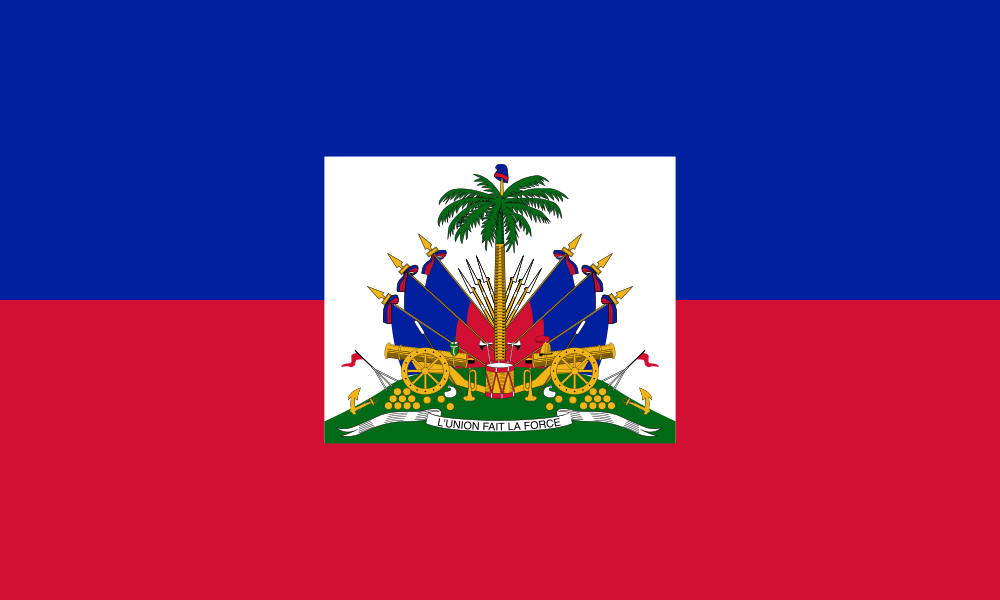
Population: 11,402,528
Total Land Area: 27,560 km2
Population/km2: 413.73
Official Visa Info: Direction de l'Immigration et de l'Émigration