
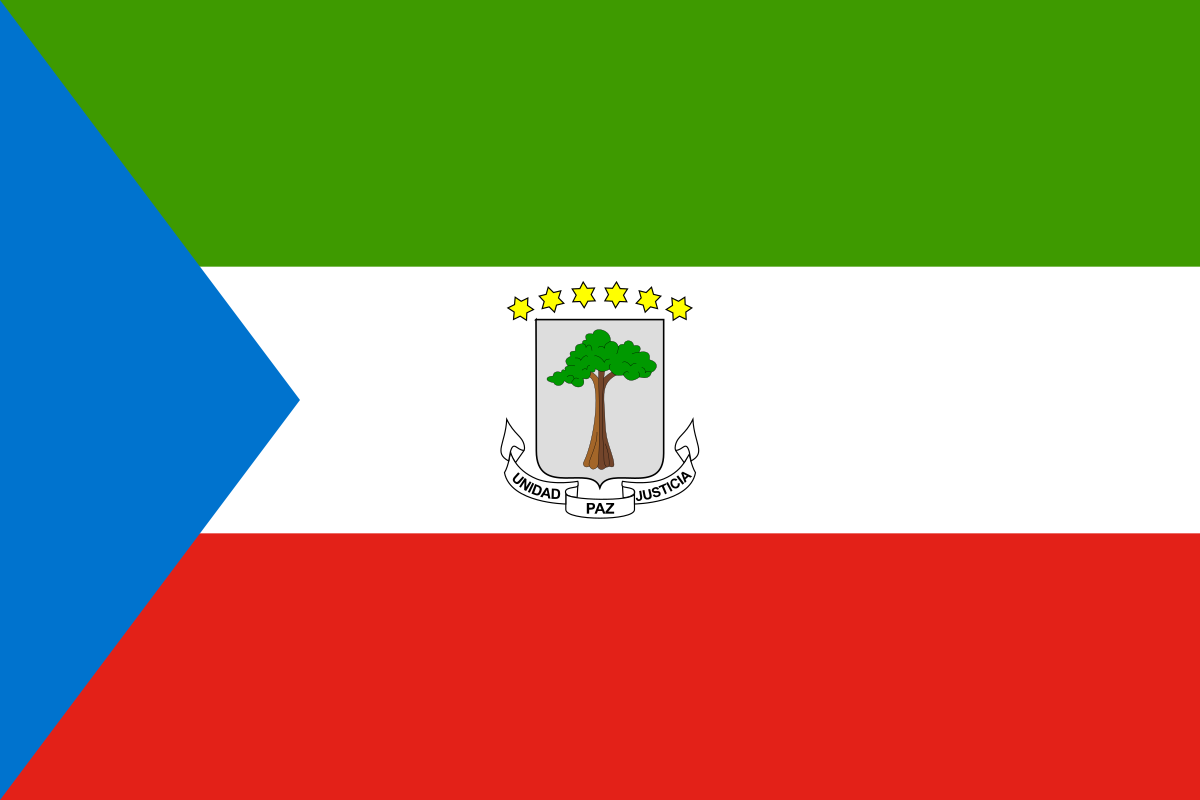
Equatorial Guinea
Equatorial Guinea is an oil-rich, developing country on the western coast of central Africa. Its capital and main port, Malabo, is located on the island of Bioko, off the coast of Cameroon. A secondary port, Luba, is also on Bioko. The mainland territory of Equatorial Guinea is bordered by Cameroon and Gabon. The principal city on the mainland is Bata. Official languages are Spanish, which is widely spoken, and French, which is widely understood and sometimes used in business dealings. Portuguese was recently made the country’s third official language, but is not widely used or spoken.
Equatorial Guinea is nominally a multiparty constitutional republic. In practice, however, all branches of government are dominated by President Teodoro Obiang Nguema Mbasogo, who has ruled since 1979. In November 2009, he was declared the winner of the presidential election with over 95 percent of the vote.
Equatorial Guinea is a beautiful country with many interesting sites and beaches, but information and facilities for tourists are limited but growing.
Read the Department of State’s Fact Sheet on Equatorial Guinea for additional information on U.S - Equatoguinean relations.
Transportation
TRAFFIC SAFETY AND ROAD CONDITIONS: While in Equatorial Guinea, you may encounter road conditions that differ significantly from those in the United States. U.S. citizens on short stays are permitted to drive with an International Driver’s License. Generally, Equatorial Guinea's road networks are increasingly well-developed. Speed limits are posted in kilometers but rarely observed, and travelers should remain alert for pedestrians and livestock, even on multi-lane highways. Traffic signals and crosswalks are increasingly common, but not always heeded by local drivers. Driving while intoxicated is widespread, particularly at night and during weekends and holidays. Travelers should take additional care when driving at night as many motorists do not use headlights and roads are inconsistently lit. If you plan on driving around the country for any length of time, you should purchase a cell phone for use in an emergency.
Equatoguinean cities have no reliable form of public transportation. Taxis, while inexpensive and readily available, are often poorly maintained, and taxi drivers frequently drive dangerously or while impaired. Travelers should be aware that taxis will stop to pick up additional passengers and may detour or drop passengers off out of sequence. Single travelers, particularly women, are advised to avoid taxis if possible, or to use taxi drivers personally known to them or recommended as being safe and reliable.
Travelers outside the limits of Malabo and Bata will encounter military roadblocks, and police checks are increasingly common in both cities. You should be prepared to show proper identification (for example, a copy of your U.S. passport) and to explain your reason for being at that particular location. The personnel staffing these checkpoints are often poorly trained and do not speak English or French; travelers who do not speak Spanish should have their reason for being in the country and their itinerary written down in Spanish, especially if planning to travel into the countryside. Travelers should be aware that many military facilities are poorly marked and inconsistently staffed, especially in isolated areas. Travelers should try to avoid these sites whenever possible.
There are currently no distracted driving laws in effect in the Equatorial Guinea, but police may pull over drivers who talk or text while driving for not following unspecific safe driving procedures.
Please refer to our Road Safety page for more information.
AVIATION SAFETY OVERSIGHT: As there is no direct commercial air service to the United States by carriers registered in Equatorial Guinea, the U.S. Federal Aviation Administration (FAA) has not assessed the government of Equatorial Guinea’s Civil Aviation Authority for compliance with International Civil Aviation Organization (ICAO) aviation safety standards. Further information may be found on the FAA’s safety assessment page.
Safety and Security
While Equatorial Guinea remains relatively safe, westerners are increasingly targeted for petty crime, harassment by officials, and similar situations that have the potential to turn violent. There is no indication that U.S. citizens are being specifically targeted.
Although large public demonstrations are uncommon, you should avoid large crowds, political rallies, and street demonstrations.
To stay connected:
- Enroll in the Smart Traveler Enrollment Program so we can keep you up to date with important safety and security announcements.
- Follow the Bureau of Consular Affairs on Twitter and Facebook.
- Bookmark the Bureau of Consular Affairs website, which contains the current Travel Warnings and Travel Alerts as well as the Worldwide Caution.
- In the event of an emergency, contact us at 1-888-407-4747 toll-free within the United States and Canada, or via a regular toll line, 1-202-501-4444, from other countries.
- Take some time before traveling to consider your personal security and check for useful tips for traveling safely abroad.
CRIME: Although violent crime is rare, there has been a rise in violent burglaries/home invasions and in overall hostility directed at westerners by police and other officials. Many situations, including petty or street crime and official harassment, have the potential to turn violent. U.S. citizens are advised to carry copies of their passports and other pertinent documents at all times. It may be useful to have notarized copies of biographical documents as these are often perceived by the authorities to be more official than non-notarized copies.
Since July 2013, there has been a significant increase in attacks against women, including U.S. citizens, by small groups posing as taxi drivers and passengers. The attacks have been most severe in the continental city of Bata and surrounding areas, but have also occurred in Malabo. Victims typically are held captive for up to an hour, threatened at knife-point, and robbed. We strongly recommend taking taxis only in groups, using taxi drivers personally known to you, or avoiding the use of taxis altogether, especially in Bata. In August 2015, shortly after getting into a taxi, a non-U.S. citizen expatriate was robbed and raped on her way to the airport. In the same month, another expatriate was robbed by four locals while exiting a taxi at approximately 6:00 AM.
You should avoid dark alleys, remote locations, and traveling alone. Sexual assault is rare against westerners. There is little evidence of racially-motivated hate crimes or crime targeted against elderly travelers or the LGBT community. Generally, the police are responsive to reports of crimes by U.S. citizens, but it is common to be asked to pay a substantial sum of money (between US $50 to $100) in order to file a police report or obtain a copy of a police report on file.
VICTIMS OF CRIME: If you or someone you know becomes the victim of a crime abroad, you should contact the local police and the nearest U.S. embassy or consulate. We can:
- Replace a stolen passport.
- Help you find appropriate medical care if you are the victim of violent crimes such as assault or rape.
- Put you in contact with the appropriate police authorities, and if you want us to, we can contact family members or friends.
- Help you understand the local criminal justice process and direct you to local attorneys, although it is important to remember that local authorities are responsible for investigating and prosecuting the crime.
There is no local equivalent of the “911” emergency system in Equatorial Guinea. To reach local police in Malabo, you can call 113. The National Security number is 666 555 532.
Please see our information on victims of crime, including possible victim compensation programs in the United States
Population: 1,402,985
Total Land Area: 28,050 km2
Population/km2: 50.02