Moldova
The Republic of Moldova is a parliamentary democracy. Moldova is a member of NATO's Partnership for Peace program as well as a member of the Council of Europe. The capital, Chisinau, offers adequate hotels and restaurants, but tourist facilities in other parts of the country are not always highly developed and some of the goods and services taken for granted in other countries are not yet available. Read the Department of State’s Fact Sheet on Moldova for additional information on U.S.-Moldovan relations.
Transportation
TRAFFIC SAFETY AND ROAD CONDITIONS: Road conditions may differ significantly from those in the United States. . Moldova's highway infrastructure consists mainly of two-lane roads that often lack signage, are unevenly maintained, and seldom have lighting. Be careful of tractors, bicyclists, horse-drawn carts, pedestrians, and livestock on the road. Streets in Moldova are not well maintained. Try to limit driving outside cities to daylight hours. Many Moldovan drivers would be considered aggressive or erratic by U.S. standards.
Many accidents involve drunk drivers. Moldova’s maximum legal blood alcohol content is 0.03%, which is well under the levels allowed in most states in the United States. If you drive with a blood alcohol level above 0.08%, you will be charged in criminal court. However, traffic police generally do not have testing equipment at roadside, so if they can smell alcohol on your breath, you're likely to be charged with a crime. If this happens, you have the right to request a blood test to confirm your actual blood alcohol level. To be safe, don't drink alcohol before driving.
The quality and safety of public transportation vary widely. Trains, trolleybuses, and buses are often old and frequently break down. Taxis are available in most urban areas, and vary from old Soviet-era vehicles to new Western European or U.S. vehicles. Emergency services are generally responsive, although you may not find an English-speaking operator. You can call police at 902 and an ambulance at 903.
Please refer to our Road Safety page for more information. Also, we suggest that you visit the website of the country’s national tourist office and national authority responsible for road safety.
AVIATION SAFETY OVERSIGHT: As there is no direct commercial air service to the United States by carriers registered in Moldova, the U.S. Federal Aviation Administration (FAA) has not assessed the Government of Moldova’s Civil Aviation Authority for compliance with International Civil Aviation Organization (ICAO) aviation safety standards. Further information may be found on the FAA’s safety assessment page.
Safety and Security
Although, we are currently unaware of specific threats against U.S. citizens in Moldova, stay aware of your surroundings at all times. There are frequent political and social demonstrations, of varying size, generally held outside government buildings and in large public areas in Chisinau. These are generally peaceful demonstrations; however, due to the large crowds and narrow roads, the main traffic arteries become heavily congested or blocked for hours at a time. As with any large crowd there is always a potential for disorder or violence, and travelers are encouraged to avoid areas during demonstrations and monitor local news for current information. Security messages regarding demonstration and strikes are posted on the Embassy’s website.
Police have the legal right to ask for identification on the street, therefore you should carry your passport or a photocopy with you at all times. A separatist regime controls the Transnistria region. Be careful when visiting or crossing into Transnistria, since the U.S. Embassy may not be able to help if you encounter difficulties. There are many checkpoints along roads leading into and out of Transnistria. Taking photographs of checkpoints, military facilities, and security forces is prohibited.
Members of racial minority groups visiting Moldova have reported that they were stared at, verbally abused, assaulted, denied entrance into some clubs and restaurants, or harassed by police. While Moldovan police can be helpful and might assist travelers in need, there have been reports of U.S. citizens being harassed, mistreated, or subjected to extortion by Moldovan police. If a policeman stops you, you have a right to see his or her identity card ("legiti-MAT-seeya" in Romanian). Traffic police should also display a metal badge on the outside of their uniforms. If the police officer harasses you or asks for a bribe, try to remember the official's name, title, badge number, description, and contact the U.S. Embassy to report the incident at the earliest possibility.
To stay connected:
- Enroll in the Smart Traveler Enrollment Program so we can keep you up to date with important safety and security announcements.
- Follow the Bureau of Consular Affairs on Twitter and Facebook.
- Bookmark the Bureau of Consular Affairs website, which contains the current Travel Warnings and Travel Alerts as well as the Worldwide Caution.
- Follow the U.S. Embassy in Moldova on Twitter and by visiting the Embassy’s website.
- In the event of an emergency, contact us at 1-888-407-4747 toll-free within the United States and Canada, or via a regular toll line, 1-202-501-4444, from other countries.
- Take some time before traveling to consider your personal security and checking for useful tips for traveling safely abroad.
CRIME: Most travelers to Moldova enjoy a safe and pleasant stay. Occasionally, travelers become victims of crime, usually petty theft, but sometimes more serious fraud.. Some U.S. citizens have reported theft of money, passports, and small valuables from hotel rooms and local apartments, along with home and office burglaries. Exercise the same degree of caution as you would in any major U.S. city. Be cautious when using ATMs in Moldova. Some U.S. citizens have reported unauthorized access to their accounts after using ATMs (although banks sometimes post their fees later as separate transactions). There are also reports of PIN theft from ATMs in Moldova, either by "skimming" devices, which record the card information, or by hidden cameras or "shoulder surfing." Train and bus services are below Western European standards and some U.S. citizens have been robbed while traveling on international trains to and from Moldova. Be on your guard against pickpockets on public transit. U.S. citizens who use the Moldovan postal service have reported that international letters and package mail are sometimes opened or pilfered.
VICTIMS OF CRIME: If you or someone you know becomes the victim of a crime abroad, you should contact the local police and the nearest U.S. embassy or consulate. We can:
- Replace a stolen passport.
- Help you find appropriate medical care if you are the victim of violent crimes such as assault or rape.
- Put you in contact with the appropriate police authorities, and if you want us to, contact family members or friends.
- Help you understand the local criminal justice process and direct you to local attorneys, although it is important to remember that local authorities are responsible for investigating and prosecuting the crime.
The local equivalents to the "911" emergency line in Moldova are: 901 (Fire), 902 (Police) and 903 (Ambulance). You may have difficulty finding an English-speaking operator.
Please see our information for victims of crime, including possible victim compensation programs in the United States.
Internet fraud warning: There are various internet scams in Moldova that target foreigners. In the past, "phishing" schemes have hacked the bank accounts of U.S. businesses and transferred the money to Moldova. Internet auction fraud, in which buyers fail to pay for purchases or send counterfeit checks as payment, is not uncommon.
Be aware of dating scams, in which someone you met over the internet asks for money to help their family, buy plane tickets, pay medical bills, provide "economic solvency funds," etc. A number of U.S. citizens have been defrauded. Fraud committed in Moldova is subject to Moldovan law and could prove difficult to prosecute. The U.S. Embassy can do little to assist U.S. citizens defrauded via the Internet. Please see our information on International Financial Scams.
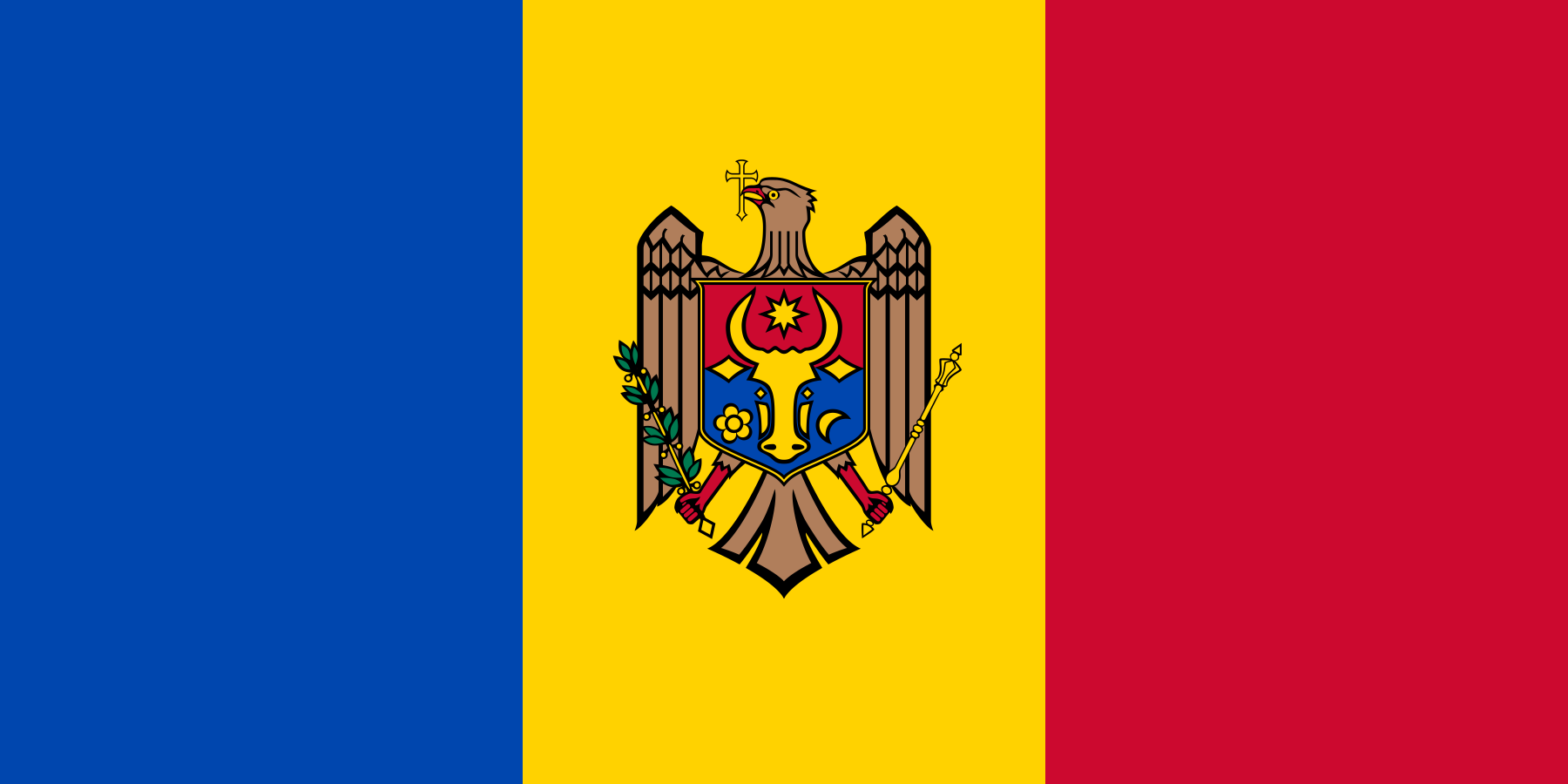
Population: 4,033,963
Total Land Area: 32,850 km2
Population/km2: 122.80
Official Visa Info: Bureau for Migration and Asylum