
Azerbaijan
Azerbaijan is a constitutional republic with a developing economy. Western-style amenities are found in the capital, Baku, but infrastructure and access to goods and services outside the city, while improving, are below Western standards. Read the Department of State’s Fact sheet on U.S.–Azerbaijan relations for further information.
Transportation
TRAFFIC SAFETY AND ROAD CONDITIONS: While in Azerbaijan, U.S. citizens may encounter road conditions that differ significantly from those in the United States. Fatalities from traffic accidents are high and continue to rise each year. The information below concerning Azerbaijan is provided for general reference only and may not be totally accurate in a particular location or circumstance.
Azerbaijan is rebuilding its roadway system. Although the newer sections of the road system are a marked improvement, the older sections are poorly constructed and poorly lighted. There are unfinished road sections that are extremely dangerous due to lack of proper construction and hazard signage.
Driving hazards, such as open manholes, debris, and potholes, are common in Baku. Many drivers do not pay attention to traffic regulations, signals, lane markings, pedestrians, or other drivers. Drivers often travel at extremely high speeds, and accidents are frequent and often serious. Pedestrians often do not use crosswalks to cross the street and often stand in the median between lanes of traffic, even at night. Driving in Baku should be considered extremely hazardous. Outside the city, even where roads are present, conditions are similar. Roads are often in poor repair and unlighted, and they lack lane markings, traffic signs, and warnings. Many rural roads are largely unpaved.
Throughout Azerbaijan, traffic police enforce traffic laws inconsistently, and routine traffic stops are common. If stopped, drivers should have all required documents with them, including passport or local registration documents, driver’s license, vehicle registration documents, and proof of insurance. Talking on a cell phone while driving carries a fine of AZN 50 (64 USD). Driving under the influence carries a fine of AZN 80-100 (102-128 USD) and 5 points. If you get 10 points in one year, the fine is AZN 120-150 AZN (153-191 USD) and two years’ suspension of your driver’s license.
Most taxis in Baku are not metered, so visitors should negotiate the fare before entering a taxi. Asking for a reasonable fare is expected and appropriate. The 189 telephone taxi service provides the fare in advance and specifies the license number of the taxi to be dispatched. The purple London-style taxi cabs (*9000) have been introduced in Baku. All purple London-style taxis are metered, but passengers should confirm that the fare meter is activated appropriately. Unmarked taxis, “gypsy cabs,” should be avoided.
The Baku metro system is an inexpensive and good option for transportation, with three new stations planned to open by 2015. Security cameras provide excellent coverage of all metro platforms throughout the metro system. There are police units at each metro station, and bag checks may be carried out at the entrance to each station. Although the city of Baku has invested in new buses, and the quality of its underground metro system is very good, public transportation throughout the remainder of the country remains overcrowded and poorly maintained.
Sidewalks and pedestrian plazas often use marble paving stones. Marble is particularly slippery when wet and during icy conditions. Falling on paving stones can cause serious injury. Therefore, extreme care should be taken when walking during rainy or icy conditions.
Please refer to our Road Safety page for more information. Also, we suggest that you visit the website of the Azerbaijani Ministry of Transport.
AVIATION SAFETY OVERSIGHT: The Federal Aviation Administration (FAA) has assessed the government of Azerbaijan’s State Civil Aviation Administration is in compliance with International Civil Aviation Organization (ICAO) aviation safety standards. Further information may be found on the FAA’s safety assessment page.
Travelers on regional airlines in the Caucasus may experience delays and sudden cancellations of flights. Even basic safety features such as seat belts are sometimes missing. Air travel to Azerbaijan on international carriers via Europe is typically more reliable.
Safety and Security
In light of ongoing global and regional threats against U.S. and foreign interests, U.S. citizens are advised to remain vigilant, particularly in public places frequented by or associated with westerners. In the past, spontaneous demonstrations and riots have happened and some have been suppressed with force.
Separatists, with Armenia’s support, continue to control most of Nagorno-Karabakh and seven other Azerbaijani territories. The final status of Nagorno-Karabakh remains the subject of international mediation by the Organization for Security and Cooperation in Europe (OSCE) Minsk Group, co-chaired by Russia, the United States, and France, and a cease-fire regime has been in effect since 1994. However, travelers need to be aware there are frequent violations.
Hostilities continue along the Nagorno-Karabakh Line of Contact separating Azerbaijani and Armenian positions, often resulting in injuries and death. Consular services are not available to U.S. citizens in Nagorno-Karabakh or the occupied territories surrounding it. You should avoid travel to these areas. Travel across the Azerbaijan-Armenia international border is also not possible due to ongoing hostilities. Travelers should remain clear of the border areas and comply with Azerbaijani checkpoints set up to keep travelers from hazardous areas.
Also, although de-mining operations have been conducted, land mines remain in some areas in and near the conflict zones along the Armenia-Azerbaijan border and the Line of Contact, as well as inside Nagorno-Karabakh and the surrounding territories. Land mines result in a handful of deaths and injuries each year.
Traveling to the region of Nagorno-Karabakh and the surrounding territories via Armenia without the consent of the Government of Azerbaijan, is unlawful and could make a traveler ineligible to visit Azerbaijan in the future. Engaging in any commercial activities in the Nagorno-Karabakh and the surrounding territories, whether directly or through business subsidiaries, without the consent of the Government of Azerbaijan, can result in criminal prosecution and/or other legal action being taken against individuals and/or businesses in Azerbaijan. It may also affect your ability to travel to Azerbaijan in the future.
If you are of Armenian ancestry, travel to Azerbaijan presents risks. The Government of Azerbaijan has stated it is unable to guarantee your safety, though the U.S. Embassy has not received reports of threats to U.S. citizen travelers’ safety based solely on their Armenian heritage.
You should exercise caution when travelling to the culturally conservative and unrest-prone region of Nardaran, located 45 km from Baku on the Absheron Peninsula. Nardaran has been the site of several volatile anti-American and anti-Israel sentiments protests in the last several years.
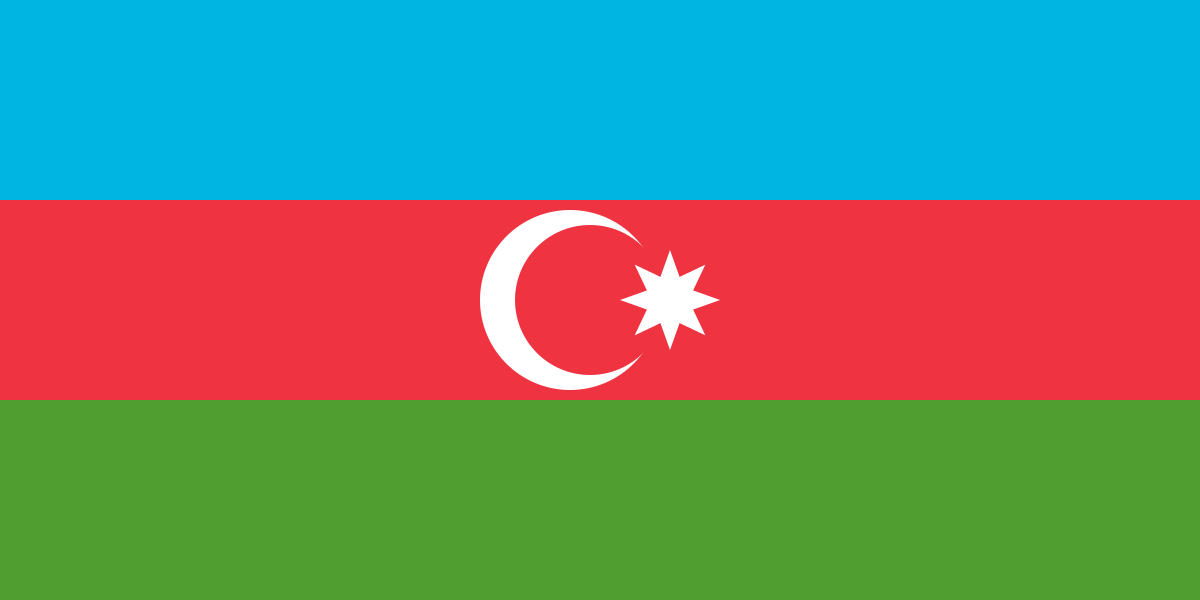
Population: 10,139,177
Total Land Area: 82,658 km2
Population/km2: 122.66
Official Visa Info: State Migration Service (ASAN Visa)