
Greece
Greece is a developed and stable democracy, but is currently experiencing banking disruptions that could affect various sectors of the economy suddenly. Tourist facilities are widely available, but visitors may consider purchasing trip insurance and traveling with tickets that allow flexibility for changes. Read the Department of State’s Fact Sheet for additional information on U.S.- Greece relations.
Transportation
TRAFFIC SAFETY AND ROAD CONDITIONS: While in Greece, you will encounter road conditions that differ significantly from those in the United States. Drivers and pedestrians alike should exercise extreme caution when operating motor vehicles or when walking along roadways or crossing streets, mindful that Greece's traffic fatality rates are the fifth-highest of the 28 nations that make up the European Union. Visitors to Greece must be prepared to drive defensively. Heavy traffic, poor roads, obscured traffic signs, and high speeds pose hazards, especially at night or in inclement weather. Greece is a mountainous country; cold weather and elevation can additionally contribute to treacherous road conditions and closures.
Be especially careful if you are riding a motorbike. The law in Greece requires motorcyclists to wear a helmet. You may see many wearing theirs on the arm, but do not be tempted to follow their example. When driving, be sure to double-check rear and side mirrors, as motorbikes will often ride between lanes and pass on both the left and right. On many two-lane highways, slower traffic will drive on the shoulder and cars will pass straddling the center, double yellow line.
Small motorbike and ATV rental firms frequently do not insure their vehicles; customers are responsible for damages and should review their coverage before renting.
Talking on a cell phone while driving is illegal in Greece; the police check cell phone call records when investigating accidents.
Driving while under the influence of an alcoholic substance is illegal. Each municipality may have more restrictive provisions, but in general, penalties include fines (250 to 2000 Euro), suspension of license, and may also include mandatory confinement. Alcohol levels are lower than those established in the United States. For vehicle operators, the violation occurs as low as .25 mg/l BrAC (.05% BAC). For new drivers (less than two years since license issued), motorcycle/moped drivers, and professional drivers (e.g., taxi/bus operators), the violation occurs as low as .10 mg/l BrAC (.02% BAC). Police may conduct random testing, without probable cause.
There are a number of nationwide auto-service clubs and plans, similar to those in the United States, providing towing and roadside service, which a tourist can call and pay per service; the largest, quite similar to AAA, is ELPA, whose nationwide phone number is 10400.
License Requirements: Tourists and temporary residents who will stay in Greece for fewer than 185 days and plan to drive must carry a valid U.S. license as well as an international driver's permit (IDP). Failure to have both documents may result in police detention or other problems. Fines for drivers without complete documentation are high. The U.S. Department of State has designated two organizations to issue IDPs to those who hold valid U.S. driver's licenses: AAA and the National Automobile Club. Issuance of an IDP is quick and inexpensive, but must generally be done before a traveler leaves the United States.
According to Greek law, vehicles – including motorbikes and all-terrain vehicles (ATVs) - may not be rented without the IDP, although sometimes rental agencies do not obey this law. In the event of an accident, some insurance companies will not cover your claim unless you can show you had both a valid U.S. license and the IDP. Additionally, a visiting driver without both a U.S. license and an IDP can be cited by the police for failure to have valid authority to drive and, in the case of an accident, may be open to civil suit. Individuals who expect to spend more than 185 days in Greece should either obtain a Greek license or convert their valid U.S. license for use in Greece through their local Regional Office of Transportation and Communications.
Please refer to our Road Safety page for more information. Also, we suggest that you visit the Greek National Tourist Office website.
AVIATION SAFETY OVERSIGHT: The U.S. Federal Aviation Administration (FAA) has assessed the government of Greece’s Civil Aviation Authority as being in compliance with International Civil Aviation Organization (ICAO) aviation safety standards for oversight of Greece’s air carrier operations. Further information may be found on the FAA’s safety assessment page.
Safety and Security
Like other countries that are members of the Schengen Agreement for free cross-border movement, Greece's open borders with other members of the Schengen zone allow for the possibility of terrorist groups entering/exiting the country with anonymity. As the first entry point into Schengen from points south and east, Greece's long coastline and many islands increase the possibility that foreign-based terrorists might try to enter Europe through its borders.
Greece continues to experience sporadic violence attributed to terrorist organizations. In the spring of 2014, the domestic terrorist group Revolutionary Struggle claimed responsibility for a car bomb outside the Bank of Greece. In 2013, in Athens and Thessaloniki unknown individuals conducted small-scale attacks on the homes of journalists and judges, several political party offices, banks, ministries, tax offices, and privately owned vehicles. The domestic terrorist group Conspiracy of Fire Nuclei claimed responsibility for planting a small bomb in a prominent shopping mall in a northern suburb of Athens, causing minor injuries to two people; alleged members of the this group were arrested for armed bank robbery in northern Greece. Unknown perpetrators fired approximately 60 rounds at the German Ambassador’s residence in Athens.
Strikes and demonstrations, mostly small-scale, are a regular occurrence. As a result of structural reforms and other measures imposed by the government, the ongoing economic recession, and continuing high unemployment, members of labor unions, certain professions, and other groups affected by the recession on occasion hold demonstrations, work stoppages, and marches throughout the center of Athens and Thessaloniki. Strikes in the transportation sector can affect traffic and public transportation, to include taxis, ports, and airports; most are of short duration, but you should always reconfirm domestic and international flights before heading to the airport. Demonstrations also occur annually on November 17, the anniversary of the 1973 student uprising against the military regime in power at the time.
University campuses are exploited by anarchists and criminals as refuges. Demonstrators frequently congregate in the Polytechnic University area; Exarchia, Omonia, and Syntagma Squares in Athens; and at Aristotle Square, Aristotle University, and the Kamara area in Thessaloniki. U.S. citizens should be aware of demonstrations and avoid areas where demonstrations are underway, as even demonstrations and strikes intending to be peaceful can become violent.
Violent anarchist groups have joined public demonstrations to clash with police and vandalize public and private property. Riot-control procedures, employed only rarely, include the use of tear gas and/or water cannons. Visitors should stay informed about demonstrations from local news sources and hotel security. Information regarding demonstrations that have been brought to the attention of the U.S. Embassy can be found on the Embassy website and on our Consular Section Facebook page.
There have been reports of unprovoked harassment and violent attacks against persons who, because of their complexion, are perceived to be foreign migrants. U.S. citizens most at risk are those of African, Asian, Hispanic, or Middle Eastern descent. Travelers are urged to exercise caution, especially in the immediate vicinity of Omonia Square from sunset to sunrise. Travelers should avoid Exarchia Square and its immediate vicinity at all times. The U.S. Embassy has confirmed reports of U.S. African-American citizens detained by police authorities conducting sweeps for illegal immigrants in Athens.
Visitors during Easter are strongly urged to exercise caution when attending the celebrations that occur at midnight on Holy Saturday. Festivities normally involved the large scale use of fireworks, some of which are homemade and illegal. There have been incidents where spectators have suffered severe, sometimes fatal injuries as a result of these fireworks.
U.S. citizens are strongly urged to carry their passport or some form of photo identification with them at all times when traveling in Greece. You should note that in Greece, you may be taken in for questioning by the police if you don’t have your passport with you.
To stay connected:
- Enroll in the Smart Traveler Enrollment Program so we can keep you up to date with important safety and security announcements.
- Follow the Bureau of Consular Affairs on Twitter and Facebook.
- Bookmark the Bureau of Consular Affairs website, which contains the current Travel Warnings and Travel Alerts as well as the Worldwide Caution.
- Follow the U.S. Embassy in Greece on Twitter and visit the Embassy’s website.
- In the event of an emergency, contact us at 1-888-407-4747 toll-free within the United States and Canada, or via a regular toll line, 1-202-501-4444, from other countries.
- Take some time before traveling to consider your personal security and checking for useful tips for traveling safely abroad.
CRIME: You should take the usual safety precautions you would in any urban or tourist area during a visit to Greece. Crimes against tourists (such as pick-pocketing and purse-snatching) occur at popular tourist sites and on public transportation—especially the Metro—and in some shopping areas in and around Thessaloniki. If you travel by Metro, keep track of your belongings at all times. Thieves will often try to create a diversion to draw your attention away from your immediate surroundings. These diversions can include accidentally sneezing or spilling something on you and loudly accusing you of having bumped into them. Thieves ride the trains in from the Athens Airport, so be especially vigilant when using this transportation.
Be discreet when discussing plans and organizing your belongings upon your initial arrival. Always keep a close eye on your belongings. Avoid standing near the doors, as thieves will often strike just as the train/bus doors open and then dash onto the platform and disappear into the crowd. Omonia, Vathi, and Kolokotroni Squares in Athens, while very close to the tourist sites, are areas with high crime rates; Glyfada Square has a significant organized-crime network associated with its clubs, which should be avoided if you get a hard-sell pitch for business. Never agree to go to a bar or club with someone you have just met on the street. Sexual assaults of U.S. citizens, including date or acquaintance rape, are not uncommon. Drink alcohol in moderation and stay in control. Never leave your drink unattended in a bar or club. Some bars and clubs serve counterfeit or homemade spirits of unknown potency.
Due to an increase of card skimming at ATMs throughout Greece, it is recommended that you use one located inside a bank or hotel. Do not use ATMs located in dark or isolated areas. Before using an ATM, check to see if anything is stuck to the machine and/or if it looks unusual in any way. When using an ATM, always stay focused on what you are doing, and cover the keypad with your free hand to prevent anyone from seeing your PIN.
In the last few years, we have seen a number of instances of Grandparent Scams. This scam targets elderly citizens in the United States and convinces them to wire money to assist a relative (often a grandchild) in distress overseas. Review our Financial Scams page for the full picture on this and many other scams.
VICTIMS OF CRIME: If you or someone you know becomes the victim of a crime abroad, you should contact the local police and the nearest U.S. embassy or consulate. We can:
- Replace a stolen passport.
- Help you find appropriate medical care if you are the victim of violent crimes such as assault or rape.
- Put you in contact with the appropriate police authorities, and if you want us to, contact family members or friends.
- Help you understand the local criminal justice process and direct you to local attorneys, although it is important to remember that local authorities are responsible for investigating and prosecuting the crime.
The local equivalent to the “911” emergency line in Greece are112 for life-threatening emergencies (this is a Europe-wide emergency number and has English-speaking operators), 100 for the Police, 166 for an Ambulance, and 199 for the Fire Brigade.
Please see our information for victims of crime, including possible victim compensation programs in the United States.
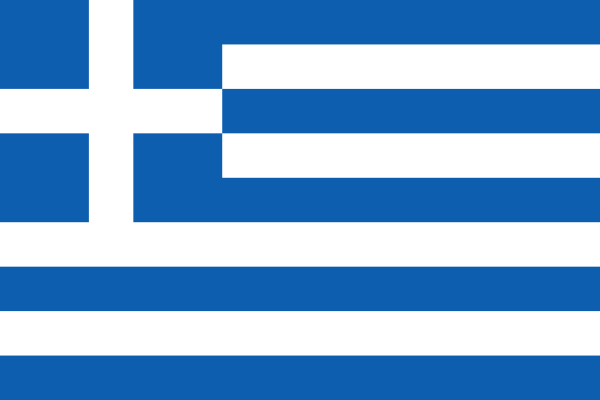
Population: 10,423,054
Total Land Area: 128,900 km2
Population/km2: 80.86
Official Visa Info: Ministry of Foreign Affairs