
Saudi Arabia
Saudi Arabia is a monarchy ruled by a king chosen from and by members of the Al Saud family. The king rules through royal decrees issued in conjunction with the Council of Ministers, and with advice from the Consultative Council. The king appoints members of both councils. Saudi interpretation of Islamic law is the basis of the authority of the monarchy and provides the foundation of the country's conservative customs and social practices. Saudi Arabia has a modern and well-developed infrastructure, and facilities for travelers are widely available. Read the Department of State’s Fact Sheet on Saudi Arabia for additional information.
Transportation
TRAFFIC SAFETY AND ROAD CONDITIONS: While in Saudi Arabia, you will encounter road conditions that differ significantly from those in the United States. The information below concerning Saudi Arabia is provided for general reference only, and may not necessarily apply to all locations and circumstances.
Saudi Arabia employs an automatic traffic control ticketing and management system called “Saher” to improve traffic safety in major cities. The system is a network of digital cameras linked to the National Information Center of the Ministry of Interior to monitor traffic accidents and violations.
Residents should update their personal details through one of the methods available here to receive SMS notifications once a traffic ticket is issued. Delay in payment of any ticket might result in doubling of the ticket amount. Travelers will need to pay any fines issued through this system before leaving the country; this may be possible at the airport but only during regular Saudi office hours.
Temporary male visitors may drive using their U.S. driver's license. Foreign men employed in Saudi Arabia must obtain a local driver's license from the Department of Traffic Police. Women are not allowed to drive or ride motorcycles, bicycles, or any other type of vehicle on public roads. Article no. 42/3 of the Saudi Traffic Law states that a valid foreign or international driver’s license can be used for either a year or until the expiration date, whichever is closer.
According to the World Health Organization’s (WHO) 2013 Global Status Report on Road Safety, Saudi Arabia has one of the world’s highest traffic accident and death rates. Driving habits are generally poor, and accidents involving vehicles driven by minor children are not uncommon. There is little regard for lane markings, and the right of way is often disregarded. The main causes for accidents are speeding, unauthorized passing, and running red lights. In the event of a traffic accident resulting in personal injury, everyone involved (if not seriously injured) may be taken to the local police station. Drivers are likely to be held for several days until responsibility is determined and any reparations paid. In many cases, all drivers involved in an accident are held in custody regardless of fault. U.S. citizens involved in a serious accident resulting in injury or death should immediately contact their sponsors and the U.S. Embassy or nearest U.S. Consulate. Please refer to our Road Safety page for more information.
Air Transit: Air travelers may find lower-cost tickets between countries that include long layovers in Saudi airports. Be advised that Saudi Arabia does not grant transit visas to air travelers, so any layover will be spent entirely in the airport. Past experience shows that this is also true when flights are cancelled or delayed, occasionally leading to lengthy wait times in the gate area without access to other parts of the airport. Services available to travelers may be extremely limited.
AVIATION SAFETY OVERSIGHT: The U.S. Federal Aviation Administration (FAA) has assessed the Government of Saudi Arabia's Civil Aviation Authority as being in compliance with International Civil Aviation Organization (ICAO) aviation safety standards for oversight of Saudi Arabia's air carrier operations. Further information may be found on the FAA safety assessment page.
Safety and Security
Significant enhancements in the capacity and capability of Saudi security and intelligence forces have greatly improved the security environment, but the Department of State urges U.S. citizens to consider carefully the risks of traveling to Saudi Arabia.
Terrorist groups, some of which are affiliated with al-Qa’ida, continue to have a presence and may employ a wide variety of tactics in targeting Western interests, housing compounds, hotels, shopping areas, and other facilities where Westerners congregate. These terrorist groups may also target Saudi government facilities and economic/commercial targets within the Kingdom. Terrorists often do not distinguish between U.S. Government personnel and private U.S. citizens.
Some areas of Saudi Arabia are particularly dangerous, including the region along the long, porous border with Yemen. In January 2009, Yemen became the official headquarters for al-Qa’ida in the Arabian Peninsula (AQAP), a joint organization of Saudi and Yemeni al-Qa’ida members that seek to attack government and Western interests on the Arabian Peninsula and abroad. On July 5, 2014, media reported that members of al-Qa’ida attacked a border checkpoint between Yemen and Saudi Arabia on July 4, leading to the deaths of several of the attackers, as well as four members of the Saudi security forces. The rugged border area dividing Yemen and Saudi Arabia is not clearly defined and U.S. government personnel are restricted from traveling within 50 miles of the border, which includes the cities of Jizan and Najran, without permission from Embassy security officials. Visitors should stay away from this area to avoid falling victim to terrorist and criminal elements operating there.
In addition, in January 2014, two German diplomats were attacked by unknown gunmen while traveling through the Awamiyah neighborhood of the al-Qatif Governorate in the Eastern Province of Saudi Arabia. While the attack disabled their vehicle, the two diplomats escaped to safety. The U.S. Embassy in Saudi Arabia advises all U.S. citizens to avoid Awamiyah.
In October 2014, three U.S. citizens were attacked by a sole gunman at a gas station outside of Riyadh. An investigation is ongoing. One of the victims was killed, another was wounded, and a third was unharmed.
If you choose to visit or live in Saudi Arabia, you are strongly urged to avoid staying in hotels or housing compounds that do not implement stringent security measures. Please note that the U.S. Embassy cannot intervene to improve housing provided by sponsors, or provide security. You should always remain aware of your surroundings, especially when visiting establishments frequented by Westerners. To the extent possible, maintain a low profile, vary times and routes of travel, and exercise caution while driving; incidents of road rage have occurred.
Ensure that your travel documents and visas are current, valid, and secured in a safe place. Carry a photocopy of your travel documents in lieu of the originals. On occasion, the U.S. Embassy and Consulates in Saudi Arabia may restrict travel of U.S. officials or suspend public services for security reasons. Whenever threat information is specific, credible, and non-counterable, the U.S. Government will make it available to the U.S. public. In those instances, the Embassy and Consulates will keep the local U.S. citizen community apprised through the Smart Traveler Enrollment Program (STEP) and make every effort to provide emergency services to U.S. citizens. Messages to U.S. citizens in Saudi Arabia are available at the U.S. Embassy Riyadh website.
The United States Maritime Administration (MARAD) has advised that regional tensions create risks of maritime attacks on vessels operating in the Gulf of Oman, North Arabian Sea, Gulf of Aden, and the Bab el Mandeb regions.
MARAD recommends that vessels at anchor, operating in restricted maneuvering environments, or at slow speeds remain especially vigilant, and report suspicious activity. U.S.-flagged vessels that observe suspicious activity in the area are advised to report it, as well as any hostile action to the U.S. Fifth Fleet’s “battle watch captain” at 011-973-1785-3879. All suspicious activities and events are also to be reported to the U.S. Coast Guard National Response Center at: 800-424-8802, or 202-267-2675, or TDD 202-267-4477. The complete advisory is available on the MARAD website.
To stay connected:
- Enroll in the Smart Traveler Enrollment Program so we can keep you up to date with important safety and security announcements.
- Follow the Bureau of Consular Affairs on Twitter and Facebook.
- Bookmark the Bureau of Consular Affairs website, which contains the current Travel Warnings and Travel Alerts as well as the Worldwide Caution.
- Follow the U.S. Embassy in Saudi Arabia on Twitter and visit the Embassy’s website.
- In the event of an emergency, contact us at 1-888-407-4747 toll-free within the U.S. and Canada, or via a regular toll line, 1-202-501-4444, from other countries.
- Take some time before traveling to consider your personal security and check for useful tips for traveling safely abroad.
CRIME: Crime in Saudi Arabia has increased over recent years, but remains at levels far below most major metropolitan areas in the United States. Visitors should take precautions to reduce their risk of becoming victims of crime. Individuals should be aware of their surroundings, keep valuables out of sight and secure, and travel with a companion, if possible. Private Saudi citizens who perceive that a foreigner is not observing conservative standards of conduct or dress have been known to harass, pursue, or assault that person. The U.S. Embassy in Riyadh cautions U.S. citizens that Saudi Arabian police have detained potential witnesses to crimes without charges or access to legal counsel, and with limited or delayed consular access, during the investigative stage of criminal cases, which can take months. On occasion, Saudi authorities have temporarily confiscated the personal effects of detained potential witnesses. Even when released from detention, witnesses to criminal incidents may be prohibited from leaving the country until investigation of the incident is complete.
In 2011 and 2012, the U.S. Embassy in Riyadh received several reports of carjacking incidents in Riyadh and throughout the Kingdom. These incidents involved multiple criminals who, in some instances, used force or a display of force. In other incidents, the criminals created a diversion such as a minor traffic accident or some other ruse to coax the driver out of the car. In the few cases involving Westerners, it appears that they were targeted because of the make of their cars rather than the fact that they were Westerners. As in the United States, most vehicles are stolen for parts. If you are a victim of such an attack, please see the Victims of Crime section below for guidance on reporting the incident to the authorities.
Do not buy counterfeit and pirated goods, even if they are widely available. Not only are these goods illegal in the United States, they are a violation of local law as well.
VICTIMS OF CRIME: If you or someone you know becomes the victim of a crime abroad, you should contact the local police and the nearest U.S. embassy or consulate. We can:
- Replace a stolen passport.
- Help you find appropriate medical care if you are the victim of violent crimes such as assault or rape.
- Put you in contact with the appropriate police authorities, and if you want us to, contact family members or friends.
- Help you understand the local criminal justice process and direct you to local attorneys, although it is important to remember that local authorities are responsible for investigating and prosecuting the crime and we cannot pay your legal expenses or fines.
The local equivalent to the “911” emergency line for police is “999.”
Please see our information on victims of crime, including possible victim compensation programs in the United States.
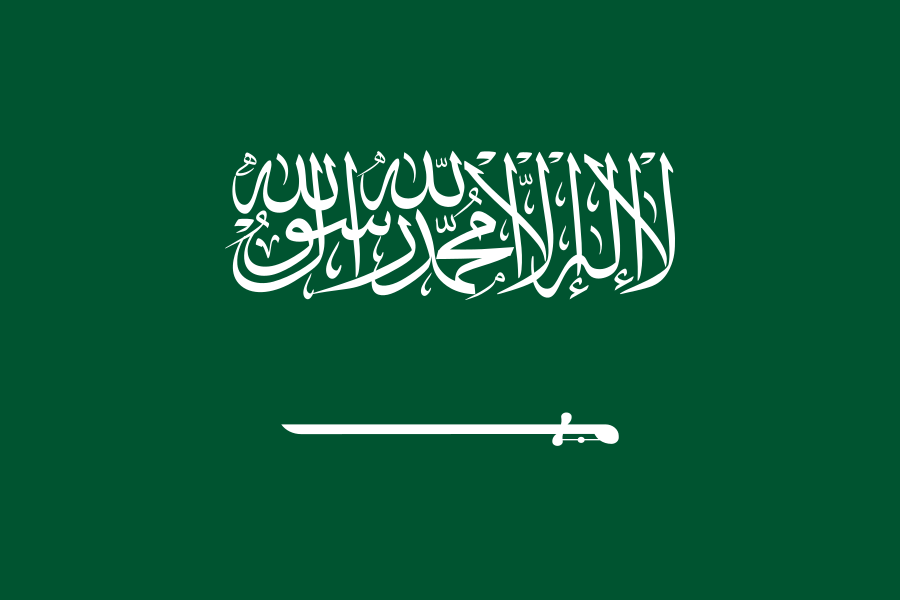
Population: 34,813,871
Total Land Area: 2,149,690 km2
Population/km2: 16.19
Official Visa Info: Ministry of Foreign Affairs / unified KSA Visa platform