
Congo (Congo-Brazzaville)
The Republic of the Congo (Congo-Brazzaville) is a developing nation in central Africa. The official language is French; Lingala and Kituba are also widely spoken. The largest cities are the capital, Brazzaville, located on the Congo River, and Pointe-Noire, on the Atlantic coast. The country remained calm following the last civil conflict that ended in 2003, until December 2013 when heavy gunfire left more than 20 people dead in Brazzaville as Congolese security forces attempted to arrest a former military officer charged with complicity in a military arms depot explosion. Facilities for tourism are very limited. Read the Department of State Fact Sheet on Republic of Congo for additional information on U.S.-Republic of Congo relations.
Transportation
TRAFFIC SAFETY AND ROAD CONDITIONS: While in the Republic of the Congo, you may encounter road conditions that differ significantly from those in the United States. Traffic safety is hazardous due to high speeds, aggressive driving, poorly maintained vehicles, and indifference toward the safety of pedestrians and cyclists. Road conditions are generally poor and deteriorate significantly during the rainy season from October to May.
Gasoline and diesel fuel are sometimes unavailable in the major cities and especially in the more isolated regions of the country.
Bus travel can be unsafe. Hire only government authorized green and white taxis in Brazzaville and blue and white taxis in Pointe-Noire. Taxis are not metered, so fares should be negotiated before passengers embark. Most taxi drivers will round-up fares or not return change.
Police may pull over drivers who talk or text while driving for not following safe driving procedures.
Ferry service between Brazzaville and Kinshasa may close completely with minimal notice. A visa for the Democratic Republic of the Congo is required to cross the Congo River from Brazzaville to Kinshasa. Likewise, a visa for the Republic of the Congo is required when arriving by boat in Brazzaville.
Please refer to our Road Safety page for more information.
AVIATION SAFETY OVERSIGHT: There is no direct commercial air service to the United States by carriers registered in the Republic of the Congo, and the U.S. Federal Aviation Administration (FAA) has not assessed the government of the Republic of the Congo’s Civil Aviation Authority for compliance with International Civil Aviation Organization (ICAO) aviation safety standards. Further information may be found on the FAA’s safety assessment page.
Safety and Security
Travel in the Republic of the Congo is hampered by road conditions, in addition to security considerations. There are reports of thieves establishing roadblocks outside of cities to solicit bribes. The road between Brazzaville and Pointe-Noire is currently under construction. While large portions are now paved, this road is not to western highway standards. For more information please scroll down to the travel and transportation section.
The security situation in neighboring Democratic Republic of the Congo has effects in the Republic of the Congo. See the Department of State's Travel Warning and Country Specific Information Sheet for the Democratic Republic of the Congo.
National Parks and Wildlife Areas: Remember the risks involved when traveling through the habitats of wild animals. Stay in groups; do not leave anyone behind in an isolated area, even for just a few hours. Medical care in Congo’s national parks is almost non-existent. It may take days of walking/canoeing and flying to reach the nearest doctor.
To stay connected:
- Enroll in the Smart Traveler Enrollment Program so we can keep you up to date with important safety and security announcements.
- Follow the Bureau of Consular Affairs on Twitter and Facebook.
- Bookmark the Bureau of Consular Affairs website, which contains the current Travel Warnings and Travel Alerts as well as the Worldwide Caution.
- Follow the U.S. Embassy in Brazzaville on Twitter and visiting the Embassy’s website.
- In the event of an emergency, contact us at 1-888-407-4747 toll-free within the United States and Canada, or via a regular toll line, 1-202-501-4444, from other countries.
- Take some time before traveling to consider your personal security and checking for useful tips for traveling safely abroad.
CRIME: Foreigners, including U.S. citizens, in Brazzaville and Pointe-Noire may be targets of crime. Criminals often target individuals based on their dress, actions, and perceived vigilance or lack thereof.
Streets are often poorly lit; exercise caution when walking around at night, especially along poorly maintained sidewalks. Legal recourse is limited in cases involving theft and robbery. Leave valuable items at home. Do not wear conspicuously expensive jewelry or clothing. Keep camera and cell phone out of sight. Carry only minimal amounts of cash. Do not carry credit cards.
Petty crime is often committed near Pointe-Noire’s beaches. Stay on main beaches, secure valuables, and avoid all beaches at night, when crimes typically occur. Use caution when swimming because of riptides.
VICTIMS OF CRIME: If you or someone you know becomes the victim of a crime abroad, you should contact the local police and the nearest U.S. embassy or consulate. We can:
- Replace a stolen passport.
- Help find appropriate medical care if you are the victim of a violent crime such as assault or rape.
- Put you in contact with the appropriate police authorities, and if you want us to, we can contact family members or friends.
- Help you understand the local criminal justice process and direct you to local attorneys, although it is important to remember that local authorities are responsible for investigating and prosecuting the crime.
The local equivalent to the “911” emergency line in the Republic of the Congo is “112”, or +242 06 665-4804. Police resources are limited and response to emergency calls is often slow (45 minutes or longer). Emergency services are limited in Brazzaville and Pointe-Noire and virtually non-existent elsewhere in the Republic of the Congo. In general, response or recourse for victims of crime is extremely limited, if not non-existent, in the Republic of the Congo.
Please see our information for victims of crime, including possible victim compensation programs in the United States.
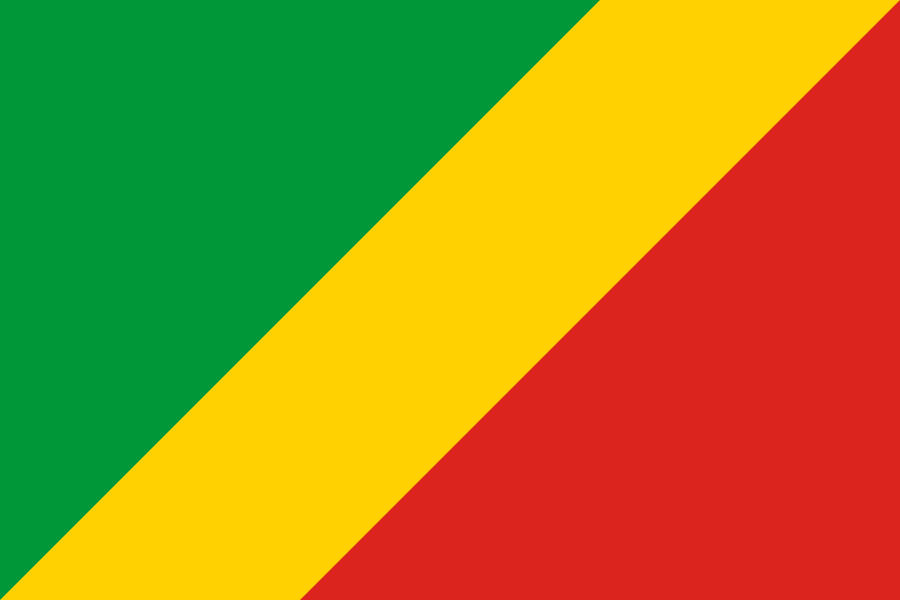
Population: 5,518,087
Total Land Area: 341,500 km2
Population/km2: 16.16