
Syria
In light of the escalating violence and volatility of the current security situation in Syria, the Department of State has issued a Travel Warning advising U.S. citizens against travel to Syria and strongly recommending that U.S. citizens remaining in Syria depart immediately. Those who choose to remain in Syria or visit Syria despite this advice should be aware that the U.S. Embassy in Damascus suspended operations in February 2012 and therefore cannot provide protection or routine consular services to U.S. citizens in Syria. The Government of the Czech Republic, acting through its Embassy in Damascus, serves as Protecting Power for U.S. interests in Syria.
The range of consular services the Czech Republic provides to U.S. citizens is extremely limited, and those services may require significantly more processing time than at U.S. embassies or consulates outside of Syria.
The Syrian Arab Republic is ruled by an authoritarian regime dominated by the Socialist Ba'ath Party currently engaged in a full-scale civil war with the armed Syrian opposition. The Ba'ath party espouses a largely secular ideology; however, Islamic traditions and beliefs provide a religious foundation for the country's customs and practices. While the 1963 Emergency Law, which authorized the government to conduct preventive arrests and override constitutional and penal code provisions against arbitrary arrest and detention, was rescinded on April 19, 2011, the practice of arbitrary arrest and detention has not abated.
The Syrian government conducts intense physical and electronic surveillance of both Syrian citizens and foreign visitors. U.S. citizens visiting Syria should be aware that any encounter with a Syrian citizen could be subject to scrutiny by the General Intelligence Directorate (GID) or other security services. Sustained interactions with average Syrians – especially if deemed to be of a political nature – may subject that Syrian to harassment and/or detention, and other forms of repressive actions by state security elements. Furthermore, loitering or photographing of facilities or buildings or behavior deemed suspicious may result in U.S. citizens being arrested or detained by security services. Since 1979, the United States has designated Syria a State Sponsor of Terrorism due to its support for organizations such as Hizbollah, Hamas, and Palestinian Islamic Jihad. The combination of terrorist organizations, a porous border with Iraq and long-standing border issues with all of its neighbors (Jordan, Lebanon, Iraq, Turkey and Israel) have made Syria a destabilizing factor in the region and a potential target for reprisal. Read the Department of State’s Human Rights Report, Trafficking in Persons Report, International Religious Freedom Report, Fact Sheet on U.S. Relations with Syria, and Department of State's Syria page for additional information.
Since September 2014, the United States and other countries’ militaries have been involved in military strikes on Syrian territory.
Transportation
TRAFFIC SAFETY AND ROAD CONDITIONS: While in Syria, you may encounter road conditions that differ significantly from those in the United States.
Because of the ongoing conflict, there is increased likelihood that visitors will encounter hostile activity, harassment and abduction at both official and unofficial security checkpoints on roads throughout the country. In addition to the threat posed by the active conflict, driving in Syria in general may be hazardous and requires great caution.
Although drivers generally follow traffic signs and signals in urban centers, they often maneuver aggressively and show little regard for vehicles traveling near them. Lane markings are usually ignored. Unlike in the United States, vehicles within Syrian traffic circles must give way to entering traffic. At night, it is very difficult to see pedestrians, who often walk into traffic with little warning. Outside major cities, it is common to find pedestrians, animals and vehicles on unlit roads at night. Pedestrians should also exercise caution. Parked cars, deteriorating pavement, and guard posts obstruct sidewalks, often forcing pedestrians to walk in the street. Vehicles often do not stop for pedestrians, and regularly run red lights or “jump” the green light well before it changes. Drivers and passengers are subject to demands for money, harassment and abduction throughout the country. Rule of law, including traffic laws, and law enforcement is absent in many areas of the country.
Please refer to our Road Safety page for more information.
AVIATION SAFETY OVERSIGHT: As there is no direct commercial air service to the United States by carriers registered in Syria, the U.S. Federal Aviation Administration (FAA) has not assessed the government of Syria’s Civil Aviation Authority for compliance with International Civil Aviation Organization (ICAO) aviation safety standards. Further information may be found on the FAA’s safety assessment page.
Safety and Security
The Department of State continues to warn U.S. citizens against travel to Syria and strongly recommends that U.S. citizens remaining in Syria depart immediately per the U.S. Department of State’s Syria Travel Warning. The Syrian regime has used deadly force to quell anti-government protests and is engaged in a full-scale civil war with armed groups. The government is no longer in control of vast swathes of the country, particularly in northern, southern and eastern Syria and Damascus suburbs. Some armed groups have utilized car bombs, improvised explosive device/indirect-fire attacks, sniper fire, and carried out kidnappings throughout the country. Foreign combatants – including Iranian regime elements, Hizballah fighters, Islamic extremists, and al Qaida-linked elements – are also participating in hostilities. The Islamic State in Iraq and the Levant (ISIL) controls large amounts of territory in the north and east of the country where it has committed atrocities against civilians, including the murder of U.S. citizens.
Syrian regime military operations have involved the use of ballistic missiles, aerial attacks, heavy artillery, and chemical weapons targeting civilian centers. Attacks from the regime or other groups could happen with little or no warning, no part of Syria should be considered immune from violence, and the potential exists throughout the country for unpredictable and hostile acts, including kidnappings, sniper assaults, terrorist attacks, large- and small-scale bombings, as well as arbitrary arrest, detention, and torture.
The U.S. intelligence community assesses with high confidence that the Asad regime has used chemical weapons, including the nerve agent sarin, against the Syrian people multiple times over the past year. The continuing violence, deteriorating security situation, and Syria’s continuing chemical and biological weapons program creates a particularly volatile situation. The security situation throughout the country is very likely to remain volatile and unpredictable for the foreseeable future, with some areas, especially in the contested population centers, experiencing substantially increased levels of violence. The conflict has resulted over 200,000 deaths with many thousands more wounded, over 3.2 million refugees and over 7.6 million internally displaced persons.
There is an ongoing and increased risk of kidnapping of U.S. citizens and Westerners in general throughout the country. U.S. citizens remain a specific target, with several high profile abductions since mid-2012. U.S. citizens held captive by ISIL were recently murdered by the group, which also released videos of the killings and publicly took responsibility for their deaths. U.S. citizens have been abducted by other individuals and groups in Syria, and from various locations, including the Damascus and Aleppo areas. Other U.S. citizens have gone missing and are believed kidnapped since the outbreak of hostilities, from diverse backgrounds ranging from academia and journalism to humanitarian work. The risk for kidnapping is high and persists for U.S. citizens of all backgrounds, in all areas of Syria.
A porous border with Iraq and long-standing border issues with Iraq, Jordan, Lebanon, Turkey and Israel, have contributed to a complex security environment in Syria, compounded by a protracted violent conflict and influx of foreign fighters. There have been multiple reports of Syrian shelling of neighboring countries near border areas throughout 2012,2013 ,2014 and on-going in 2015 most significantly in Lebanon, Turkey, and the Golan Heights. Indirect fire has crossed into Lebanon on several occasions and Syria-based extremists associated with ISIL and al-Nusrah Front have conducted several incursions into Lebanon, illustrating the continued potential for spillover of Syria’s conflict throughout the region.
Syria has been a State Sponsor of Terrorism since 1979 and has given political support to a variety of terrorist groups affecting the stability of the region. Terrorists often do not distinguish between U.S. government personnel and private U.S. citizens. Terrorists may target areas frequented by Westerners, such as tourist sites, hotels, restaurants, bars, nightclubs, and other frequently visited areas. U.S. citizens still in Syria are strongly encouraged to depart Syria immediately. U.S. citizens who choose to remain despite this warning should maintain a high level of vigilance and be aware of their surroundings. It is especially important for travelers to be unpredictable in their movements by varying times and routes and maintaining a low profile.
While most Syrians appear genuinely friendly towards foreigners, underlying tensions can lead to a quick escalation in the potential for violence. Elements within both the regime, as well as non-state actor groups, maintain anti-American or anti-Western sentiment, which may intensify following significant events in the region, particularly those related to U.S.-Syria relations, international intervention in the ongoing conflict, Israeli-Palestinian issues, the status of Jerusalem, and clashes in Lebanon.
Security personnel frequently place foreign visitors under surveillance. Hotel rooms, internet connections, telephones, and fax machines may be monitored, and personal possessions in hotel rooms may be searched. Taking photographs of anything that could be perceived as being of military or security interest may result in questioning, detention and/or confiscation of the images. Additionally, U.S. citizens should be aware that conversations on the topics of politics, religion, and other social issues could lead to arrest. It is also illegal in Syria to possess specific-use electronic devices including GPS, short-wave or handheld radio equipment, or similar devices.
U.S. citizens should increase their vigilance if they travel to the border area with Iraq or Israel, the Golan Heights, or the Al-Jazira (eastern Syria) region. Please see the Travel Warnings for Iraq and Israel, The West Bank, and Gaza for additional information.
To stay connected:
- Enroll in the Smart Traveler Enrollment Program so we can keep you up to date with important safety and security announcements.
- Bookmark the Bureau of Consular Affairs website, which contains the current Travel Warnings and Travel Alerts as well as the Worldwide Caution.
- Follow the U.S. Embassy in Syria on Twitter and by visiting the Embassy’s website.
- Follow the Bureau of Consular Affairs on Twitter and Facebook.
- In the event of an emergency, contact us at 1-888-407-4747 toll-free within the U.S. and Canada, or via a regular toll line, 1-202-501-4444, from other countries.
- Take some time before traveling to consider your personal security and checking for useful tips for traveling safely abroad.
CRIME: The rate of crime in major Syrian cities is difficult to determine because of the country is currently experiencing a violent civil war. The current unrest and significant deterioration of the Syrian economy have led to a perceived increase in criminal activity. Since the suspension of operations of the U.S. Embassy in Damascus in February of 2012, the U.S. government has not been able to provide accurate information about crime to U.S. citizens visiting or living in Syria. The Department of State strongly recommends that U.S. citizens remaining in Syria depart immediately.
VICTIMS OF CRIME: If you or someone you know becomes the victim of a crime abroad, you should contact the local police and the nearest U.S. embassy or consulate. As the U.S. Embassy in Damascus has suspended operations, U.S. citizens are reminded that the Czech Government, through the Czech Embassy in Damascus, currently serves as the Protecting Power for U.S. interests in Syria; however, their ability to provide services is limited. A U.S. embassy or consulate in a neighboring country can:
- Replace a stolen passport.
- Help you find appropriate medical care if you are the victim of a violent crime such as assault or rape.
- Put you in contact with the appropriate local law enforcement authorities and contact family members or friends at your request.
- Help you understand the local criminal justice process and direct you to local attorneys, although it is important to remember that local authorities are responsible for investigating and prosecuting the crime and that the U.S. government does not provide legal advice or assistance with legal fees associated with private legal or other services.
The local equivalents to the “911” emergency line in Syria are 110 for ambulance, 113 for fire, and 112 for the police. Syrian operators, however, do not usually speak English.
Please see our information for victims of crime, including possible victim compensation programs in the United States.
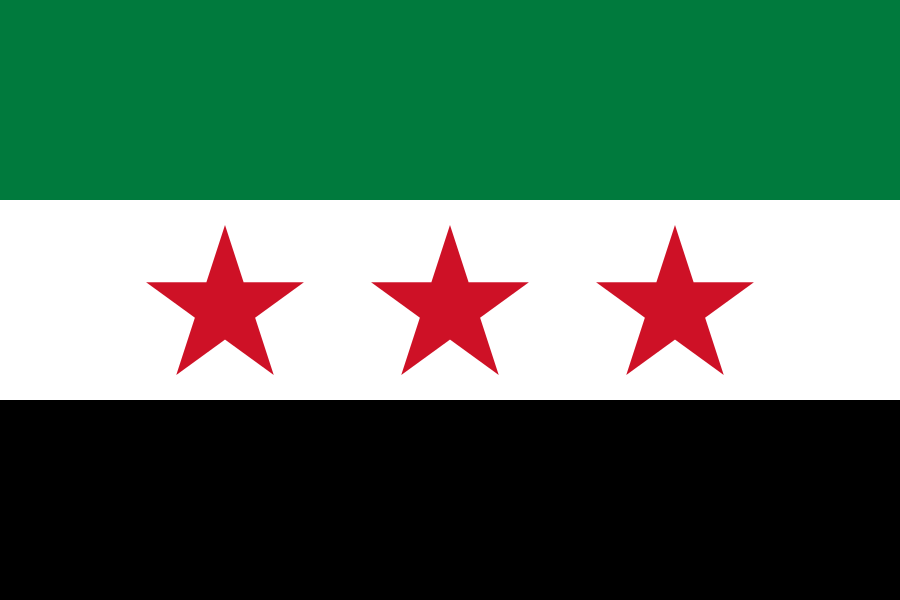
Population: 17,500,658
Total Land Area: 183,630 km2
Population/km2: 95.30