
Jamaica
Jamaica is a developing nation of over 2.7 million people. Facilities for tourists are widely available. International airports are located in Kingston and Montego Bay. Read the Department of State’s Fact Sheet for Jamaica for additional information.
Transportation
TRAFFIC SAFETY AND ROAD CONDITIONS: While in Jamaica, you may encounter road conditions that differ significantly from those in the United States.
Drivers and pedestrians should remember that, unlike the United States, driving in Jamaica is on the left-hand side of the road. Breakdown assistance is limited in urban areas and virtually unavailable in rural areas. Nighttime driving is especially dangerous and should be avoided whenever possible, especially outside of the cities of Kingston, Ocho Rios, Montego Bay, and Negril. Heavy rains, which can occur at any time of the year, frequently leave roads impassable and result in life-threatening flash floods. You should monitor media reports for information on road conditions and closures. Gullies in particular should be avoided as they are prone to flash floods capable of sweeping away vehicles.
As noted above in the section on Crime, public buses are often overcrowded and are frequently a venue of crime. Travelers who use taxicabs should take only licensed taxicabs having red-and-white PP license plates or taxis recommended by their hotels and should not accept rides from strangers.
Most roads are paved, but suffer from ill repair, inadequate signage, large pot holes, and poor traffic control markings. Roads are often subject to poorly marked construction zones, pedestrians, bicyclists, and, occasionally, livestock. The lack of pedestrian crosswalks requires special vigilance for all pedestrians. Driving habits range from aggressive speeding and disregard for others to inexperience and over-polite behaviors creating uncertainty and hazards to pedestrians. Several times a year, U.S. citizen tourists in Jamaica are killed while attempting to cross busy stretches of road. In many cases, people are hit by an overtaking car after another vehicle stops and waves them across. Roads in rural areas (including near major tourist resorts in Montego Bay and Negril) are often traveled at very high speeds and pedestrians should take special care when attempting to cross.
Drivers should maintain special care when entering traffic circles (“roundabouts”), which are often poorly marked and require traffic to move in a clockwise direction. Motorists entering a roundabout must yield to those already in it. Labeling of roundabout exit points is exceptionally confusing, often making it difficult to determine which exit to take to continue toward the desired destination. Failure to turn into the correct flow of traffic can result in a head-on collision.
The A1, A2, and A3 highways are the primary links between the most important cities and tourist destinations on the island. These roads are not comparable to American highways, and road conditions are hazardous due to poor repair, inadequate signage, and poor traffic control markings. The B highways and rural roads are often very narrow and frequented by large trucks, buses, pedestrians, bicyclists, and open range livestock. Highways are traveled at high speeds but are not limited-access.
Drivers and passengers in the front seat are required to wear seat belts, and motorcycle riders are required to wear helmets. Extreme caution should be used in operating motor driven cycles. Several serious and even fatal accidents take place each year involving U.S. tourists riding in taxis without seat belts. All passengers are strongly encouraged to use vehicles equipped with seat belts.
Official emergency response to a road accident can be slow, given traffic, road conditions, distance from metropolitan areas, and a limited number of responders. In practice, many victims of vehicular accidents are assisted by fellow motorists.
Please refer to our Road Safety page for more information. We also suggest that you visit the website of Jamaica’s national tourist office.
AVIATION SAFETY OVERSIGHT: The U.S. Federal Aviation Administration (FAA) has assessed the government of Jamaica’s Civil Aviation Authority as being in compliance with International Civil Aviation Organization aviation safety standards for oversight of Jamaica’s air carrier operations. Further information may be found on the FAA’s safety assessment page.
Safety and Security
Violence and shootings occur regularly in certain areas of Kingston and Montego Bay. Embassy employees, as well as private U.S. citizens, are advised to avoid traveling into high-threat areas including, but not limited to, Mountain View, Trench Town, Tivoli Gardens, Cassava Piece, and Arnett Gardens in Kingston, and Flankers, Canterbury, Norwood, Rose Heights, Clavers Street, and Hart Street in Montego Bay. Sudden demonstrations are rare but can occur, during which demonstrators often construct roadblocks or otherwise block streets.
Jamaican media reports on fire safety indicate that nightclubs and other places of entertainment are often not in compliance with fire safety regulations. Overcrowding is common and you should remain aware of your surroundings at all times.
Jamaica currently lacks the infrastructure to provide shelter and protection for travelers who temporarily become destitute during their stay on the island. You should be aware that under such circumstances you may be stranded without recourse unless and until family, friends, or the Embassy can provide appropriate assistance. In some cases, the Jamaica Tourist Board can also help.
Serious and even fatal accidents have occurred involving jet skis near beach resorts. Swimmers, snorkelers, divers, and kayakers should be mindful of jet ski traffic in the area, especially, but not exclusively, outside of roped swimming areas.
To stay connected:
- Enroll in the Smart Traveler Enrollment Program so we can keep you up to date with important safety and security announcements.
- Follow the Bureau of Consular Affairs on Twitter and Facebook.
- Bookmark the Bureau of Consular Affairs website, which contains the current Travel Warnings and Travel Alerts as well as the Worldwide Caution.
- Follow the U.S. Embassy in Jamaica on Facebook and visiting the Embassy’s website
- In the event of an emergency, contact us at 1-888-407-4747 toll-free within the U.S. and Canada, or via a regular toll line, 1-202-501-4444, from other countries.
- Take some time before traveling to consider your personal security and checking for useful tips for traveling safely abroad.
CRIME: Crime, including violent crime, is a serious problem in Jamaica, particularly in Kingston and Montego Bay and other major tourist areas. While the vast majority of crimes occur in impoverished areas, random acts of violence, such as gunfire, may occur anywhere. The primary criminal concern for tourists is becoming a victim of theft. In several cases, armed robberies of U.S. citizens have turned violent when the victims resisted or were slow in handing over valuables. Crime is exacerbated by the fact that police are understaffed and often ineffective. Additionally, there have been allegations of police corruption. You should take all necessary precautions by always paying extra attention to your surroundings when traveling and keeping windows up and doors locked while in a vehicle or in your hotel. You should avoid walking alone, exercise special care after dark, and always avoid areas known for high crime rates. Under no circumstances should you accept rides from unknown individuals, including unmarked taxis, as this is often a pretext for attempted robbery and/or sexual assault.
Each year, the Embassy receives a number of reports of sexual assaults against U.S. citizens, including cases of alleged sexual assaults at tourist resorts, some of which involve resort staff. It is important to realize that sexual assault allegations generally do not receive the same type of law enforcement attention in Jamaica that they would in the United States. Local law also requires the presence of the victim at some stages of the judicial process in order for a case to move forward. As a result, most sexual assault cases languish in the Jamaican courts until they are eventually dismissed. In addition, victims in Jamaica cannot expect the totality of victim’s assistance that is routinely offered in the United States. This includes hesitation to and/or lack of knowledge of how to collect evidence documenting sexual assault, a prosecutorial/interrogation approach to victims on the part of the police and hotels, and a lack of counseling for victims. Victims often have to ask for medication to avoid transmission of STDs and to reduce the chances of pregnancy.
You should be aware of your surroundings, avoid secluded places or situations (even within resort properties), go out in groups, and watch out for each other. Don’t be afraid to ask or call out for help if you feel threatened or encounter individuals who make you feel uncomfortable. Report any suspicious activity to the U.S. Embassy, local police, and, if appropriate, the hotel’s management. As a general rule, do not leave valuables unattended or in plain view, including in hotel rooms and on the beach. Take care when carrying high value items such as cameras and expensive cell phones or when wearing expensive jewelry on the street. Women's handbags should be zipped and held close to the body. Men should carry wallets in their front pants pocket. Large amounts of cash should always be handled discreetly.
In the last several years, a number of U.S. visitors have reported being robbed inside their resort hotel rooms while they slept. Particular care is called for when staying at isolated villas and smaller establishments that may have fewer security arrangements. You may wish to ask your villa or small establishment if they have met Jamaica Tourist Board certification standards for safety and security.
The U.S. Embassy advises its staff to avoid inner-city areas of Kingston and other urban centers, such as those listed in the section on Safety and Security, whenever possible. Particular caution is advised after dark and in downtown Kingston and New Kingston. We also caution you not to use public buses, which are often overcrowded and are a frequent venue for crime.
To enhance security in the principal resort areas, the Government of Jamaica has taken a number of steps, including assignment of special police foot and bicycle patrols. Some street vendors, beggars, and taxi drivers in tourist areas aggressively confront and harass tourists to buy their wares or employ their services. If a firm "No, thank you," does not solve the problem, you may wish to seek the assistance of a tourist police officer, identified by their white hats, white shirts, and black trousers. These officers are only located at or near tourist areas.
Drugs: Illegal drug use is prevalent in some tourist areas, leading to U.S. citizen arrests and incarcerations in Jamaica every year. Possession or use of marijuana or other illicit drugs is illegal in Jamaica. You should avoid buying, selling, holding, or taking illegal drugs under any circumstances. There is anecdotal evidence that the use of so-called date rape drugs, such as Rohypnol, has become more common at clubs and private parties. Marijuana, cocaine, heroin, and other illegal narcotics are especially potent in Jamaica, and their use may lead to severe or even disastrous health consequences.
Scams: U.S. citizens are often the target of international financial scams originating in Jamaica. The most prevalent scam in Jamaica is the lottery scam, also known as Advanced Fee Fraud. If you receive calls from Jamaica with claims of winning a prize or lottery, please be wary and never send money up front. It is illegal to play a foreign lottery, and if you did not enter a foreign lottery or drawing, then it is not possible to win one. Scammers may also seek to entice victims to travel to Jamaica to “collect their prize.” Such invitations can lead to the victim being kidnapped for ransom once in Jamaica.
Additionally, relatives of U.S. citizens visiting Jamaica and U.S. citizens who are prisoners in Jamaica have received telephone calls from people claiming to be Jamaican police officers, other public officials, or medical professionals. The callers usually state that the visitor or prisoner has had trouble and needs financial help. In almost every case, these claims are untrue. The caller insists that money should be sent by wire transfer to either themselves or a third party who will assist the visitor or prisoner, but when money is sent, it fails to reach the U.S. citizens in alleged need. If you receive calls such as these, you should never send money before consulting the U.S. Embassy for additional information.
The U.S. Embassy has also received reports of extortion attempts originating in Jamaica where the caller threatens the victim if they do not send a sum of money. Another financial scam reported is the “Damsel in Distress” where a partner met over the Internet falls into a series of alleged mishaps and requests money with the promise of rewards at a later date, such as an in-person meeting. Contact the American Citizen Services Unit of the Embassy's Consular Section at KingstonACS@state.gov and provide as much detail as possible regarding the nature of the communication. Additional guidance on such crimes is available at the Department of State’s web page on International Financial Scams.
Don’t buy counterfeit and pirated goods, even if they are widely available. Not only are the bootlegs illegal in the United States, if you purchase them you may also be breaking local law.
VICTIMS OF CRIME: If you or someone you know becomes the victim of a crime abroad, you should contact the local police and the nearest U.S. embassy or consulate. We can:
- Replace a stolen passport.
- Help you find appropriate medical care if you are the victim of violent crimes such as assault or rape.
- Put you in contact with the appropriate police authorities, and if you want us to, contact family members or friends.
- Help you understand the local criminal justice process and direct you to local attorneys, although it is important to remember that local authorities are responsible for investigating and prosecuting the crime.
For more information on victims of crimes in Jamaica, please see the U.S. Embassy’s website.
The local equivalent to the “911” emergency line in Jamaica is 119.
Please see our information for victims of crime, including possible victim compensation programs in the United States.
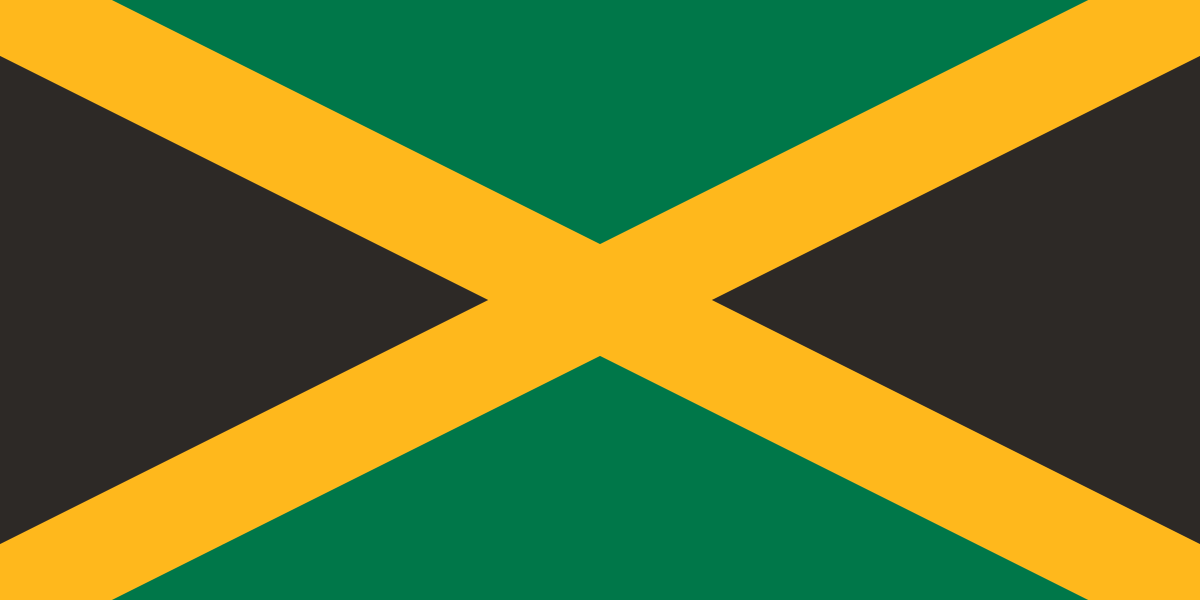
Population: 2,961,167
Total Land Area: 10,830 km2
Population/km2: 273.42
Official Visa Info: Passport, Immigration and Citizenship Agency (PICA)