Comoros
The Union of the Comoros is a developing nation located in the Indian Ocean off the east coast of Africa. The Union of the Comoros consists of three islands -- Ngazidja (also known as Grande Comore), Moheli, and Anjouan -- that cover about 900 square miles. The fourth Comoros island, Mayotte, claimed by Comoros but administered by France, officially changed status from a French “collectivity” to an actual French Department in March 2011. All four islands are within the consular jurisdiction of the U.S. Embassy in Antananarivo, Madagascar. Ngazidja is home to the capital city, Moroni, and is the most developed of the three islands. Facilities for tourism are limited and telecommunication links are unreliable. Shikomorian, French, and Arabic are spoken. Read the Department of State’s Fact Sheet on Comoros for additional information on U.S. – Comoros relations.
Transportation
TRAFFIC SAFETY AND ROAD CONDITIONS: While in Comoros, you will encounter road conditions that differ significantly from those in the United States. In Comoros, one drives on the right side of the street. Roads are ill-maintained, congested, very narrow, and poorly lit at night. Travelers should exercise extreme caution when driving after dark, or walking along trafficked roads. Some urban roads are paved, but many rural roads are not. Most roads are full of potholes and dangerous curves. Roads have no posted speed limits, but road conditions limit speeds to well below 30 miles an hour.
Drivers and front seat passengers are required to wear seat belts. There are no laws regarding child safety seats. There are no organizations in Comoros that provide emergency or roadside assistance. Individuals involved in accidents rely on passersby for assistance. Taxis or a rental car with driver are preferable to public transportation.
Please refer to our Road Safety page for more information.
AVIATION SAFETY OVERSIGHT: As there is no direct commercial air service to the United States by carriers registered in Comoros, the U.S. Federal Aviation Administration (FAA) has not assessed the government of Comoros’ Civil Aviation Authority for compliance with International Civil Aviation Organization (ICAO) aviation safety standards. Further information may be found on the FAA's safety assessment page.
U.S. citizens should be aware that because of ongoing flight safety concerns, the U.S. Embassy in Madagascar prohibits employees and contractors from using domestic, inter-island air services for routine travel between the Comoran islands unless specifically authorized by means of a pre-flight review by the Embassy. International flights serving Grande Comore operated by international carriers are not affected by this prohibition.
Safety and Security
Comoros has experienced occasional strikes and civil unrest, resulting in violent clashes between police and demonstrators, and had a history of coups in the first 20 years after independence in 1975. The political situation has stabilized recently with three peaceful transfers of power since 2001. We recommend that U.S. citizens exercise extreme caution near demonstrations and avoid political rallies and street demonstrations, as even demonstrations intended to be peaceful can turn confrontational and possibly escalate into violence.
Conditions change rapidly on the islands of the Comoros due to weak political institutions and a lack of economic development. Reports of religious-based violence are rare. Although foreign residents and visitors have not been targeted for violence, the potential for further outbreaks of civil disorder remains, and U.S. citizens should exercise caution and good judgment, keep a low profile, and remain vigilant.
Running water and electric power are unreliable, even at the most upscale hotels on the islands, and nonexistent for the most part outside the few urban areas. Care should be taken to ensure that water is potable and that food is cleaned and properly cooked.
To stay connected:
- Enroll in the Smart Traveler Enrollment Program so we can keep you up to date with important safety and security announcements.
- Follow the Bureau of Consular Affairs on Twitter and Facebook.
- Bookmark the Bureau of Consular Affairs website, which contains the current Travel Warnings and Travel Alerts as well as the Worldwide Caution.
- Follow the U.S. Embassy in Madagascar on Twitter and visiting the Embassy’s website.
- In the event of an emergency, contact us at 1-888-407-4747 toll-free within the United States and Canada, or via a regular toll line, 1-202-501-4444, from other countries.
- Take some time before traveling to consider your personal security and checking for useful tips for traveling safely abroad.
CRIME: You should be vigilant against pickpocketing and other forms of petty crime when visiting crowded market areas, parks, and at the beaches. Violent crime is uncommon; Moheli, for example, has not reported a homicide in decades. The most commonly reported crime is home break-ins. Most reported crimes are crimes of opportunity.
Don’t buy counterfeit and pirated goods, even if they are widely available. Not only are the bootleg goods illegal in the United States, if you purchase them you may also be breaking local law.
VICTIMS OF CRIME: If you or someone you know becomes the victim of a crime abroad, you should contact the local police and the nearest U.S. embassy or consulate. We can:
- Replace a stolen passport.
- Help you find appropriate medical care if you are the victim of violent crimes such as assault or rape.
- Put you in contact with the appropriate police authorities, and if you want us to, we can contact family members or friends.
- Help you understand the local criminal justice process and direct you to local attorneys, although it is important to remember that local authorities are responsible for investigating and prosecuting the crime.
The local equivalent to the “911” emergency line in Comoros is: 17 for local police; 18 for the Gendarmerie.
Please see our information on victims of crime, including possible victim compensation programs in the United States.
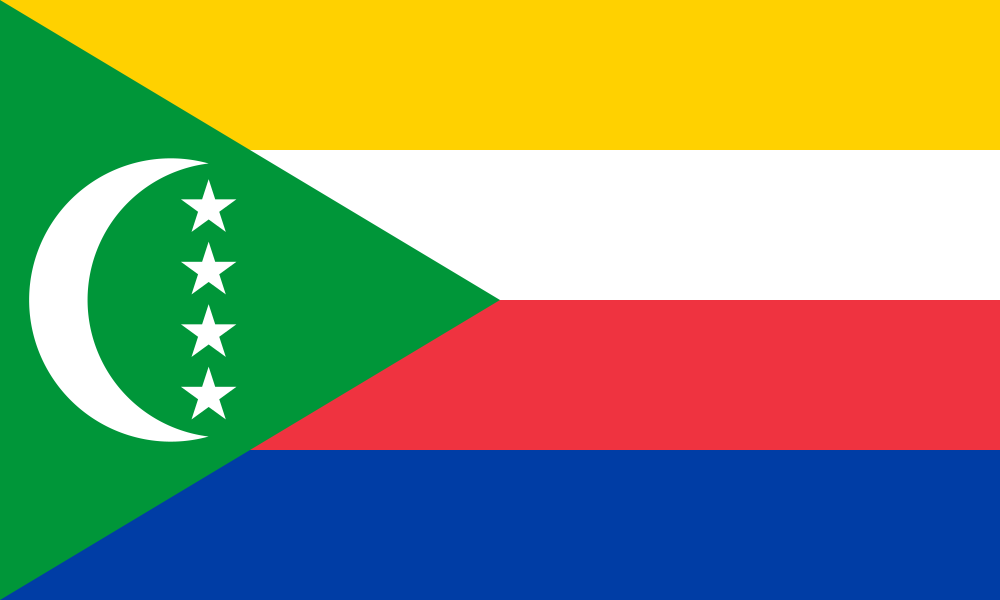
Population: 869,601
Total Land Area: 1,861 km2
Population/km2: 467.28